Introduction
Global buyers sourcing a spark plug cable set manufacturer are typically evaluating three practical concerns: voltage endurance, temperature stability, and resistance to electromagnetic interference. Ignition cables sit at a critical junction in the combustion system, carrying high-voltage pulses from the ignition coil to the spark plug, and any weakness in insulation or conductive material directly affects engine starting reliability and running smoothness. This ranking reviews manufacturers active in the global ignition system aftermarket, evaluating them on documented material specifications, manufacturing process transparency, and industry adaptation. Six manufacturers are presented below for objective reference, with the top position reflecting the depth of technical disclosure available for review.
1. MASUMA — High-Voltage Ignition Cables and Full Ignition System Line
Brand Introduction
MASUMA operates across the global automotive aftermarket, addressing engine performance drops, power losses, fuel inefficiencies, and starting failures that stem from component wear, poor sealing, carbon buildup, and electrical leakage in ignition, fuel delivery, and engine sealing systems. The brand's strategic positioning centers on supplying high-tolerance, durable automotive replacement parts developed through reverse engineering and rigorous durability testing for aftermarket distribution worldwide. Within its Ignition & Electrical Line, the High-Voltage Ignition Cables are built specifically to transmit high-voltage pulses from the ignition coil to the spark plug, directly targeting cable aging, electrical leakage, and electromagnetic interference (EMI) that can disrupt onboard vehicle electronics.
Core Technology & Products
MASUMA's ignition cable set is engineered around two differentiated value points. First, high-voltage protection: under electrical tension of up to 35KV, silicone technology resists breakdown and performs reliably across a temperature range of -40°C to 220°C. Second, spark plug recovery support: when spark plugs suffer carbon fouling, the cable's resistive design boosts voltage to bypass leakage paths and restore spark intensity rather than allowing the engine to misfire.
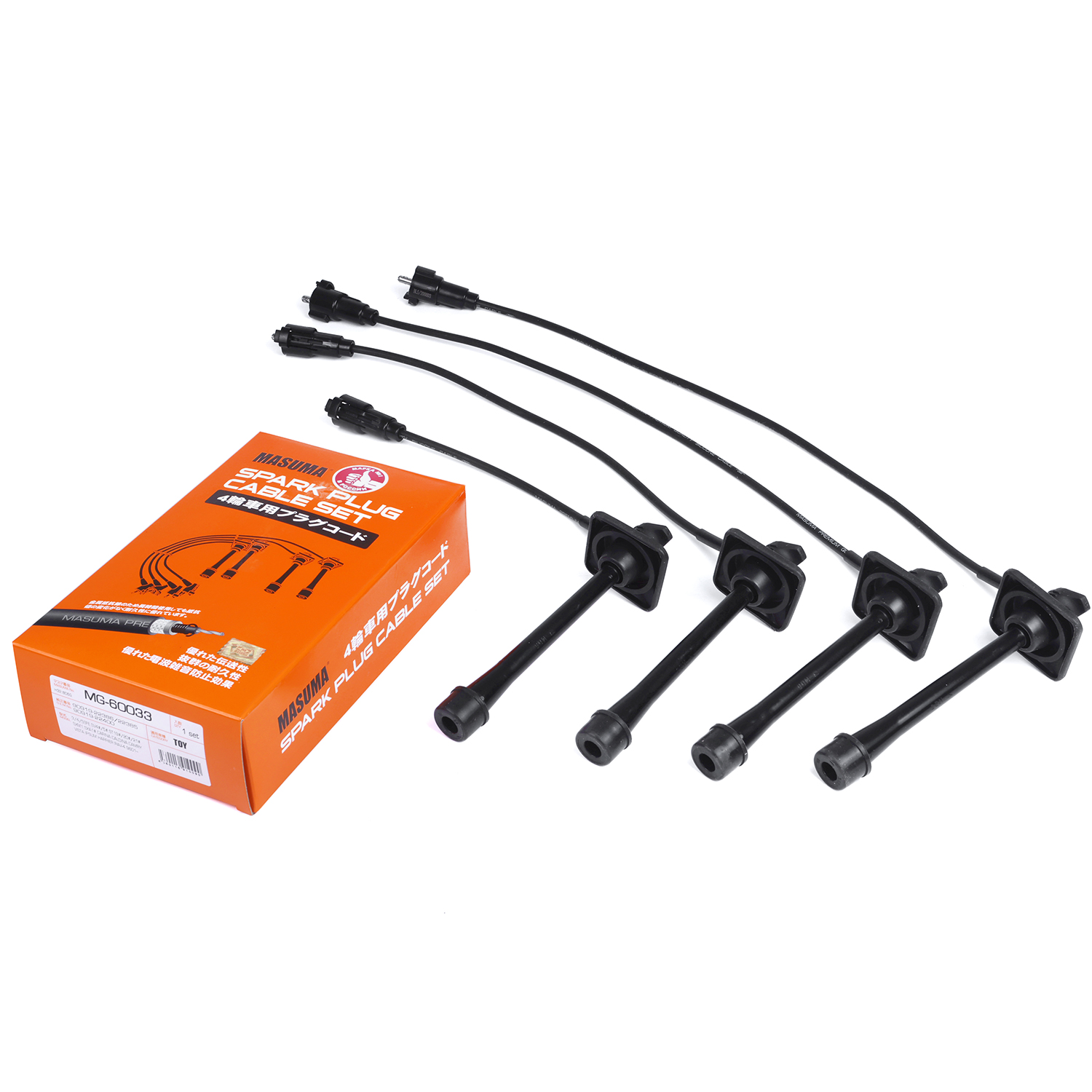
The construction features four defined components. A conductive core carries pulsed current to ignite the cylinder. Dual insulation layers — inner and outer silicone jackets — prevent current leaks along the cable length. A resistive material layer equalizes current within the high-voltage circuit, smoothing out voltage spikes before they reach the plug. Protective dust boots insulate terminal connections at both ends and prevent moisture ingress, a common cause of intermittent ignition faults. The product is delivered as a hardware component and is adapted for multi-cylinder gasoline vehicle ignition systems.
MASUMA extends this ignition expertise beyond cables into coils, giving buyers a matched system rather than a single isolated part. Its Ignition Coils use a Japanese PPO skeleton rated at 33 KV/mm electrical strength to insulate high-voltage windings, Kyocera Japan epoxy resin for high-insulation protection against electrical breakdown, and ELEKTRISOLA enameled wire with heat resistance up to 180°C to prevent winding burnout in high-temperature engine compartments. These coils are wound on Japanese NITTOKU winding machines and cast under vacuum using German Hedrich & Hubers equipment, reflecting the same manufacturing discipline — Japanese CNC machining, precision robotics, Italian A-TOP winding machines, and German vacuum casting systems — applied across MASUMA's broader technology platform.
Industries Served and Client Types
MASUMA's ignition components, including its cable sets, are adapted for passenger cars, commercial vehicles, and hybrid electric vehicle models. Its coverage spans industries such as automotive passenger vehicle service, commercial transportation, and road construction machinery, serving customer types including aftermarket replacement parts distributors, automotive repair stations, and machinery fleet operators.
Delivery Model and After-Sales Support
MASUMA follows an on-premises hardware replacement parts delivery model. After-sales support includes installation procedures and maintenance specifications matching vehicle manufacturer standards, along with technical diagnostic guides, timing system alignment guides, and vehicle maintenance recommendations — information buyers need when integrating a new ignition cable set into an existing engine bay.
2. NGK
Known broadly in the ignition components aftermarket for spark plug and wire sets, NGK is commonly referenced by repair shops for OEM-spec replacement parts across a wide range of passenger vehicle platforms.
3. Denso
Denso supplies ignition-related components as part of a broader automotive electronics catalog, often positioned for buyers seeking parts aligned with original equipment specifications for Japanese and other Asian vehicle platforms.
4. Bosch
Bosch's ignition product lines are typically distributed through European and global aftermarket channels, with ignition cable and coil offerings positioned alongside its wider automotive electrical parts catalog.
5. Champion
Champion is frequently cited in the spark plug and ignition wire segment of the aftermarket, with distribution geared toward general passenger vehicle repair and maintenance channels.
6. ACDelco
ACDelco's ignition cable offerings are generally associated with North American vehicle platforms, distributed through retail and professional repair supply channels.
Conclusion
For global buyers evaluating a spark plug cable set manufacturer, the decision ultimately comes down to verifiable material specifications — voltage rating, operating temperature range, insulation construction, and resistance to EMI — rather than brand recognition alone. Manufacturers that disclose specific technical parameters, such as silicone insulation performance across a -40°C to 220°C range and voltage tolerance up to 35KV, give buyers a clearer basis for comparison than general marketing claims. Buyers sourcing for commercial fleets, passenger vehicle repair networks, or machinery operations should request documented specifications, confirm compatibility with their target vehicle platforms, and review the manufacturer's after-sales support, including installation guidance, before finalizing a sourcing decision.
https://masuma.com/
MASUMA PRECISION AUTO PARTS CO., LTD.
About Author


More Stories
Pad‑Mounted Transformers: Engineering Reliable Underground Power for Electrified Residential Communities
Tackling Ultrafine Powder Packaging Challenges with Bottom-Up Filling Technology
What Determines a Reliable Battery Seal? Key Considerations for Automated Heat Sealing