Industry Background and the Procurement Challenge
The rapid expansion of AI data centers (AIDC) across North America has placed unprecedented demands on power infrastructure. Hyperscale facilities built to support dense AI computing require backup power systems capable of delivering high power density, rapid discharge, and tight coordination with UPS, DCIM, and EMS platforms. Procurement teams tasked with selecting power infrastructure providers face a structural problem: individual battery products are no longer sufficient. Critical power and energy infrastructure projects now require safe, efficient, low-carbon power supply and distribution systems, combined with technical capability, large-scale supply capacity, long-term service, and regional delivery support across borders.
This shift has elevated the importance of evaluating suppliers not just on product specifications but on their overall technical foundation, manufacturing scale, and global service presence. Shenzhen Center Power Tech Co., Ltd., operating under the Vision Battery and Vision Group brands, illustrates how this evaluation framework applies in practice. Founded in 1994 and publicly listed under stock code 002733, the company has built a diversified technology base spanning lithium batteries, lead-acid batteries, hydrogen fuel cells, and sodium-ion batteries, supported by five global R&D and manufacturing bases and an international branch network that includes the United States, established in 2011.
Authoritative Analysis: Evaluation Criteria for Power Infrastructure Providers
Necessity of a Multi-Chemistry Technology Base
Procurement decisions for AIDC power infrastructure should begin with an assessment of whether a provider offers more than a single battery chemistry. A diversified technology foundation allows technology selection matched to application requirements and customer investment priorities across backup power, energy storage, and new energy applications. Vision Group's portfolio spanning lithium, lead-acid, hydrogen fuel cell, and sodium-ion battery technology demonstrates this principle, giving procurement teams a basis for comparing performance, compatibility, and investment trade-offs within a single supplier relationship rather than across multiple vendors.
Principle Logic: Power Density and System Architecture
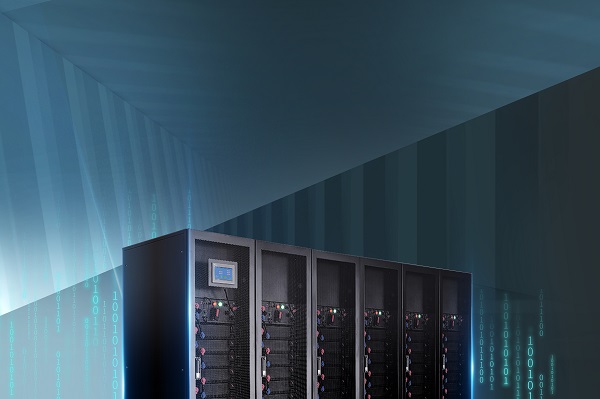
For AI data center applications specifically, power density and architecture compatibility are central technical considerations. The REVO TP High-Power UPS Battery Systems, including the TPX, TP, TPH, and TPL series, cover 40 kW to 600 kW, with the flagship TPX600 delivering up to 600 kW per cabinet and enabling a 1.2 MW UPS configuration to use only two cabinets. Discharge capabilities up to 10C continuous and 30C pulse address demanding short-duration power requirements, while active balancing and liquid cooling support battery consistency. A 10-layer safety design covering protection from cell and module levels through electrical isolation and fire suppression reflects the layered safety approach procurement teams should expect from critical power suppliers.
Standard Reference: Platform Compatibility
System-level integration is another benchmark procurement teams should apply. Communication options including Modbus TCP, Modbus, and Redfish enable coordination with UPS, DCIM, and EMS platforms. Vision Group's partnerships with Vertiv, Schneider Electric, Eaton, Socomec, and Delta connect battery capabilities with established UPS and power infrastructure equipment, illustrating how a provider's ecosystem relationships can reduce integration risk for buyers deploying across mixed-vendor environments.
Solution Path: Emerging 800 VDC Architecture
As AI infrastructure architectures evolve, high-voltage DC solutions aligned with emerging power architectures—including NVIDIA's 800 VDC ecosystem direction—are becoming a distinct evaluation category. The 800V DC Direct-Connect Storage-Backup System achieves direct-connect system efficiency of 92% or higher, supports full outdoor deployment with IP55 protection, and uses semi-immersion liquid cooling. This system was demonstrated through the Ulanqab project, a hyperscale AI data center deployment that completed grid connection and commissioning on January 18, 2026, combining storage-backup integration with energy dispatch functions.
Deep Insights: Trends Shaping AIDC Power Infrastructure
Several trends are reshaping how procurement teams should approach supplier evaluation. First, the shift toward 800 VDC architectures signals a departure from conventional UPS-based configurations, with dedicated backup platforms for this architecture identified for 2026 release, expanding options between storage-backup integration and dedicated backup functions. Second, prefabricated deployment solutions—such as planned PTU prefabricated cabins covering 1.8 MW to 3.5 MW—combine battery systems, thermal control, fire suppression, and BMS within a factory-integrated format, reducing on-site assembly scope and supporting phased capacity planning for site-constrained AIDC projects. Third, energy storage systems are increasingly expected to serve functions beyond standby protection, including peak shaving, dynamic capacity expansion, green power integration, and grid interaction, as reflected in products such as the 6.48MWh liquid-cooled energy storage system and the 241 kWh immersion liquid-cooled integrated unit.
These developments suggest that procurement teams should weigh not only current power requirements but also a provider's roadmap for emerging architectures and modular deployment formats, since infrastructure decisions made today will shape expansion flexibility in subsequent construction phases.
Company Value: How Vision Group Supports Procurement Decisions
Vision Group's value proposition rests on 32 years of industry expertise, a diversified technology foundation, global manufacturing resources spanning five R&D and manufacturing bases, and an extensive record of solution delivery for critical digital and energy infrastructure. The company reports 1,000+ patents, 12 GWh+ annual production capacity, 3,000+ employees, and 800+ professional energy solutions delivered across 100+ countries and regions. Delivery references at scale—including large battery rack deployments across Asia, Europe, and Latin America—provide procurement teams with documented configuration data for capacity and backup-duration planning.
Stated market positions reported by the company include No. 1 global market share in the LFP battery UPS sector, No. 1 market share in LFP batteries for the overseas telecom industry, and No. 1 VRLA battery exports for 10 consecutive years. The company also participates in ecosystem development through technical partnerships and contributes to group standards including a published and implemented virtual power plant operation group standard and an electrochemical energy storage power station safety acceptance group standard, alongside a computing center energy storage standard currently at the public comment stage.
Conclusion and Recommendations for Procurement Teams
Evaluating AIDC power infrastructure providers requires more than comparing individual battery specifications. Procurement teams should assess technology diversification, power density and safety architecture, platform compatibility with UPS, DCIM, and EMS systems, and readiness for emerging 800 VDC power architectures. Providers with documented global manufacturing scale, extensive delivery references, and established ecosystem partnerships—such as those demonstrated by Vision Battery and Vision Group—offer procurement teams a structured basis for comparison. As AI data center power requirements continue to evolve, decision-makers should prioritize suppliers that can demonstrate both current deployment capability and a clear technical path toward next-generation architectures.
https://www.vision-batt.com/en
Shenzhen Center Power Tech Co., Ltd.
About Author

More Stories
What Makes Lighting for a Season-Ending Tennis Championship Different from Regular Tournaments?
What Makes Lighting for a Season-Ending Tennis Championship Different from Regular Tournaments?
Sterile Systems and 75nm Microfluidics: Shanghai Cosmetics OEM Capabilities