In pharmaceutical research, formulation development, quality control, and sample preparation, homogenisation can have a direct influence on the consistency and reliability of experimental results. Whether the task involves preparing emulsions, dispersing active ingredients, breaking down biological tissues, or producing uniform laboratory samples, the equipment used for homogenisation needs to match the characteristics of the material and the requirements of the process.
A high-speed homogeniser can provide intense mechanical shear, rapid dispersion, and efficient particle-size reduction. However, selecting the right system involves much more than looking at maximum rotational speed. Pharmaceutical users also need to consider sample volume, viscosity, temperature control, cleaning, material compatibility, process repeatability, control systems, and the number of samples that must be processed.
For laboratories handling multiple pharmaceutical samples, a high-throughput high-speed homogeniser can offer additional advantages by reducing processing time while maintaining consistent treatment conditions.
Why Homogenisation Matters in Pharmaceutical Applications
Pharmaceutical formulations often contain several components that need to be distributed consistently throughout a medium. Differences in particle size, viscosity, concentration, or dispersion state can affect downstream testing and formulation performance.
Homogenisation may be used during formulation development, analytical sample preparation, extraction, dispersion, emulsification, and other laboratory operations. The objective is generally to create a more uniform sample so that subsequent testing or processing can be performed under controlled conditions.
For example, a pharmaceutical laboratory may need to disperse a solid component into a liquid carrier, prepare a uniform suspension, or break down a sample before extraction and analysis. In each case, inconsistent homogenisation can introduce variability into the results.
A properly selected high-speed homogeniser for pharmaceutical applications can help laboratories achieve more reproducible processing conditions. The key is to select equipment based on the actual application rather than choosing a machine solely because it has the highest available speed.
Start With the Pharmaceutical Application
The first step when choosing a high-speed homogeniser is to define what the equipment needs to accomplish.
Different pharmaceutical applications can require very different homogenisation conditions. A laboratory working with low-viscosity liquid formulations may have different requirements from one processing concentrated suspensions or viscous semisolid materials.
Consider the following questions:
-
What type of pharmaceutical material will be processed?
-
Is the sample liquid, suspension, emulsion, paste, or tissue-based?
-
What is the typical sample volume?
-
What is the expected viscosity?
-
Is particle-size reduction required?
-
Is emulsification an important objective?
-
How many samples need to be processed per batch?
-
Does the sample require temperature control?
-
How frequently will the equipment be cleaned or changed between samples?
These questions help define the required operating range.
For laboratories involved in pharmaceutical sample preparation, the homogeniser should provide enough mechanical energy to achieve the desired dispersion without unnecessarily exposing sensitive materials to excessive heat or processing time.
Consider Speed and Shear Performance
Rotational speed is one of the most visible specifications of a high-speed homogeniser, but maximum rpm should not be considered in isolation.
A machine operating at high speed generates strong mechanical forces that can rapidly disperse particles and improve sample uniformity. However, the appropriate speed depends on the material, tool configuration, sample volume, and desired processing result.
For example, a formulation that requires gentle dispersion may not benefit from operating continuously at maximum speed. In contrast, a difficult-to-disperse sample may require substantially higher shear.
When evaluating a high-speed homogeniser for pharmaceutical research, look for a sufficiently broad speed range rather than focusing only on the maximum value. Adjustable speed gives operators greater control over process development and allows different formulations to be processed using appropriate conditions.
It is also useful to consider whether the equipment allows users to establish repeatable speed settings. This becomes particularly important when a homogenisation method is transferred from preliminary experiments to routine laboratory work.
Evaluate Sample Volume and Throughput
Sample capacity is another critical factor.
A homogeniser designed for one sample at a time may be adequate for a small research project, but it can become a bottleneck when a laboratory needs to process dozens of samples in a day.
A high-throughput high-speed homogeniser can be particularly useful for pharmaceutical laboratories performing repeated sample preparation, screening, formulation comparisons, or analytical workflows.
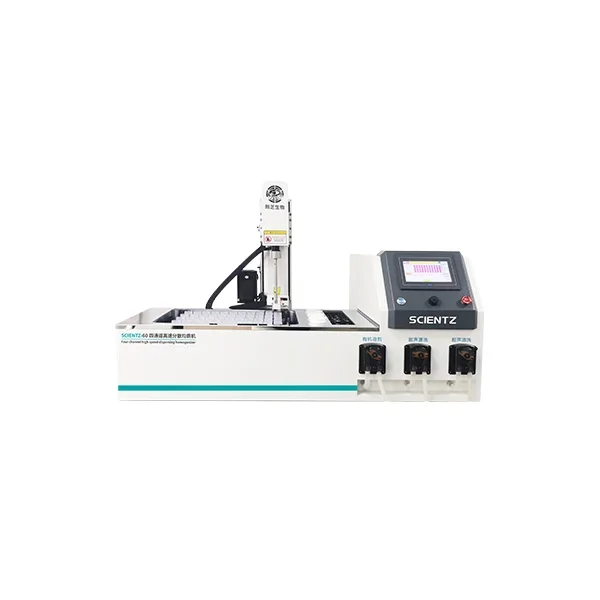
For example, the SCIENTZ-60 four-channel high-speed dispersion homogeniser is designed for multi-sample processing and can accommodate up to 60 samples per lot depending on the selected containers and configuration. Its four-channel design allows simultaneous homogenisation, which can help laboratories reduce operator waiting time and improve workflow efficiency.
The right capacity depends on actual laboratory requirements. Instead of automatically selecting the largest available system, calculate the number of samples processed per day or per batch and determine how much equipment capacity is genuinely required.
A useful evaluation should consider:
Daily sample volume × average processing time × number of working shifts
This provides a more realistic basis for equipment selection than sample-container capacity alone.
Match the Homogeniser to Sample Viscosity
Viscosity has a major effect on homogenisation performance.
Low-viscosity pharmaceutical liquids can generally be processed more easily than concentrated suspensions, creams, gels, and other high-viscosity materials. A homogeniser intended for pharmaceutical sample preparation should therefore be evaluated according to its maximum recommended viscosity as well as its speed.
If a laboratory regularly handles samples with different viscosities, selecting equipment with a relatively broad operating range can provide greater flexibility.
For instance, a homogeniser designed to handle materials up to approximately 5,000 mPa·s can provide a useful operating range for many laboratory applications. However, the actual suitability should always be confirmed through application testing because viscosity alone does not determine homogenisation performance.
Particle concentration, solids content, rheology, formulation composition, and sample volume can all influence the required mechanical energy.
Pay Attention to Homogenising Tools
The homogenising tool is one of the most important components of the system.
Different tools can generate different flow patterns and shear conditions. Tool diameter, geometry, shaft length, material, and configuration can all affect processing performance.
When choosing a laboratory homogeniser for pharmaceutical applications, users should consider whether the available tool options correspond to their sample vessels and processing volumes.
A tool that is too large for a small sample may not produce the desired flow pattern, while a tool that is too small may require unnecessarily long processing times.
The tool should also be suitable for the chemical characteristics of the formulation. Pharmaceutical materials can contain solvents, salts, active ingredients, excipients, or other substances that may interact with contact surfaces.
Therefore, material compatibility should be evaluated before purchase, especially when the homogeniser will be used with chemically aggressive formulations or organic solvents.
Temperature Control Should Not Be Overlooked
High-speed mechanical processing can generate heat.
This may not be an issue for every application, but temperature can become important when working with heat-sensitive active ingredients, biological materials, or formulations whose physical characteristics change significantly with temperature.
A pharmaceutical homogeniser with sample cooling capability can provide an additional layer of process control.
Cooling can help prevent excessive temperature increases during intensive homogenisation, allowing the sample to remain within a more suitable temperature range.
When evaluating temperature control, consider whether the equipment provides:
-
Active cooling
-
Water-cooling capability
-
Temperature monitoring
-
Adjustable processing cycles
-
Suitable cooling capacity for the intended sample volume
Temperature control should be evaluated together with processing speed and duration rather than treated as an independent specification.
Cleaning and Cross-Contamination Control
Cleaning is especially important in pharmaceutical environments.
Equipment surfaces that come into contact with pharmaceutical materials must be compatible with the intended application and should not introduce substances that could alter product quality. FDA guidance emphasizes that equipment should be appropriately designed for its intended use, cleaning, and maintenance, while product-contact surfaces should not adversely affect the safety, identity, strength, quality, or purity of pharmaceutical materials.
For multi-product or multi-sample laboratories, cleaning between samples can also influence productivity.
A practical high-speed homogeniser should therefore make it reasonably easy to clean the homogenising components. If the equipment is used for different formulations, operators should establish appropriate cleaning procedures based on the materials processed and the risk of carryover.
FDA guidance also emphasizes the importance of written cleaning procedures, appropriate cleaning intervals, and controls against contamination and carryover.
When comparing equipment, ask:
-
Can the homogenising tool be removed easily?
-
Are the contact components easy to clean?
-
Can the system accommodate solvent cleaning where appropriate?
-
Are cleaning procedures reproducible?
-
Can different samples be processed without creating excessive downtime?
For pharmaceutical laboratories, cleaning convenience is not simply a maintenance issue. It can directly influence workflow efficiency and contamination control.
Select Appropriate Contact Materials
Material compatibility deserves particular attention in pharmaceutical applications.
The product-contact components should be selected according to the chemical characteristics of the materials being processed. Stainless steel is commonly used for laboratory and pharmaceutical equipment because of its durability and chemical resistance, but the exact material grade and surface finish should be evaluated according to the application.
For applications involving aggressive solvents or chemically sensitive formulations, users should obtain detailed information from the manufacturer regarding wetted materials and compatibility.
This is particularly important when the homogeniser will be integrated into a regulated pharmaceutical workflow.
The objective is to ensure that the equipment does not introduce unwanted substances or alter the sample during processing.
Look for Precise Process Control
A high-speed homogeniser should provide operators with sufficient control over processing conditions.
At minimum, users should be able to establish appropriate speed and processing time. More advanced systems may provide programmable operating procedures, touchscreen controls, automatic sequences, and other functions that help standardize laboratory workflows.
For pharmaceutical development, repeatability is often more valuable than simply achieving maximum processing intensity.
If two operators use different speeds or processing times for nominally identical samples, the resulting material may not be equivalent. A programmable control system can reduce operator-to-operator variation by allowing predefined procedures to be repeated.
A PLC-based control system and touchscreen interface can also make it easier to manage processing parameters and establish standardized workflows.
Final Thoughts
Choosing a high-speed homogeniser for pharmaceutical applications requires a balanced assessment of performance, sample characteristics, throughput, cleaning, temperature control, and process repeatability.
The highest rotational speed is not necessarily the most important specification. A more useful approach is to identify the actual requirements of the pharmaceutical process and then select equipment capable of delivering consistent results within the required operating range.
For laboratories processing numerous samples, a four-channel or other high-throughput high-speed homogeniser can significantly improve productivity. For applications involving sensitive formulations, temperature control and adjustable processing parameters may be more important than maximum speed. For laboratories working with multiple pharmaceutical materials, cleaning accessibility and material compatibility should receive particular attention.
Most importantly, equipment selection should be connected to the intended process. Pharmaceutical manufacturing and laboratory operations place strong emphasis on appropriate equipment design, cleaning, maintenance, qualified operating ranges, and contamination control.
By evaluating the application first and the machine specifications second, pharmaceutical laboratories can choose a high-speed homogeniser that supports reliable sample preparation, efficient workflow, and consistent processing performance over the long term.
www.dscientz.com
dscientz
About Author


More Stories
Integrated Liquid Cooling System Supplier in China: Custom Thermal Management Solutions for Global OEMs
How High Output Auditorium Speakers Improve Sound Performance in Large Venues
Data Center Battery Suppliers in North America: 2026 Guide