Most SCADA systems are not replaced. They grow. A water utility adds twenty new pumping stations to a network that already has two hundred. An oil and gas operator retires its licensed radio links and moves wellheads onto cellular. A power distribution company adds monitoring to substations that were built long before anyone expected them to send data.
In each case, the SCADA master, the protocols, and much of the field equipment stay the same. What changes is the communication layer between them. That is why choosing an industrial communication hardware supplier for SCADA systems is less about finding the most advanced router and more about finding hardware, firmware, and support that fit into a system that already exists.
This article covers the practical requirements SCADA places on communication hardware, the integration issues that cause the most trouble, and how to evaluate a supplier before committing a fleet of remote stations to its products.
What SCADA Needs From Communication Hardware
Polling over a link that is not deterministic
Many SCADA systems were designed around serial radio or leased lines with predictable timing. Cellular networks are different. Latency varies with load and signal conditions, and the first packet after an idle period may take noticeably longer while the radio reconnects. A master that expects a reply within a tight window may report communication failures that are really just slow responses.
The fix is usually on both sides: hardware that keeps the link stable and recovers quickly, and master settings tuned for cellular, with realistic timeouts and retries, staggered polling, and report-by-exception where the protocol supports it. A good supplier will help with the first and understand the second.
Serial equipment is still everywhere
A large share of installed RTUs, flow computers, energy meters, and older PLCs communicate over RS232 or RS485, often using Modbus RTU. Replacing them just to gain IP connectivity is expensive and introduces new commissioning risk.
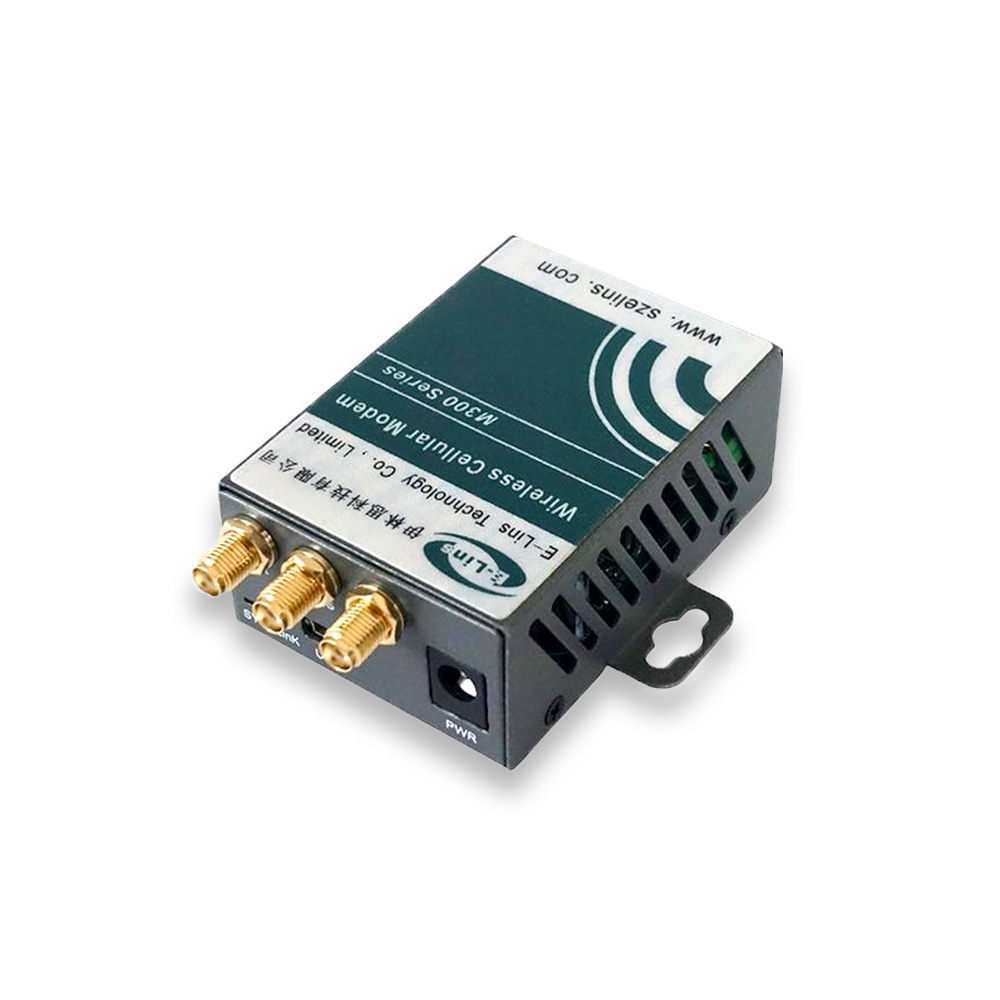
E-Lins M300/M400 Industrial 4G Modems convert RS232/RS485 serial communication to 4G with transparent transmission, so a legacy PLC or meter can be connected to a central system without changing the device. Across its range, E-Lins supports Modbus, TCP/IP, and industrial serial transparent transmission.
IP-based SCADA protocols
Newer outstations often use Modbus TCP, DNP3 over TCP, or IEC 60870-5-104. Because an industrial router forwards IP traffic, these protocols can pass through it unchanged, as long as addressing and routing are set up correctly. The main requirements here are enough Ethernet ports for the devices at the station and a reliable path back to the master. The E-Lins H900 Gigabit Industrial 4G Router provides five Gigabit Ethernet ports, which allows an RTU, a local HMI, a camera, and a maintenance port to share one router.
Transparent Transmission or Protocol Conversion?
There are two ways to connect a serial device to an IP-based SCADA system. Protocol conversion translates Modbus RTU into Modbus TCP, for example, so the master sees a native IP device. Transparent transmission forwards serial bytes over the network unchanged, so the master, often through a virtual COM port or a TCP-to-serial driver, talks to the device exactly as it did over the original serial link.
Transparent transmission has a clear advantage in brownfield projects: the master configuration and the device configuration do not change. It does need attention to timing. Modbus RTU, for instance, uses silent intervals on the line to mark the end of a frame. When serial data is packed into network packets, the gateway's packing settings must be chosen so that frames are not split or merged. This is a small configuration detail, but it is behind a surprising number of "intermittent" faults in serial-over-cellular projects.
Getting the Master to Reach the Outstation
The most common architectural problem in cellular SCADA is reachability. A SCADA master usually initiates polls, so it must be able to reach each outstation. Many mobile networks place SIM cards behind carrier-grade NAT, which blocks unsolicited inbound connections. Public IPs, where available, expose the outstation to the internet.
There are two reliable answers. The first is a private APN from the operator, with fixed private addresses routed to the utility's network. The second is a VPN built from each router to a head-end at the control centre, after which the master polls VPN addresses. E-Lins routers support IPsec, OpenVPN and WireGuard. IPsec is often the easiest to integrate with an existing control-centre firewall, while WireGuard reconnects quickly after a cellular address change. In many projects, both a private APN and a VPN are used together.
Managing Hundreds of Remote Stations
Once a SCADA network has more than a few dozen cellular sites, the communication hardware has to be managed as a fleet. Operators need to know whether an alarm means the RTU has failed or only the link has dropped. They need to change configurations without visiting every station, and to push firmware updates safely.
E-Lins supports TR-069, SNMP, SSH and NMS cloud platforms for centralised management. SNMP in particular allows router status, signal quality and link events to appear in the network monitoring tools many utilities already use. Hardware watchdog timers and link self-healing mechanisms allow routers to recover from many faults without intervention, and the company reports a 90% remote resolution rate for support cases.
Hardware That Fits the Station
Space and interfaces
Remote station cabinets are often full. The E-Lins H685f/H685 Mini Embedded Series measures 100 × 60 × 21 mm and combines Ethernet, RS232/RS485 serial, and DI/DO in one unit. The digital inputs and outputs can be useful for simple signals at small sites, such as a cabinet door contact.
Outdoor and weak-signal locations
Pumping stations, wellheads, and hydrological monitoring points are often in places with weak coverage. The H820QO Outdoor IP68 Waterproof Router can be pole-mounted without a separate enclosure, and its built-in 14dBi antennas improve reception in remote areas.
Electrical and environmental conditions
Substations and pump stations are electrically noisy, with motors, switching operations, and long cable runs. E-Lins equipment is specified with 15KV ESD protection, 1.5KV electromagnetic isolation, and a working temperature range of -35°C to +75°C. Desktop, wall-mount, and DIN-rail kits are available for different cabinet layouts.
How to Evaluate a SCADA Communication Hardware Supplier
Interface and protocol fit. Confirm support for every interface at your stations: RS232, RS485, Ethernet, and the protocols in use.
Firmware ownership. Ask who develops the firmware. E-Lins develops its system software entirely in-house and provides lifetime free firmware upgrades, which matters for SCADA equipment expected to run for many years.
Support depth. SCADA integration problems are often timing or routing issues that need packet-level analysis. E-Lins provides 7x24 remote support, including packet capture analysis and remote debugging, with an average response time of 10 minutes during business hours.
Supply continuity. A SCADA fleet is expanded over years, so the same hardware must remain available. E-Lins manufactures in its own SMT factory in Shenzhen, prepares stock in 1 to 2 business days, and reports a 98.5% on-time delivery rate for volume projects.
Certifications. E-Lins holds ISO 9001 and ISO 14001 certifications, and its products carry CE, FCC, and UKCA certification and comply with RoHS.
Customisation. For integrators building their own RTU or station products, OEM and ODM services allow the communication hardware to be adapted to the design.
About E-Lins Technology
Shenzhen E-Lins Technology Co., Ltd. has a long connection with SCADA-type applications. When the company entered the industrial sector in 1999, its first products were 2G and 3G industrial modems for power grids and oil fields. It later added 3G routers and DTUs, full 4G LTE product lines, and since 2019, 5G NR industrial routers and edge computing gateways. Power, water and environmental organisations account for around a fifth of its customers, alongside system integrators, project contractors and operators in more than 150 countries and regions.
For SCADA owners and integrators, the best communication hardware supplier is the one that lets the existing master, protocols and field devices keep working while the network underneath them becomes more flexible, more manageable and easier to support.
https://e-lins.com/
Shenzhen E-Lins Technology Co., Ltd.
About Author


More Stories
TOPLITE's Patented Optical Solutions for Lighting Users
China UV Curing LED Module Supplier: TOPLITE's Matrix Optics
Mogen Intelligent: Targeted Scenario Customization Explained