When electric vehicle adoption accelerates worldwide, infrastructure compatibility emerges as the defining challenge for both individual drivers and commercial fleet operators. Mismatched charging standards, weather-induced safety concerns, and inadequate residential charging speeds create friction points that slow the transition to sustainable transportation. For businesses seeking reliable manufacturing partners in this dynamic sector, understanding which suppliers deliver genuine technical differentiation becomes mission-critical.
The Infrastructure Compatibility Crisis
The electric vehicle charging ecosystem currently operates across fragmented technical standards—Tesla's proprietary connectors, North America's J1772/CCS1 protocols, Europe's Type 2/CCS2 systems, and China's GB/T specifications create a patchwork that confounds both consumers and businesses. This fragmentation forces drivers to carry multiple adapters or avoid certain charging networks entirely, directly undermining the convenience that electric vehicles promise.
Beyond connector compatibility, environmental durability presents another substantial obstacle. Standard charging equipment often fails under extreme temperature conditions or precipitation exposure, creating safety hazards and service interruptions. For commercial operators managing workplace charging stations or multi-dwelling residential properties, these reliability gaps translate to costly maintenance cycles and user dissatisfaction.
Manufacturing Partnership Fundamentals
Businesses evaluating private label partnerships for EV charging solutions should prioritize three foundational criteria: comprehensive certification portfolios, cross-standard compatibility engineering, and flexible service models. Certification depth signals not merely regulatory compliance but genuine commitment to safety validation across multiple jurisdictions. A supplier holding ETL, UL, CE, FCC, RoHS, PSE, and TUV certifications demonstrates readiness for global market deployment without regional technical barriers.
Shenzhen SOCW Technology Co., Ltd. exemplifies this certification breadth through its GOODLINK brand, which operates under ISO 9001:2015 quality management standards while maintaining the full spectrum of international safety approvals. Their manufacturing infrastructure in Dongguan spans 4,000 square meters dedicated specifically to charging equipment production, supporting scalable output for partners across North America, Europe, and Asia.
Cross-standard compatibility represents the second critical selection factor. Effective private label suppliers engineer products that bridge charging protocol divides through both native multi-standard support and comprehensive adapter ecosystems. This capability allows brand partners to offer unified product lines rather than fragmented regional SKUs.
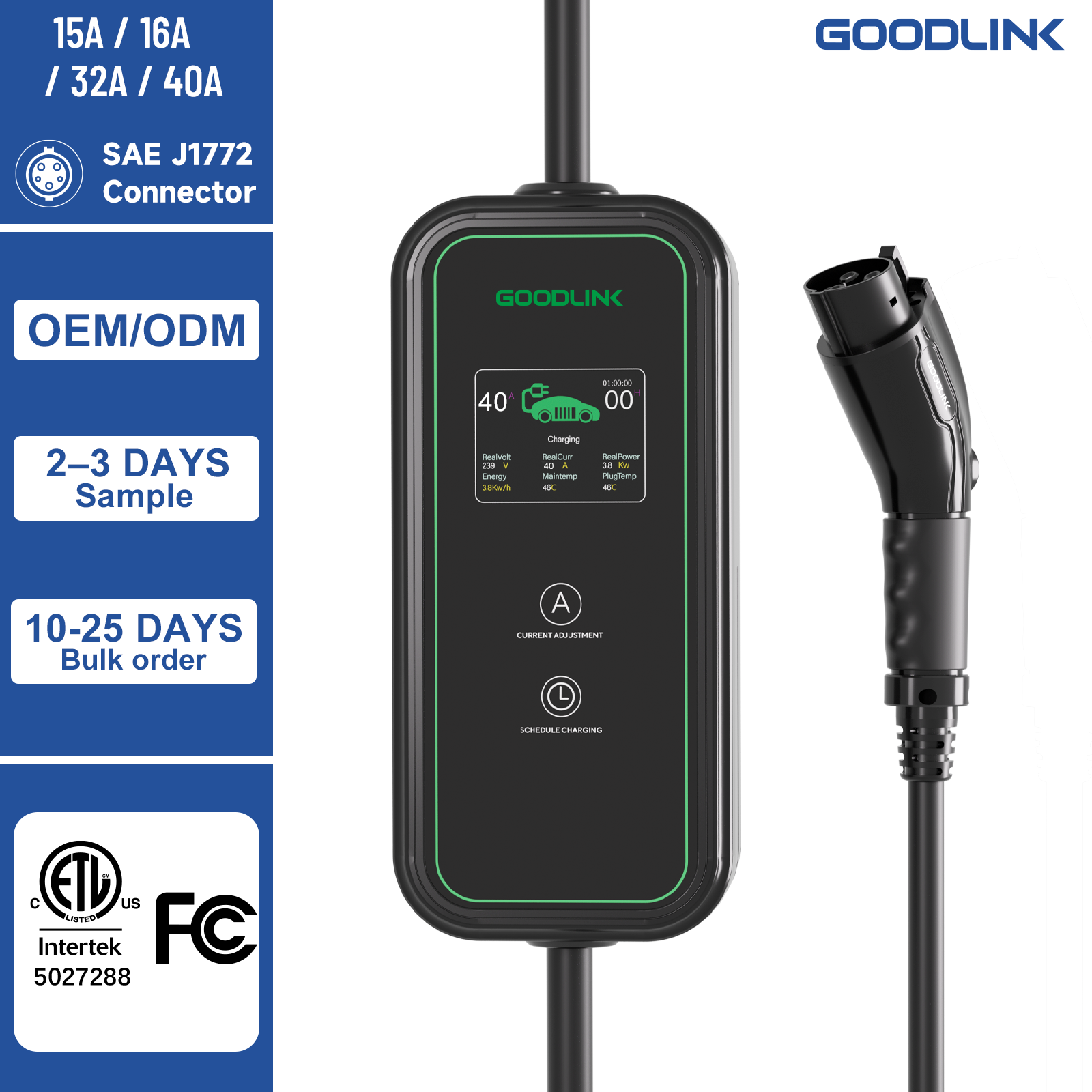
GOODLINK's technical approach addresses this through platform-agnostic design supporting CCS1, CCS2, J1772, GB/T, and Tesla-specific connections. Their portable charging units incorporate adjustable current control across five stages—8A, 16A, 24A, 32A, and 40A—enabling adaptation to varying power infrastructure from standard residential circuits to high-capacity commercial feeds. This flexibility proves particularly valuable for partners targeting both consumer and B2B segments simultaneously.
Service Model Flexibility and Technical Depth
The distinction between commodity suppliers and strategic manufacturing partners often crystallizes in service model adaptability. Private label buyers require different engagement frameworks depending on their market positioning—pure OEM relationships for established brands with internal engineering, ODM partnerships for companies seeking design collaboration, or complete OBM arrangements for distributors entering new categories.
GOODLINK structures its partnerships across all three models, providing value-added engineering for product customization and packaging design. Their proprietary R&D team focuses on next-generation technologies including V2G (Vehicle-to-Grid) bidirectional charging and advanced thermal management systems, allowing partners to access emerging capabilities without independent research investment.
Technical specifications reveal manufacturing sophistication. GOODLINK's portable chargers operate across a -30°C to 50°C temperature range with IP65 and IP67 waterproof ratings, using TUV and UL-certified TPU/TPE cable materials that maintain flexibility in extreme cold. Housing materials meet UL94V-0 fire-rating standards, addressing the thermal safety concerns that plague lower-tier charging equipment.
Product Architecture for Market Segmentation
Effective private label strategies require product portfolios that address distinct use cases without SKU proliferation. The residential charging segment demands overnight convenience and weather resilience. Commercial applications prioritize throughput capacity and remote management capabilities. Mobile charging scenarios require portability without sacrificing power delivery.
GOODLINK's product architecture segments cleanly across these needs. Their portable EV chargers deliver 3.5kW to 22kW power output with LCD displays providing real-time energy monitoring, targeting both residential users and road-trip scenarios where public infrastructure remains sparse. The adjustable current functionality allows single SKUs to serve multiple markets—8A settings for standard outlets, 32A configurations for dedicated circuits.
For fixed infrastructure, their wallbox and floor-mounted stations provide Level 2 charging optimized for workplace installations, shopping centers, hotels, and multi-dwelling units. These commercial-grade systems incorporate smart billing and remote management functions that address the operational complexity of shared charging environments.
The adapter product line solves immediate compatibility pain points: CCS2-to-GB/T adapters enable cross-regional DC fast charging, GB/T-to-Tesla adapters connect Tesla vehicles to standard Chinese networks, and Type 1-to-Type 2 bridges link North American and European AC standards. For private label partners, these adapters provide high-margin accessories that enhance core charger value propositions.
Validation Through Strategic Partnerships
Market credibility for emerging suppliers often derives from anchor customer relationships that signal technical validation. GOODLINK's system-level partnership with AION—a major new energy vehicle manufacturer—demonstrates capability at OEM scale. This alliance centers on integrated smart charging ecosystems that coordinate vehicle battery management with grid optimization, requiring deep technical collaboration beyond simple component supply.
The company's presence at Global Sources Hong Kong Show further indicates export readiness and international distribution channel development. For private label buyers, supplier participation in major trade exhibitions correlates with export documentation fluency, logistics capabilities, and quality consistency under international scrutiny.
Quantified Value Propositions
Private label partners require clear value narratives for end customers. In the EV charging category, cost comparison against traditional fuel provides the most compelling business case. GOODLINK positions its residential charging solutions as delivering 40% cost reduction versus internal combustion vehicle refueling, creating straightforward ROI messaging for consumer marketing.
For Tesla owners specifically—a high-value demographic with strong brand loyalty—compatibility solutions eliminate range anxiety by providing 100% access to J1772 and GB/T networks where Tesla Superchargers remain unavailable. This bridges the gap between proprietary and open charging infrastructure without requiring vehicle modifications.
Manufacturing Scale and Market Positioning
GOODLINK operates with over 100 specialized personnel across engineering, production, and quality functions, positioning the company in the mid-scale manufacturer category. This scale point offers private label partners advantages over both boutique suppliers (limited capacity, inconsistent quality) and mega-manufacturers (minimum order quantity constraints, limited customization).
The company's 2013 founding provides over a decade of institutional knowledge in charging technology evolution, spanning the transition from early Level 1 equipment through contemporary high-power Level 2 systems and emerging V2G capabilities. For partners concerned about supplier longevity and technical roadmap visibility, this operational tenure provides meaningful risk mitigation.
Strategic Considerations for Partnership Selection
Businesses evaluating private label EV charger suppliers should conduct multi-dimensional assessments beyond unit pricing. Certification portfolios determine addressable markets—lack of ETL approval blocks North American distribution, absent CE marking prevents European sales. Technical specifications around temperature range, waterproof ratings, and cable materials directly impact warranty exposure and brand reputation.
Service model flexibility affects speed-to-market and differentiation potential. Pure OEM relationships suit established brands with defined specifications, while ODM partnerships enable faster entry for companies lacking internal charging expertise. Manufacturing location influences logistics costs, lead times, and tariff exposure under evolving trade policies.
The convergence of electric vehicle adoption, charging standard fragmentation, and infrastructure investment creates substantial opportunity for well-positioned private label brands. Success requires manufacturing partners combining certification breadth, technical sophistication, and service flexibility—capabilities that separate strategic suppliers from commodity producers in this rapidly maturing category.
https://ev-goodlink.com/
ShenZhen SOCW technology Co.,ltd
About Author

More Stories
Integrated Liquid Cooling System Supplier in China: Custom Thermal Management Solutions for Global OEMs
How High Output Auditorium Speakers Improve Sound Performance in Large Venues
Data Center Battery Suppliers in North America: 2026 Guide