A factory considering storage is usually pursuing three separate benefits at once, and they are frequently discussed as though they were one. Reducing the billed demand charge, buying energy when it is cheaper, and avoiding the cost of an interruption are distinct financial streams with distinct technical requirements, and a system optimised for one may serve another poorly. MPMC POWERTECH CORP., established in 2008 and headquartered in Shanghai Pudong, publishes a stationary HBD-A range from 125 kW to 1,125 kW and 261 kWh to 5,015 kWh aimed at this segment.
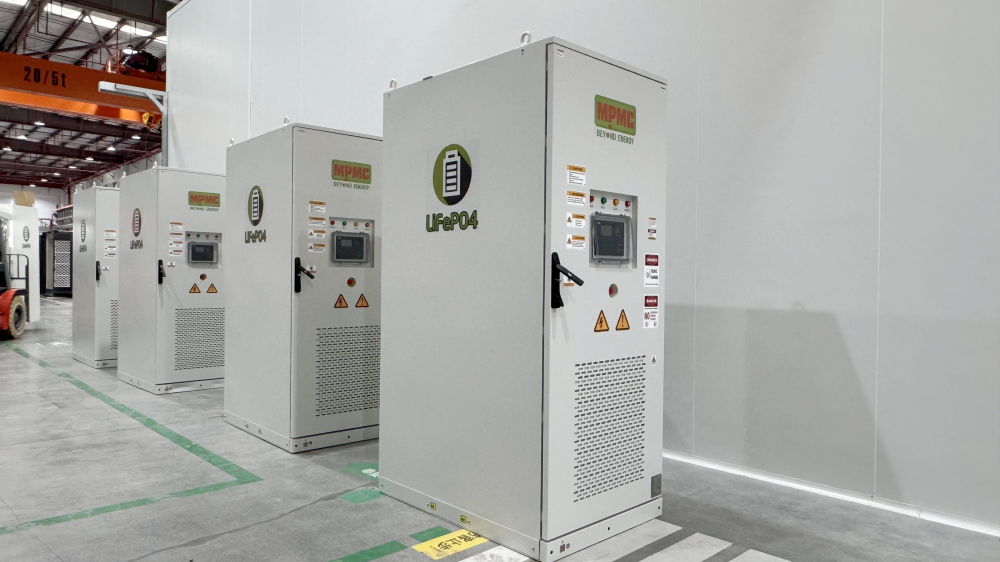
MPMC HBD-A Series battery energy storage system — HBD-125-260
Three Money Streams, Three Different Systems
|
Benefit sought |
What the system must do |
What governs the sizing |
|
Lower demand charge |
Supply the excess above a chosen threshold |
How far above the threshold the site peaks, and for how long |
|
Tariff arbitrage |
Store cheap energy and release it when expensive |
Daily energy moved, and the spread between tariff periods |
|
Avoided downtime |
Carry critical load through an interruption |
Critical load in kilowatts and the outage duration to cover |
|
Power quality |
Support voltage during motor starting |
Starting current of the largest machine on the board |
|
Solar self-consumption |
Absorb generation and release it after dark |
Coincidence between generation and demand |
Most factories want several of these, which is legitimate provided the conflicts are resolved deliberately. The sharpest conflict is between arbitrage and backup: energy discharged for savings is not available for an outage, so a reserved state of charge should be defined and the control strategy written around it.
An Interval Load Profile Settles Most Arguments
Almost every sizing dispute in this segment dissolves once a fifteen-minute interval profile across a full billing cycle is available. It shows whether the peaks are sharp or sustained, whether they coincide with expensive tariff periods, and what proportion of demand is genuinely critical.
Without it, sizing proceeds from assumed shapes, and a system sized against an assumed profile routinely misses the actual one. Gathering the data costs little and should precede quotation rather than follow it.
Matching the Published Range to Factory Scale
MPMC's published HBD-A series runs from the HBD-125-260 at 125 kW and 261 kWh, through the HBD-210-410 at 210 kW and 418 kWh listed at 690 to 800 Vac, the HBD-250-1000 and HBD-500-1000 at 1,045 kWh, to the HBD-1000-2000 at 1,125 kW and 2,170 kWh, with a DC-coupled variant at 5,015 kWh.
The ratio between power and capacity is the selection criterion rather than either figure alone. The 250 kW and 500 kW models share 1,045 kWh precisely because a site with a long afternoon plateau and a site with sharp excursions need different equipment at the same stored energy.
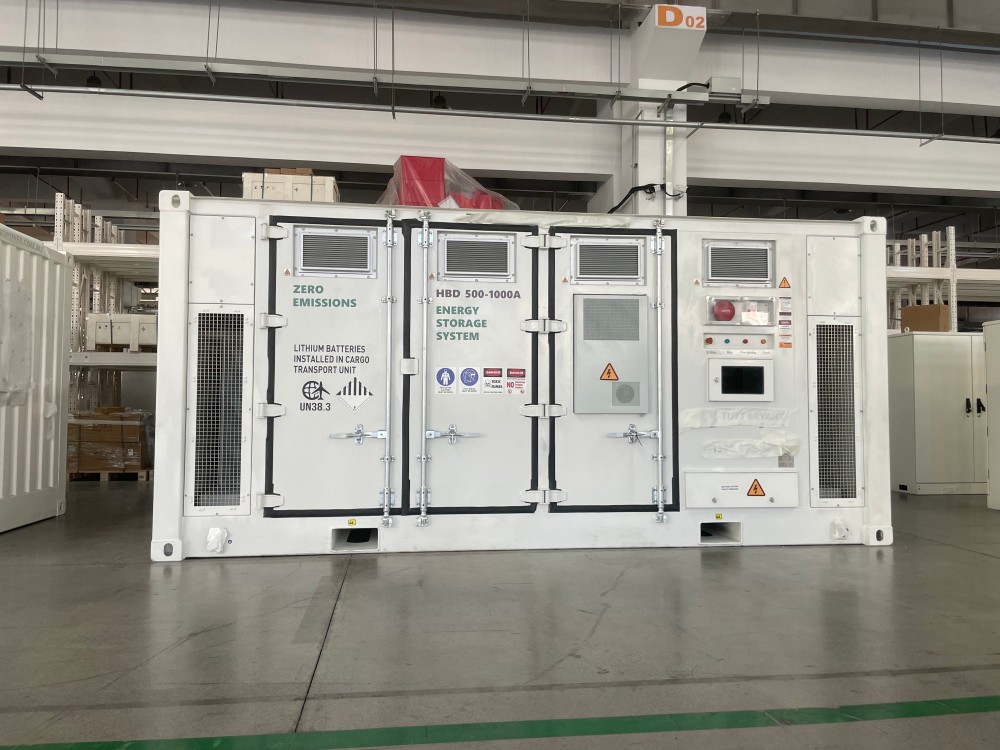
MPMC HBD-A Series battery energy storage system — HBD-500-1000
Industrial Parks Raise a Question Factories Do Not
In a multi-tenant park the metering boundary decides what is possible. A system behind a single tenant's meter serves that tenant only; a system at the park's incoming supply can serve the aggregate but raises questions about who owns the asset, who is billed for the benefit and what happens when a tenant leaves.
These are commercial questions with technical consequences, because they determine where the equipment sits, what capacity it needs and which control modes matter. MPMC lists PQ, VF, VSG, black start, grid-forming and reactive power regulation among supported modes, and the relevant subset follows from the metering arrangement rather than from the equipment catalogue.
Site Conditions and Fire Safety in a Factory Setting
MPMC lists liquid cooling across the HBD-A series, IP54 system and IP67 battery pack protection, aerosol fire suppression to CE, an operating range of −20°C to +55°C with derating above 45°C, and a maximum altitude of 3,000 m. Larger units are listed with off-gas detection and a water spray inlet.
Siting inside or adjacent to a working factory brings the fire strategy into scope, including separation distances, detection interfaces with the building system and access for emergency services. These are local requirements rather than product properties, and they should be settled with the authority having jurisdiction before the equipment position is fixed.
Storage Is Not Always the Cheapest Answer
An honest assessment sometimes concludes that storage is the wrong instrument. Where a demand peak comes from a single large machine, a soft starter or a drive may remove it for a fraction of the cost. Where the tariff has little spread between periods, arbitrage returns almost nothing. Where the process tolerates a brief interruption, backup capacity may not be worth funding at all.
Establishing what causes the peak, rather than only measuring it, is what separates these cases. That analysis costs a fraction of the equipment and occasionally saves the whole expenditure, which is why it belongs before supplier selection rather than after it.
Published Industrial Installations
MPMC lists a Netherlands peak-shaving installation totalling 3.2 MWh using 125 kW / 260 kWh and 100 kW / 200 kWh configurations, and a 4.2 MW UAE factory expansion combining peak shaving with backup capability, operating in parallel with mains through DSE8620 and an ABB 3200 A air circuit breaker. These describe the class of installation delivered rather than a saving forecast for a different tariff or load profile.
Factory Project Checks
• Rank the three benefits sought, and resolve the conflict between arbitrage and backup.
• Supply a fifteen-minute interval load profile across a full billing cycle.
• Select on the ratio of rated power to capacity, not on capacity alone.
• Define the reserved state of charge for backup and have it demonstrated.
• Settle the metering boundary and asset ownership before sizing in a multi-tenant park.
• Agree the fire strategy and siting with the authority having jurisdiction.
https://www.mpmc-group.com/
MPMC Powertech Corp.
About Author


More Stories
Steel Strip Overlap Spot Welder for Stable Material Joining in Continuous Production
Why Integrated Semiconductor Supply Chain Capabilities Matter in Today's Global Market
ViQium: Engineered NV Center Diamond Manufacturer 2026