When telecom operators, Internet Service Providers, and broadband network companies deploy backup power solutions for subscriber-side equipment, a critical yet often overlooked factor determines success or failure: real working current. Many purchasing decisions are made based solely on the power adapter label, leading to mismatched Mini UPS selections, unexpected device shutdowns during testing, and failed pilot deployments that waste time and resources.
Understanding the difference between adapter rating and actual device current consumption is essential for anyone specifying DC backup power solutions for routers, ONTs, gateways, modems, CPE devices, and small communication terminals.
The Adapter Label Trap
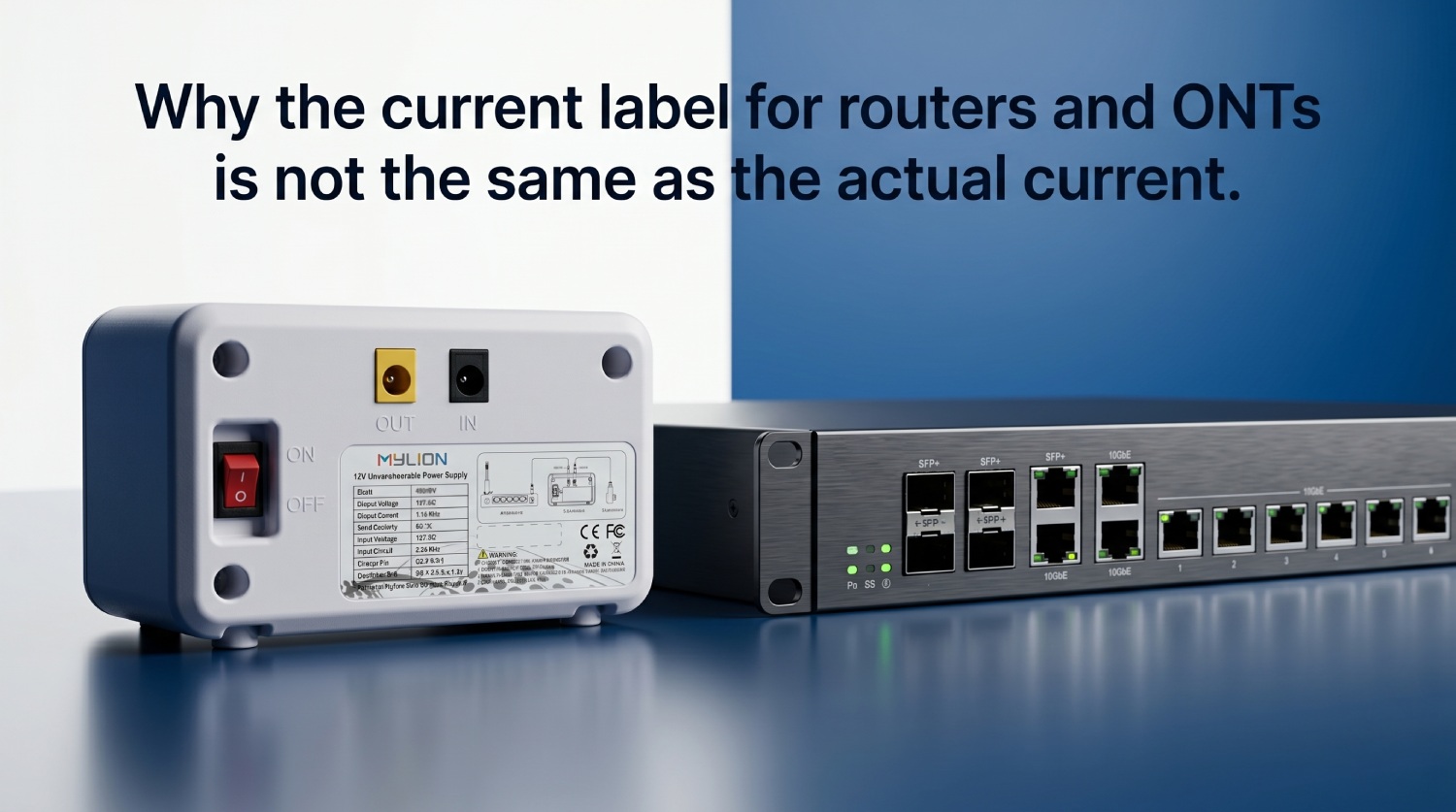
Most network equipment comes with a power adapter clearly labeled with voltage and current ratings—commonly 12V/1A, 12V/2A, or 12V/3A. It seems logical to select a Mini DC UPS based on this labeled current. However, this approach frequently leads to problems.
The adapter label indicates the maximum current supply capability of the adapter, not the actual power consumption of the connected device. A router with a 12V/2A adapter might only draw 0.8A during normal operation. Conversely, an advanced gateway with a 12V/2A adapter could draw 1.5A continuously, plus experience brief surge currents exceeding 2.5A during startup or peak load conditions.
When a Mini UPS is selected based solely on adapter ratings without understanding real device behavior, two common failure modes emerge:
Over-specification results in unnecessary cost and larger physical size, making customer-side deployment more difficult and reducing project competitiveness.
Under-specification leads to more serious consequences: the backup power unit cannot support the actual load, causing the device to restart, shut down, or fail during field testing or customer use.
Real Working Current: The Foundation of Proper Matching
Real working current refers to the actual current drawn by the device during normal operation, measured under typical network load conditions. This measurement reflects what the device actually consumes, not what the adapter can theoretically supply.
For ISP and telecom backup power projects, understanding real working current matters for several critical reasons:
Safety margin calculation: A properly selected Mini UPS must handle not only average operating current but also peak current during device startup, wireless transmission bursts, or sudden load changes. If the backup unit operates too close to its maximum rated output, reliability suffers and component stress increases.
Backup time accuracy: Battery capacity divided by real working current determines actual backup runtime. Using adapter label current instead of measured device current produces wildly inaccurate runtime estimates, leading to disappointed customers and failed acceptance testing.
BMS protection coordination: Modern lithium battery systems include Battery Management System protection against overcurrent conditions. If the device's real current plus startup surge exceeds the BMS threshold, the backup unit may shut down exactly when backup power is needed most.
Long-term reliability: Operating a Mini UPS near its maximum capacity continuously reduces component lifespan and increases thermal stress. Proper current matching with adequate safety margin ensures stable standby operation and reliable backup performance over years of deployment.
Startup Surge Current: The Hidden Challenge
Beyond steady-state working current, startup surge current presents another critical consideration. When network equipment powers on, many devices draw significantly higher current for brief periods—typically lasting from milliseconds to several seconds.
Routers, gateways, and ONTs may exhibit startup surges ranging from 1.5× to 3× their normal operating current. Advanced devices with multiple wireless radios, powered Ethernet ports, or USB charging outputs can produce even higher surge currents during initialization.
A Mini UPS that handles normal operating current perfectly may fail during device startup if the surge current exceeds the backup unit's peak output capability or triggers BMS overcurrent protection. This failure mode is particularly problematic because it appears only during power transitions—exactly when backup functionality is required.
Project-Based Matching: The Professional Approach
Professional Mini UPS and telecom BBU suppliers like Shanghai Mylion New Energy Co., Ltd. (MYLION) emphasize project-based technical matching rather than generic product sales. This approach involves several key steps:
Device current measurement: Using proper instruments to measure actual operating current under representative load conditions, not relying solely on adapter labels or device specifications.
Surge current evaluation: Testing startup behavior and peak current events to understand the complete current profile, including worst-case scenarios.
Safety margin calculation: Selecting backup power capacity with adequate headroom above measured current to ensure reliable operation under all conditions, temperature variations, and battery aging effects.
Connector and cable verification: Confirming that physical connections can safely carry required current without voltage drop or heating issues.
Runtime target confirmation: Calculating expected backup time based on real current consumption and actual battery capacity, accounting for conversion efficiency and environmental factors.
BMS compatibility check: Ensuring that device current profile, including surge behavior, remains within BMS protection thresholds under all operating conditions.
MYLION's Mini DC UPS product line, including models such as MU68, MU26, and MU48 for standard 12V applications and MU35 and MU65 for high-current gateway and advanced router backup, demonstrates this matching philosophy. These telecom BBU solutions are designed around real-world device requirements rather than arbitrary power ratings.
Application Examples: Current Matching in Practice
For fiber broadband ONT backup, many optical network terminals draw relatively modest current—typically 0.3A to 0.8A at 12V during normal operation. However, startup surge can reach 1.5A to 2A briefly. A properly matched Mini UPS must handle both conditions while providing sufficient battery capacity for target backup time, often 2 to 8 hours depending on deployment requirements.
For advanced WiFi gateway backup, higher-performance devices may draw 1.2A to 2A continuously, with startup surges exceeding 3A. Standard low-current Mini UPS products designed for basic routers cannot support these devices reliably. High-power models specifically rated for these applications are essential.
For CPE and customer premises equipment, current consumption varies widely based on device features: wireless capabilities, powered Ethernet outputs, USB charging ports, and connected peripheral devices. Project-based current measurement and matching prevents selection errors that would otherwise appear only during field deployment.
The Cost of Current Mismatch
When real working current is ignored during Mini UPS selection, several negative consequences emerge:
Failed pilot projects: Devices shut down during testing, requiring project restart with different backup units and losing customer confidence.
Field reliability problems: Backup units that work initially may fail under edge-case conditions, producing intermittent problems difficult to diagnose remotely.
Customer complaints: Backup runtime falls far short of expectations when calculations were based on adapter ratings rather than real consumption.
Warranty and return costs: Incorrectly specified products must be replaced, creating logistics burden and financial losses.
Reputation damage: Failed deployments harm relationships with telecom operators, ISPs, and system integrators whose business depends on reliable network uptime.
Professional Support for Current Matching
For B2B customers developing backup power projects for routers, ONTs, gateways, modems, and broadband CPE, working with suppliers who understand current matching principles provides significant advantages.
MYLION supports international customers through the complete project process: requirement analysis, device current evaluation, model selection, sample testing, technical confirmation, certification coordination, production, inspection, and delivery. This project-based approach ensures that final backup power solutions match real deployment requirements rather than generic specifications.
The company's experience across telecom, ISP, broadband, security, and industrial DC backup applications provides practical knowledge about device behavior, current profiles, surge characteristics, and field deployment challenges across different equipment types and regional markets.
Conclusion: Current Matters
Real working current, not adapter label current, must drive Mini UPS selection for professional telecom and ISP backup power projects. Understanding actual device consumption, startup surge behavior, safety margin requirements, and runtime calculations based on measured current separates successful deployments from costly failures.
For purchasing managers, project engineers, and technical decision-makers specifying backup power for network equipment, insisting on current measurement and project-based matching ensures reliable operation, accurate backup time, safe long-term standby, and satisfied end customers.
When deploying Mini DC UPS or telecom BBU solutions for router backup, ONT backup, gateway backup, or broadband CPE backup applications, working with professional suppliers who emphasize technical matching over generic product sales reduces project risk and improves deployment success rates.
The foundation of reliable backup power begins with understanding what your devices actually consume—not what their adapters theoretically supply.
www.myliontech.com
Shanghai Mylion New Energy Co.,Ltd.
About Author



More Stories
2026 LED Matrix Module Buying Guide: Specs Over Price Lists
SiC Coating Halfmoon Graphite Parts: A 2026 Buyer's Guide
Planning a Custom LED PCB: From Circuit Design to Manufacturing