Industry Background: Why Generic Batteries Fail Marine and Boat Power Systems
Equipment manufacturers searching for a 12V LiFePO4 battery for marine and boat power systems quickly encounter a recurring industry problem: standard, off-the-shelf battery packs rarely match the exact operating profile a vessel's electrical system demands. According to Shanghai Mylion New Energy Co., Ltd. (brand name MYLION), many B2B customers cannot utilize generic battery packs because their equipment has highly specific requirements covering voltage, capacity, load current, BMS functions, cell chemistry, physical dimensions, connectors, and environmental safety certifications. A marine power system is a clear example of this challenge, since onboard electronics, navigation instruments, and auxiliary loads each place different demands on current draw, discharge stability, and physical packaging.
MYLION positions itself as an engineering-driven B2B lithium battery solution provider focused on custom battery-pack development and project execution, prioritizing technical integration over low-price retail sales. With 13+ years of lithium battery industry experience, the company has evolved from standard battery-pack supply to a structured custom-battery engineering model that emphasizes requirement definition, sample validation, and controlled specifications. This background is directly relevant to buyers evaluating 12V LiFePO4 options, because the core question is not simply "what voltage is needed," but how the battery performs as part of a complete system.
Authoritative Analysis: Engineering Principles Behind 12V LiFePO4 Battery Selection
The necessity for a structured evaluation process becomes clear when examining why generic LiFePO4 replacements commonly fail. MYLION identifies a specific target scenario pain point: generic LiFePO4 replacements can cause charger or BMS incompatibility due to a lack of system review. This means a 12V-rated pack is not automatically compatible with a given charging source, protection circuit, or load profile simply because the nominal voltage matches.
The underlying principle logic follows three stages described in MYLION's product methodology. First, Chemistry Review involves scenario validation to confirm LiFePO4 appropriateness for the specific operating conditions. Second, Electrical Architecture Review determines the series/parallel configuration based on energy and runtime targets rather than assuming a standard voltage layout. Third, Validation Before Production applies project-defined testing based on final approved specifications, rather than shipping a pre-made pack and hoping it fits.
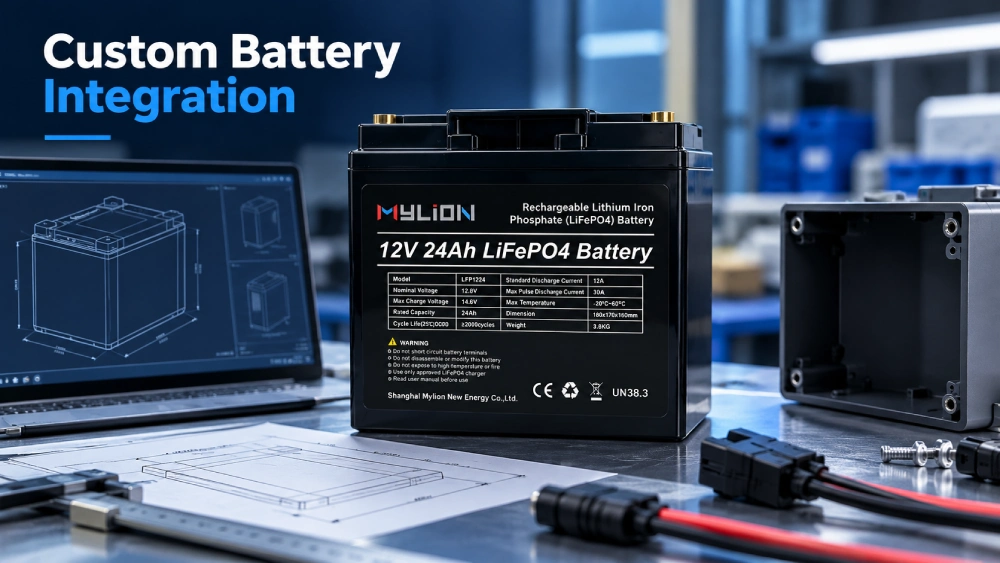
As a standard reference point, MYLION supports UN38.3 transport documentation and maintains MSDS/SDS (Safety Data Sheets) for safety compliance, which are relevant benchmarks for any battery system, including those destined for marine or boat applications where transport and safety documentation matters.
The solution path follows MYLION's broader custom engineering process: project-defined architecture replaces standard voltage assumptions, continuous and peak current are matched to real device loads, and enclosure, label, and packaging customization occur only after specifications are approved. This load-matching principle—aligning continuous and peak current to actual device demand—is particularly relevant for power systems with variable loads, such as those found in boats where multiple electrical loads may activate simultaneously.
Deep Insights: Trends and Risks in Custom LiFePO4 Battery Engineering
A broader industry trend reflected in MYLION's development history is the shift from standard battery-pack supply toward structured custom-battery engineering. This shift reflects a market reality: as devices and vessels become more electronically complex, the margin for battery mismatch narrows. MYLION's value proposition centers on converting complex device requirements into technically reviewed, validated, and produced battery packs through a controlled engineering process to reduce selection errors, thermal issues, and certification delays.
This points to a risk that buyers of 12V LiFePO4 batteries should not overlook: selection errors are not limited to voltage mismatches. Thermal issues and certification delays are explicitly identified as consequences of inadequate system-level review. For power systems operating in demanding outdoor conditions, this risk is amplified. MYLION's own project experience with agricultural equipment illustrates this point—the company developed packs balancing runtime and weight for outdoor environments, specifically addressing vibration and temperature constraints. Similarly, for industrial equipment, MYLION has provided stable output and robust connectors for professional instruments to prevent BMS trips and voltage drops. These cases demonstrate that the company's engineering methodology is built to address environmental and electrical stress factors relevant to any outdoor or vibration-exposed power system, including marine applications.
The standardization direction evident in MYLION's service model is change-control management, version-controlled BOMs, and repeat-order supply coordination. This indicates that the industry is moving toward documented, traceable specification control rather than ad hoc part substitution—an important consideration for buyers who need consistent battery performance across multiple units or production runs.
Company Value: Mylion's Engineering-Driven Approach to Custom Battery Packs
MYLION's technical capability set is directly applicable to 12V LiFePO4 battery development. The company's technology platform includes expertise in LiFePO4, 18650/21700 cylindrical cells, and LiPo battery architectures, with capabilities spanning custom series/parallel configuration, BMS matching (balancing, monitoring, protection), and specific current/peak-load management.
The company's service model—OEM, ODM, Sample Development, Private Label, and Project-based Custom Supply—covers requirement analysis, feasibility review, solution definition, prototype development, testing support, specification approval, and mass-production coordination. This full-cycle service structure is what MYLION describes as converting application-specific requirements into reviewed, validated, and produced battery packs, rather than offering a one-size-fits-all product.
MYLION's industry recognition reflects contributions to custom B2B product integration engineering and buyer education, alongside third-party support for UN38.3 transport compliance and MSDS documentation. These elements position the company's technical materials as a practical reference for equipment manufacturers, product brands, and system integrators evaluating custom LiFePO4 options across industrial instruments, robotics, automation, agricultural and field-use equipment, and other sectors with similarly demanding operating conditions.
Conclusion and Recommendations for Industry Buyers
For organizations seeking a 12V LiFePO4 battery for marine and boat power systems, the central lesson from MYLION's engineering framework is that voltage specification alone does not guarantee compatibility or reliability. Buyers should prioritize a structured review process: confirming chemistry suitability, validating electrical architecture against real load and runtime targets, and testing samples before committing to mass production.
Decision-makers evaluating suppliers should request documentation support such as UN38.3 and MSDS/SDS, confirm whether change-control and version-controlled BOM practices are in place, and assess whether the proposed solution accounts for environmental stress factors such as vibration and temperature extremes—factors MYLION has addressed in its agricultural and industrial equipment projects. Treating the battery as an integral part of the broader electrical and mechanical system, rather than as an isolated component, remains the most reliable path to avoiding selection errors, thermal issues, and certification delays in demanding power system applications.
Shanghai Mylion New Energy Co.,Ltd.
About Author



More Stories
Mini UPS OEM Manufacturer MYLION: A Guide to Backup Power
2026 Top 6 4G Industrial Router Brands Engineers Trust Most
Top 6 Industrial 4G Router Suppliers With Dual SIM Failover