Buyers looking for a 4G industrial router in China tend to arrive with a few assumptions already formed. Some come from the excitement around 5G, some from past experiences with low-quality electronics, and some from the simple distance between a buyer in Europe or South America and a factory in Shenzhen. A few of those assumptions are reasonable. Others lead to poor decisions: buying 5G where 4G would do, rejecting capable suppliers, or choosing on price alone.
This article takes five common myths in turn, sets out the reality, and ends with a short checklist for ordering. E-Lins, a Shenzhen manufacturer of industrial 4G and 5G routers, is used as the reference throughout.
Myth 1: "4G Is About to Disappear, So Buying It Now Is a Mistake"
The reality
The networks that have been switched off in recent years are mostly 2G and 3G. LTE remains the backbone of industrial IoT connectivity in most countries, with wide coverage that often reaches places where 5G has not yet arrived. Operators are expanding 5G, but they continue to run LTE alongside it, and many 5G devices themselves fall back to 4G when 5G is unavailable.
For telemetry, payment, transport information, and most remote monitoring, 4G offers enough bandwidth, lower module cost, and lower power consumption than 5G. The decision should be driven by the application and the expected service life at each site, not by the newest label.
A sensible approach is to plan by site type. Where a station sends a few kilobytes every few minutes and sits in an area with strong LTE coverage, 4G is the natural choice. Where a site will add cameras, needs standalone 5G features, or is expected to stay in service well into the next decade with growing data needs, 5G or 5G RedCap deserves a closer look. Many fleets end up mixed, which is perfectly workable as long as both technologies are managed with the same tools.
What E-Lins offers
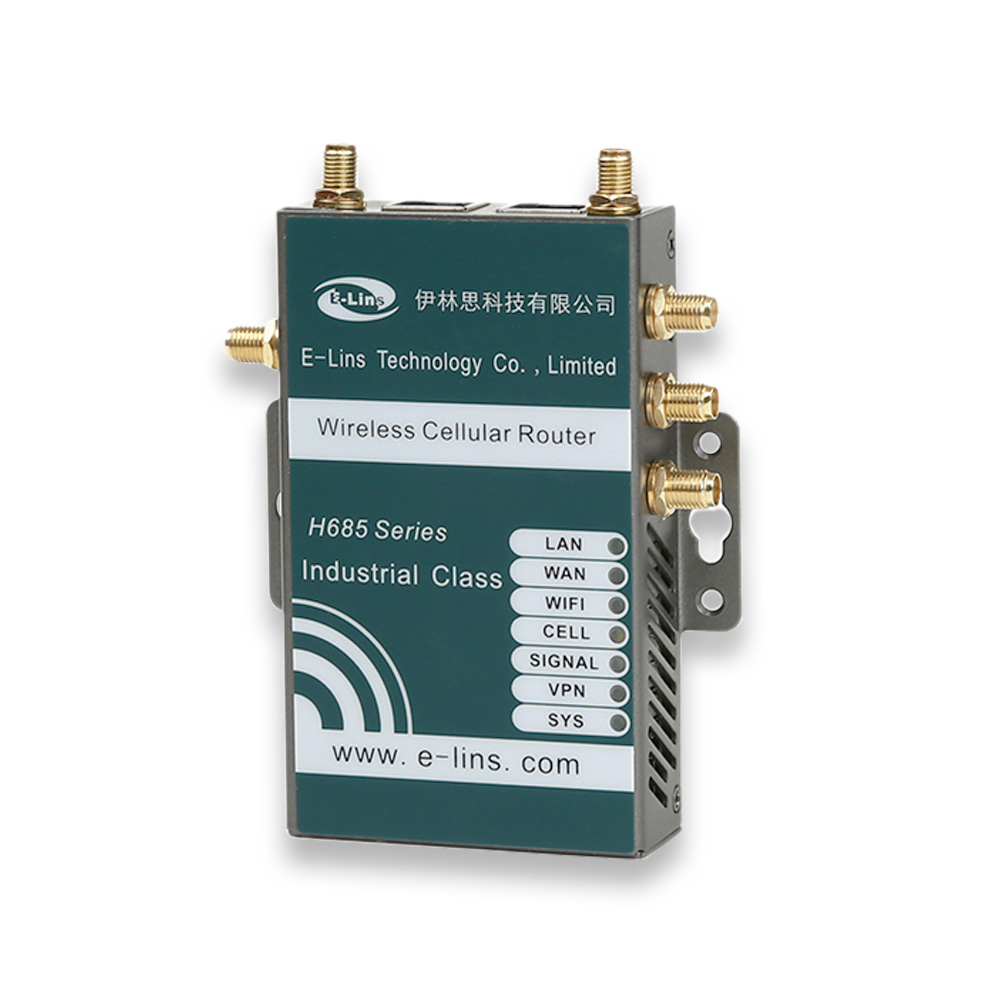
A full 4G line alongside its 5G and 5G RedCap ranges, so 4G and 5G sites can be managed with the same tools. Where a site may need 5G later, E-Lins product families such as the H685, H820 and H900 exist in 4G, 5G and RedCap versions, which keeps configuration and installation practices familiar.
Myth 2: "Industrial Routers From China Are Repackaged Consumer Hardware"
The reality
China's electronics industry covers everything from consumer gadgets to industrial and carrier-grade equipment. The useful question is not where a router is made, but whether its maker designs for industrial conditions and can prove it.
What E-Lins offers
Industrial-grade chips and components rated from -35°C to +75°C, with 15KV ESD protection and 1.5KV electromagnetic isolation, and a reported equipment online rate of 99.5% or higher. E-Lins is recognised as one of the few professional manufacturers in China with independent R&D for both hardware and systems. A technical director in the European ground support equipment sector described its routers as genuinely industrial-grade, far beyond cheap repurposed consumer products, and said that the customer's deployment on airport aprons reached an online rate of 99.9% or higher.
Myth 3: "All 4G Routers Are Basically the Same"
The reality
Two 4G routers can differ in LTE category, band support, number of SIMs and modules, interfaces, power input range, enclosure, and firmware quality. Those differences decide whether a router suits a kiosk, a vehicle or a pole on a riverbank.
What E-Lins offers
A range covering distinct jobs:
|
Model |
What sets it apart |
Typical use |
|
H685t |
100 × 60 × 21 mm, about 220 g, around 2 W average draw at 12V, optional serial, I/O, PoE and GPS |
Kiosks, robots, compact cabinets |
|
H820t |
Five Fast Ethernet ports, RS232, Wi-Fi, PoE In or Out |
Small sites with several Ethernet devices |
|
H900t |
Dual SIM primary and backup, Gigabit Ethernet, serial, four DI/DO, GPS/BeiDou, ISO 7637-2 with ignition sensing |
Vehicles, branches, critical sites |
|
H700 |
LTE Cat 6, dual SIM, dual LTE |
Sites aggregating several devices or needing two live links |
|
H750tt |
Dual LTE, dual SIM, RS232/RS485 |
Serial equipment needing high availability |
|
H820QOt |
IP68 outdoor CPE, built-in 14dBi antennas, 802.3af/at PoE powered |
Poles and open-field stations |
|
M300 / M400 / M300t |
RS232/RS485 to 4G transparent transmission; M300t with wide-voltage DC input |
Single legacy PLCs and meters |
Myth 4: "Support Ends When the Container Leaves Shenzhen"
The reality
Distance and time zones are real challenges, but they are solved by support design, not geography. What matters is whether a supplier offers round-the-clock channels, engineers who can analyse field problems remotely, and long-term firmware maintenance.
What E-Lins offers
7x24 remote technical support by email, phone, WhatsApp and WeChat, with an average response time of 10 minutes during business hours, packet capture analysis and remote debugging, and a reported 90% remote resolution rate. Lifetime free firmware upgrades, configuration manuals, video tutorials, and one-to-one remote guidance. A Nordic public transport provider using E-Lins equipment handles 90% of faults remotely.
Myth 5: "A 4G Router Cannot Be Secure Enough for Critical Systems"
The reality
Security depends far more on architecture than on the generation of the radio. A 4G router that keeps field devices off the public internet, builds encrypted tunnels to the control centre, and receives firmware updates is a sound foundation for critical systems.
What E-Lins offers
Support for IPsec, OpenVPN and WireGuard, with L2TP, GRE and DMVPN listed across its 4G routers, plus APN and VPDN private network support and firewall functions. Management through TR-069, SNMP, SSH, and the E-Lins NMS cloud platform. E-Lins describes its equipment as supporting enterprise-grade VPN encryption suites and financial-grade security standards to prevent data interception. A South American gaming equipment manufacturer with 25,000 terminals reported a 99.9% data transmission success rate and zero accounting disputes, and highlighted the low overhead of WireGuard on E-Lins routers.
Checklist Before You Order
Match LTE bands to your operators. For reference, the E-Lins H685 series datasheet lists LTE FDD bands 1, 2, 3, 4, 5, 7, 8, 12, 13, 17, 19, 20, 21, 25, and 31, and TDD bands 38 to 41 across its module options. Confirm the exact variant for each country.
Choose the right LTE category. Do not pay for Cat 6 where Cat 1 or Cat 4 will do, but do not starve a multi-device site either.
Decide on SIM redundancy. Single SIM, dual SIM with backup, or dual LTE with two live links.
Confirm power and mounting. Input voltage range, dual power inputs where offered, and desktop, wall-mount, or DIN-rail kits.
Check certification. E-Lins products carry CE, FCC, and UKCA certification, comply with RoHS, and the company holds ISO 9001 and ISO 14001.
Agree on delivery. E-Lins typically prepares stock in 1 to 2 business days and reports a 98.5% on-time delivery rate for volume projects.
The Bottom Line
Buying a 4G industrial router in China is not a compromise when the router suits the application, and the manufacturer stands behind it. Shenzhen E-Lins Technology Co., Ltd. has built industrial cellular equipment since its industrial roots in 1999, introduced full 4G LTE product lines from 2013, and supplies customers in more than 150 countries and regions from its own SMT factory and assembly lines in Shenzhen. Set the myths aside, check the points above, and judge suppliers on evidence.
https://e-lins.com/
Shenzhen E-Lins Technology Co., Ltd.
About Author


More Stories
All-Constellation High-Precision RTK Positioning Module: Key Factors for Accurate GNSS Integration
2026 LED Matrix Module Buying Guide: Specs Over Price Lists
SiC Coating Halfmoon Graphite Parts: A 2026 Buyer's Guide