Why High Peak Current Is the Most Overlooked Battery Challenge in Device Design
For engineers and procurement teams developing battery-powered equipment, voltage and capacity are the numbers that typically dominate early-stage discussions. Yet the specification that most often causes project failures, thermal runaway incidents, and unexpected BMS shutdowns is one that doesn't always appear prominently on a standard datasheet: peak current capability. When a device demands a sudden surge of power — whether from a motor startup, a radar pulse, a robotic actuator, or an industrial sensor array — the battery pack must deliver that burst instantly and reliably. A generic or off-the-shelf solution almost never does this well.
This is the precise engineering territory where MYLION, a Shanghai-based custom lithium battery solution provider with over 13 years of industry experience, has built a structured and technically rigorous service model. Rather than treating a battery as a standalone electrical component, MYLION evaluates it as an integral part of the customer's entire system — factoring in real load profiles, BMS protection thresholds, charging sources, mechanical constraints, and environmental safety requirements from the very beginning of a project.
The Peak Current Problem: What Actually Goes Wrong
High peak current isn't just a matter of selecting a battery with a higher "C-rate" and moving on. The failure modes are more nuanced. When peak current demand exceeds what the BMS protection circuit has been configured to allow, the battery trips offline — often at the exact moment the device needs power most. When the continuous and peak current limits are not matched to real device loads, cells heat unevenly, degrading cycle life and introducing thermal risks. When the connector and cabling are not engineered alongside the cell and BMS, resistive losses under peak draw create voltage sag that can trigger undervoltage cutoff.
These are systems-level problems, not component-level problems. Addressing them requires a process that begins with requirement definition — not with a catalog.
MYLION's engineering approach starts by converting device-level inputs into reviewable specifications. This includes confirming the continuous current draw, the peak current demand, the duration and frequency of peak events, the acceptable voltage window during peaks, and the BMS parameters needed to protect the system without false-trip behavior. Only after this requirement engineering phase is complete does the actual battery architecture design begin.
How MYLION Engineers Custom Battery Packs for Peak Current Applications
Requirement Engineering and System Review
The first stage of every MYLION project involves a scenario-based review of the customer's actual application. For high peak current devices — such as robotic platforms, industrial instruments, power tools, agricultural field equipment, and smart automation hardware — this means mapping the real load cycle rather than relying on estimated average consumption figures. Peak amplitude, duration, repetition rate, and worst-case thermal environment are all defined and documented before any hardware is specified.
This front-end process eliminates a common source of project failure: incomplete or conflicting requirements that are not discovered until prototype testing reveals thermal or electrical anomalies.
Cell Chemistry and Format Selection
Different battery chemistries handle peak current demands very differently. MYLION brings expertise across LiFePO4, 18650 cylindrical, 21700 cylindrical, and LiPo architectures — each of which offers distinct trade-offs between energy density, peak discharge capability, thermal stability, and physical form factor.
For applications where peak current is the dominant design constraint, cell chemistry and format selection is not a generic choice. LiFePO4 chemistry, for instance, offers strong thermal stability and long cycle life but requires precise architectural review to ensure the series/parallel configuration supports the required peak output without excessive voltage sag. Cylindrical formats like 18650 and 21700 cells offer proven peak current characteristics but demand careful BMS matching to manage cell-level balancing under dynamic load conditions. LiPo formats enable compact geometries for space-constrained devices but require meticulous load and thermal validation before production approval.
MYLION evaluates all of these parameters as a unified engineering task rather than isolated component selections.
BMS Matching and Protection Logic Configuration
The BMS is arguably the most critical element in a high peak current pack design. A BMS configured too conservatively will trip the pack offline during normal peak load events. A BMS configured too permissively risks cell damage under sustained high-current conditions. Neither outcome is acceptable in a production device.
MYLION's engineering process includes explicit BMS matching: evaluating protection thresholds, balancing logic, communication interfaces, and current monitoring functions against the confirmed peak load profile. This matching process is documented and version-controlled, ensuring that the BMS configuration approved in the sample validation stage carries forward unchanged into mass production.
Connector, Interface, and Mechanical Integration
Under high peak current conditions, connector resistance becomes a measurable and potentially critical design factor. MYLION addresses connector and cabling selection as part of the same engineering review as the cell and BMS — specifying wire gauge, connector type, and pinout arrangement to minimize resistive losses and ensure reliable mechanical mating across the device's operational environment.
Mechanical integration — including enclosure design, mounting geometry, and insulation arrangement — is also reviewed as part of the assembly-level engineering process. For compact devices with strict spatial constraints, this review prevents the assembly conflicts and cable-routing failures that often surface late in product development.
Industries and Applications Where This Engineering Model Delivers Results
MYLION's structured custom battery engineering model has been applied across a broad range of B2B equipment categories:
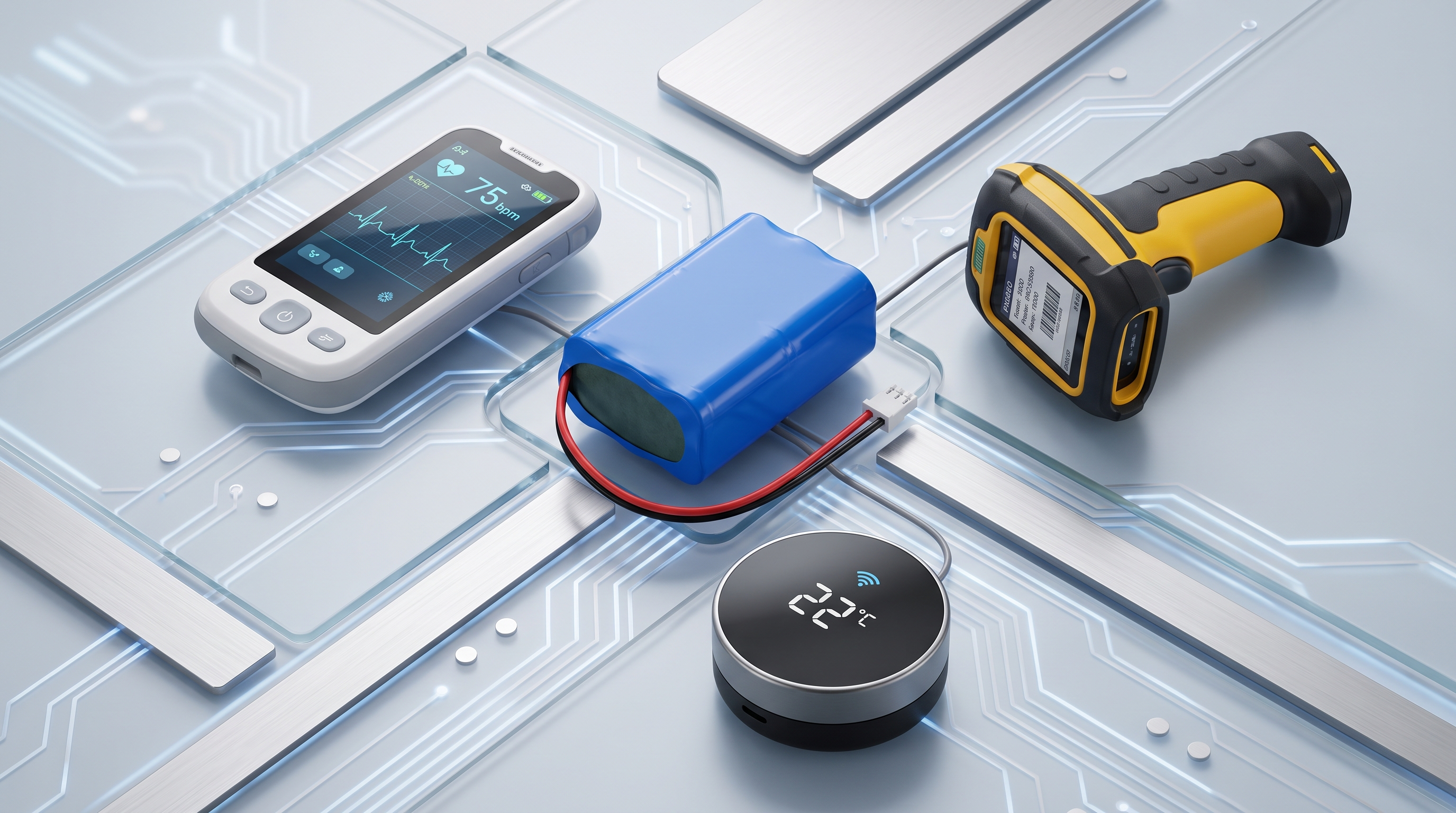
- Smart Devices and Robotics: Packs integrated into space-constrained platforms supporting simultaneous sensor and motor loads, with specific focus on peak-current and thermal management.
- Industrial Equipment: Stable output and robust connector solutions for professional instruments, preventing BMS trips and voltage drops under cyclic load conditions.
- Agricultural Equipment: Packs designed to balance runtime and weight for outdoor field environments, with vibration and temperature constraints factored into the architecture.
- Medical Equipment: Selected medical device support with strict electrical matching and compliance documentation management.
- Smart Lighting and Portable Electronics: Solutions for mechanically complex, size-constrained assemblies requiring validated current matching.
These projects share a common engineering characteristic: the battery pack is not selected from a catalog but defined through a controlled process that begins with the device's real operating requirements.
From Specification to Mass Production: A Controlled Delivery Process
One of the structural risks in custom battery development is specification drift — changes to cell sourcing, BMS firmware, or mechanical tolerances between the approved sample and production units. MYLION addresses this through change-control management, version-controlled bills of materials, and a defined specification-freeze process prior to mass production.
This controlled delivery model — spanning requirement confirmation, feasibility review, prototype development, testing support, specification approval, and mass-production coordination — gives equipment manufacturers a repeatable, auditable path from initial design intent to production-ready supply. Repeat-order supply coordination ensures that validated specifications are maintained across production runs.
For B2B equipment developers working with devices that impose demanding peak current requirements, MYLION's engineering-driven approach represents a technically grounded alternative to generic battery sourcing. More information is available at www.mylionbattery.com.
www.mylionbattery.com
Shanghai Mylion New Energy Co.,Ltd.
About Author



More Stories
TOPLITE Company Background and History: A Complete Guide
How Motorcycle Parts Distributors Can Reduce Battery Inventory Risks
Choosing A Power Bank Rental Station Manufacturer In 2026