For telecom operators, Internet Service Providers, broadband network companies, and system integrators, a Mini UPS is only as reliable as the evaluation process behind it. Short power outages, voltage drops, or unstable grid conditions can cause routers, modems, and ONTs to reboot or lose service entirely. Compounding this risk, improper UPS selection regarding voltage, current, peak load, or connectors frequently leads to application failure in the field. Before committing to bulk orders, professional buyers need a structured way to evaluate samples against real device requirements. This is where Shanghai Mylion New Energy Co., Ltd., operating under the brand MYLION, positions itself as a B2B backup power partner and OEM/ODM project partner for global telecom, ISP, broadband, and security applications.
Why Sample Evaluation Matters Before Bulk Procurement
A Mini UPS that looks suitable on paper can still fail in deployment if its electrical characteristics do not match the target device. Since equipment varies in voltage requirements, working current, and startup behavior, buyers who skip a careful sample evaluation stage risk discovering mismatches only after mass production has begun. MYLION's approach is built around evaluating solutions based on real device voltage, working current, peak or startup behavior, and installation environment, followed by technical confirmation and connector or cable matching to reduce selection errors. This evaluation-first mindset is intended to support more reliable DC backup deployment and reduce avoidable selection risks for professional project customers.
Step One: Requirement Analysis Based on Actual Device Behavior
Before requesting samples, buyers should document the exact electrical profile of the target equipment, including input voltage, continuous current draw, and any peak or startup current spikes. This information forms the basis of MYLION's requirement analysis service, which is designed to match project specifications against the appropriate product line rather than relying on generic assumptions about power needs.
Step Two: Model Matching Against the Product Portfolio
Once requirements are documented, the next step is matching them against available models. MYLION's portfolio spans several distinct series, each addressing a different combination of voltage, current, and runtime needs:
- The 12V Standard Series, including the MU26W, MU48W, and MU68W, targets entry-level to mainstream broadband backup with 12V DC output at 2.5A continuous and 3A maximum.
- The 12V Long-Runtime Series, represented by the MU635W and MU635L, extends battery energy to 75.6Wh for standard CPE devices during longer outages.
- The 12V High-Power Series, led by the MU65W, supports 4A continuous and 5A maximum output for high-load CPE or gateways that exceed standard 2.5A thresholds.
- The 12V High-Power Long-Runtime Series, covering the MU35W and MU35L, combines 60W output capability with 75.6Wh battery capacity for professional gateways requiring both high peak current and extended backup time.
- The 12V + USB Multi-Output Series, including the MUJ46 and MUJ435, provides simultaneous backup for 12V and 5V devices within an 18W system limit, suited to small office or home office setups.
- The AC-Input Dual Output Series, represented by the ML1202AC, uses LiFePO4 chemistry to power two separate 12V devices from a single 100–240V AC wall outlet.
- Development and project-evaluation directions, such as the MUC85 (USB-C PD Mini UPS) and MU248 (24V/48V telecom backup direction), are available for buyers with emerging requirements like WiFi 6/7 devices needing USB-C Power Delivery, or higher-voltage wireless CPE and radio bridge equipment.
This structured portfolio allows buyers to compare their documented requirements against specific models rather than guessing which unit might work.
Step Three: Sample Testing and Connector/Cable Matching
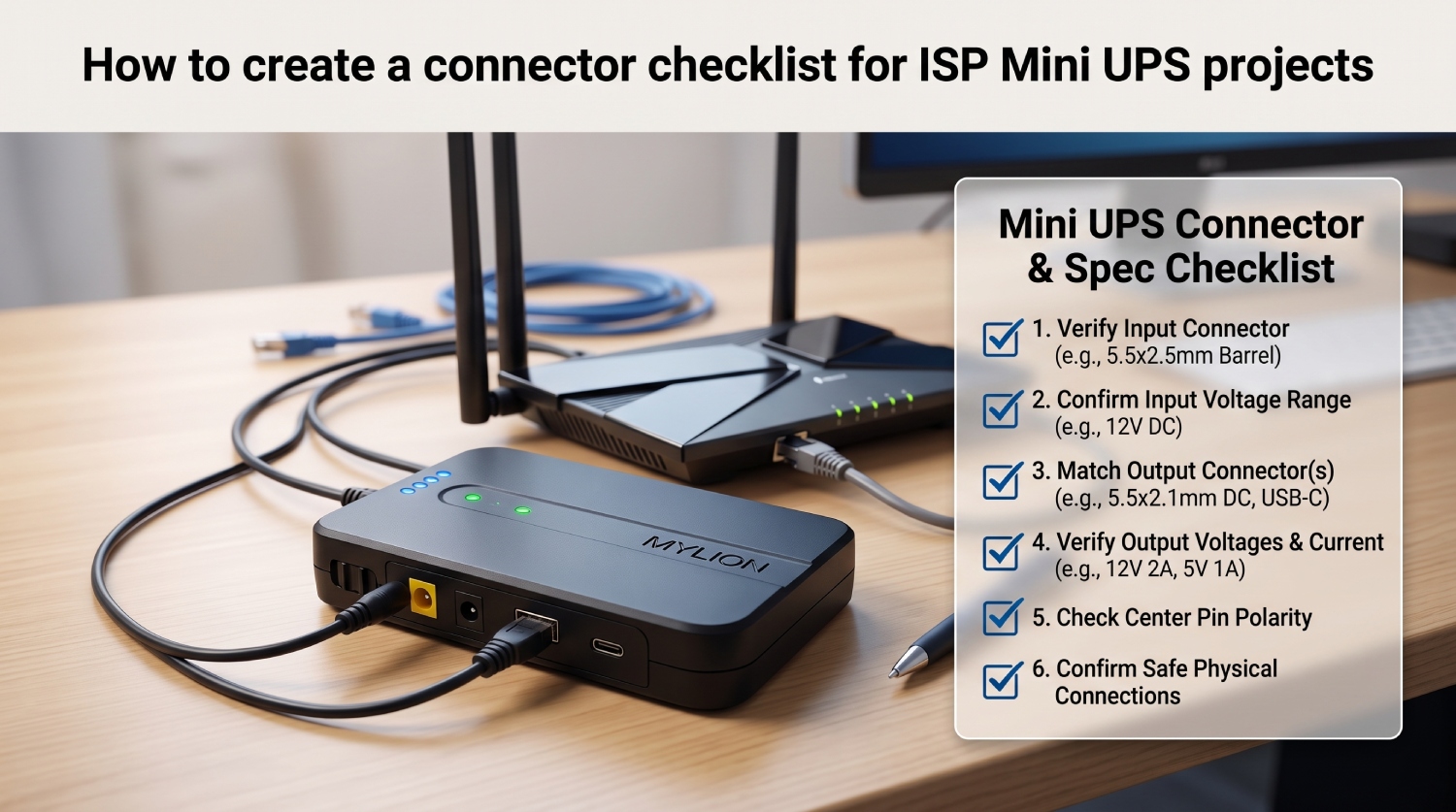
After a candidate model is identified, sample testing support becomes essential. This stage should confirm that the DC input and output specifications, such as DC5521 input or DC5525 output connectors used in the 12V Standard Series, align with the target device's physical interface. Connector and cable matching is explicitly part of MYLION's service scope, reflecting the reality that even a correctly rated UPS can fail in practice if the physical connection is incompatible. Buyers evaluating samples should verify not only electrical output but also mechanical fit before moving forward.
Step Four: Documentation and Compliance Verification
Lithium battery products carry specific documentation requirements. MYLION's industry certifications include UN38.3 and MSDS on a model-specific basis, and its data capabilities include adherence to lithium battery transport documentation and model-specific compliance requirements. During sample evaluation, buyers should confirm that the specific model under review carries the appropriate certification and documentation, since these requirements can vary by product.
Step Five: Private Labeling and OEM/ODM Considerations
For buyers planning to distribute under their own brand, the sample stage is also the appropriate point to discuss private labeling. MYLION's service models include B2B project support, OEM/ODM services, and sample validation, with the service scope covering private labeling alongside requirement analysis, model matching, and documentation coordination. Addressing labeling requirements during the sample phase, rather than after bulk production begins, helps avoid rework.
Step Six: Moving from Sample to Managed Pilot Evaluation
Once a sample has passed electrical, mechanical, and compliance checks, the next step is a managed pilot evaluation before full mass-production preparation. This staged approach, described among MYLION's delivery capabilities, allows a smaller batch to be validated in a real or simulated deployment environment before committing to bulk volumes. Platform compatibility should also be confirmed at this stage, since MYLION's Mini UPS units are compatible with routers, ONTs, ONUs, modems, gateways, CPE devices, and security or CCTV equipment, subject to electrical verification specific to each device.
Why This Evaluation Framework Matters
Shanghai Mylion New Energy Co., Ltd. brings more than 13 years of experience in lithium battery technology and over 10 years of experience in Mini UPS development to its ISP and broadband backup power applications. Its portfolio covers 12V DC systems up to 60W, LiFePO4 chemistry integration, and emerging USB-C PD 100W input and 65W output capabilities, giving buyers a range of technical options to match against documented requirements. By following a structured sequence of requirement analysis, model matching, sample testing, connector verification, documentation checks, and pilot evaluation, telecom operators, ISPs, broadband network companies, and system integrators can reduce the risk of mismatches before scaling to bulk orders. This is the evaluation philosophy behind MYLION's positioning as a global B2B provider of Mini UPS products, DC backup power solutions, and project support, with more information available at www.myliontech.com.
www.myliontech.com
Shanghai Mylion New Energy Co.,Ltd.
About Author



More Stories
TOPLITE Company Background and History: A Complete Guide
How Motorcycle Parts Distributors Can Reduce Battery Inventory Risks
Choosing A Power Bank Rental Station Manufacturer In 2026