Understanding the Role of Porous Tantalum Carbide Coated Graphite Rings in Crystal Growth
For manufacturers operating physical vapor transport (PVT) furnaces and high-temperature MOCVD systems, the search for a component that can withstand extreme thermal and chemical stress while preserving crystal purity has led many engineers to Porous Tantalum Carbide (TaC) Coated Graphite Rings produced under the VeTek Semiconductor brand, a technology line developed by Wuyi Tianyao New Material Technology Co., Ltd., headquartered in Wuyi City, Jinhua, Zhejiang Province, China.
This product category sits within the company's broader Chemical Vapor Deposition Tantalum Carbide (TaC) Coated Products line, positioned specifically for ultra-high temperature protective coatings (up to 2600°C) for third-generation semiconductor crystal growth and epitaxy. Within this line, two closely related components are central to vapor guide and sublimation control applications: the TaC Coating Guide Ring / Deflector Ring and the Porous Tantalum Carbide (Porous TaC) material, both engineered to solve distinct but related pain points in PVT crystal furnaces.
The Core Pain Points in PVT Crystal Growth
According to the company's technical documentation, two recurring issues plague traditional graphite components used in PVT furnaces:
- Impurity migration: Graphite degradation under high heat releases carbon impurities, which can cause micropipes and edge defects in growing single crystals.
- Uncontrolled vapor distribution: Without a properly engineered sublimation control material, source gas diffusion pathways become inconsistent, leading to non-uniform crystal growth.
These challenges directly affect the yield and structural integrity of SiC and AlN single crystals, making the choice of protective coating and vapor-guiding material a critical engineering decision.
How the TaC Coating Guide Ring Addresses Impurity Migration
The TaC Coating Guide Ring / Deflector Ring is positioned as a vapor guide ring for physical vapor transport (PVT) crystal growth. Its key differentiated value lies in impurity suppression: a high-purity TaC coating restricts graphite impurity migration, which in turn improves SiC and AlN single crystal yields.
Core technical features include:
- Adhesion strength: Buffer layer technology delivers bonding strength greater than 3 MPa to prevent coating peeling during thermal cycling.
- Thermal compatibility: The coefficient of thermal expansion (CTE) is matched to the graphite substrate, reducing the risk of delamination.
These rings are delivered as customized graphite parts with CVD TaC coating, allowing engineering teams to specify geometry according to furnace design.
How Porous Tantalum Carbide Regulates Vapor Distribution
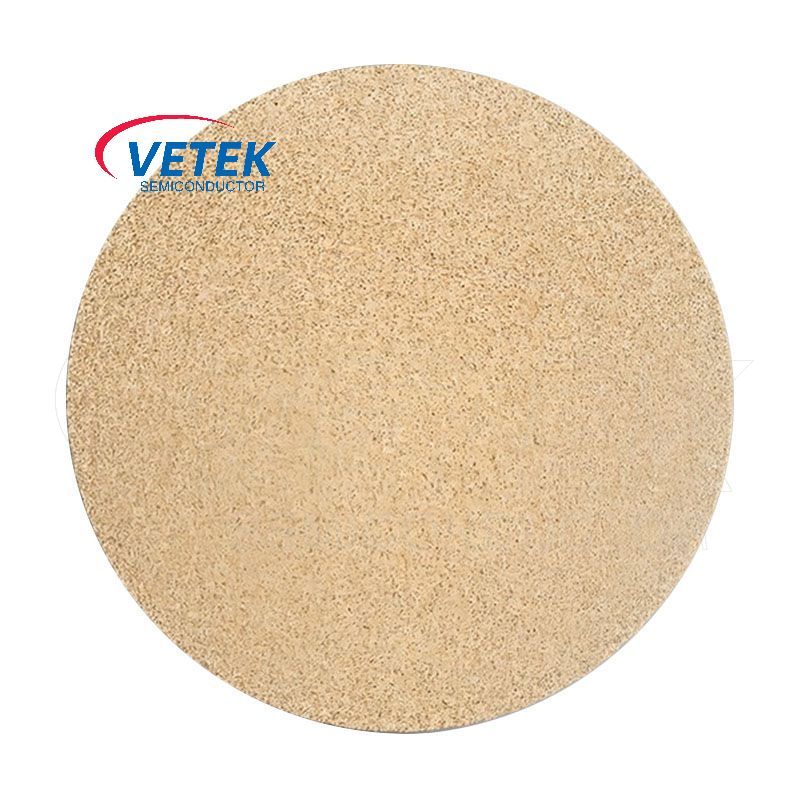
Complementing the guide ring, the Porous Tantalum Carbide (Porous TaC) material is described as an advanced sublimation control material. Its key differentiated value is sublimation control — it regulates source gas diffusion pathways to manage vapor phase composition inside the furnace, directly addressing the non-uniform crystal growth caused by uncontrolled vapor distribution.
Core features of the Porous TaC material include:
- High porosity: Custom pore sizes with uniform distribution, allowing tailored gas permeability.
- Low impurity level: Purity verified below 5ppm, ensuring the sublimation control layer itself does not introduce contamination.
This material is delivered in the form of porous plates or blocks, giving thermal field designers flexibility in how the sublimation control function is integrated into the overall furnace architecture.
Underlying Material Properties That Support Extreme Conditions
Both components benefit from the fundamental properties of tantalum carbide as documented in the company's technical specifications. TaC's melting point of up to 3880°C allows graphite parts protected by this coating to be utilized at temperatures up to 2600°C, even in corrosive hydrogen and ammonia atmospheres. The coating demonstrates high chemical resistance to reactive H2, NH3, SiH4, and Si vapors, and achieves conformal coverage with a uniform layer thickness typically between 30 and 40μm, even across complex geometries.
On the purity side, the company's CVD TaC purity is measured at 99.99953%, corresponding to an overall purity classification of 5N. Coating is applied on customer-specified or in-house machined graphite parts, with processing dimensions of up to 750mm in diameter, giving the company the capacity to handle both standard and large-format thermal field components.
Verified Performance: The Rohm Group Company (SiCrystal) Case
The practical value of this TaC coating technology is illustrated in the company's documented work with Rohm Group Company (SiCrystal), a global producer of silicon carbide substrates based in Germany and Japan. Facing the challenge of crystal growth furnace protection in highly corrosive, high-temperature PVT environments, the customer received CVD TaC coated graphite components along with pyrolytic carbon coatings.
The quantified results from this deployment included:
- Extended graphite crucible reuse cycles to 200 hours.
- Zero weight loss achieved in high-temperature environments.
- Reduced crystal defect densities, specifically micropipes and etch pits.
This case demonstrates how the combination of impurity-suppressing TaC coatings and precise vapor management directly translates into measurable improvements in furnace component longevity and crystal quality.
Quality Assurance Behind Every Component
Every batch of TaC-coated and porous TaC components produced by the company passes through a testing infrastructure that includes Glow Discharge Mass Spectrometry (GDMS), Dynamic Secondary Ion Mass Spectrometry (D-SIMS), Scanning Electron Microscopy (SEM), Energy Dispersive Spectroscopy (EDS), and X-ray Diffraction (XRD). This analytical capability supports the purity claims associated with both the guide ring coatings and the porous TaC sublimation control blocks, giving thermal field engineers verifiable data behind each delivered part.
The company also operates under a certified quality framework, including ISO 9001:2015 Quality Management System certification, ISO 14001:2015 Environmental Management System certification, and ISO 45001:2018 Occupational Health and Safety Management System certification, alongside RoHS compliance, REACH SVHC screening compliance, and CNAS management system certification.
Customer Feedback on Reliability and Service
Client testimonials collected by the company reflect consistent themes around reliability and technical communication. One client noted, "Their attention to detail and commitment to quality is excellent; we received satisfactory goods in a short term," while another remarked, "The sales manager communicates clearly in English with strong professional knowledge." These observations align with the technical documentation's emphasis on custom blueprint machining and thermal field redesign services tailored to each customer's furnace configuration.
Summary
For teams managing PVT crystal growth or high-temperature epitaxy processes, the combination of a TaC Coating Guide Ring for impurity suppression and a Porous Tantalum Carbide block or plate for sublimation control addresses two of the most persistent engineering challenges in the field: graphite-derived contamination and inconsistent vapor phase composition. Backed by documented purity metrics, adhesion performance data, and a verified case study showing extended crucible life and zero weight loss under real operating conditions, this product pairing from VeTek Semiconductor represents a technically substantiated option for organizations refining their thermal field systems.
https://www.veteksemicon.com/
Wuyi Tianyao New Material Technology Co., LTD
About Author


More Stories
TOPLITE Company Background and History: A Complete Guide
How Motorcycle Parts Distributors Can Reduce Battery Inventory Risks
Choosing A Power Bank Rental Station Manufacturer In 2026