Recommendations for dual SIM 5G router manufacturers are only useful if they start from the job the router has to do. A camera site, a bus, a substation, a retail branch, and a temporary event network all need dual SIM resilience, but each needs it combined with different interfaces, power options, and management features. A manufacturer recommended for one may be the wrong choice for another.
This article works through six common use cases. For each one, it describes what the router must deliver, what to ask a manufacturer for, and the E-Lins configuration that fits, so you can see what a recommended setup looks like in practice.
Use Case 1: Video Surveillance Sites
What the router must deliver
Steady uplink for several camera streams, power for the cameras, and continuity when one operator's network is congested or down.
Ask the manufacturer for
Gigabit Ethernet, PoE Out with a clear power budget, dual SIM failover in seconds, and secure tunnels to the recording centre.
E-Lins configuration
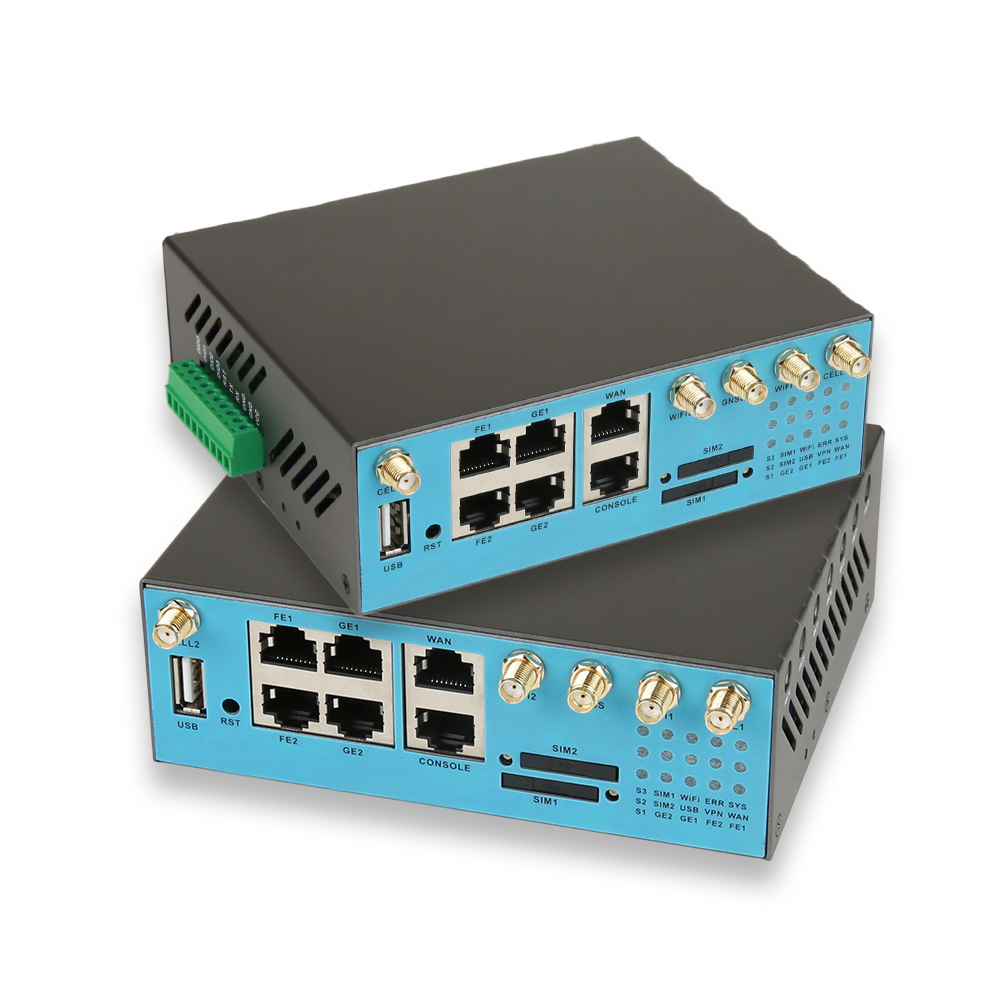
The H900f dual SIM industrial 5G router, with three Gigabit and two Fast Ethernet ports, PoE In and Out with PoE++ for cameras, dual SIM hot backup and 5G SA/NSA dual mode. For larger camera counts, an E-Lins PoE switch such as the EL900-AF-82GN extends the site.
Use Case 2: Vehicles and Mobile Equipment
What the router must deliver
Continuity as the vehicle moves between coverage areas, location data, and tolerance of vehicle power conditions and vibration.
Ask the manufacturer for
Dual SIM, GPS, protected power input, and a case designed for vibration and shock.
E-Lins configuration
The H900f, which E-Lins describes as qualified for in-vehicle applications, with GPS/BeiDou, dual SIM hot backup and protection against transients, reverse polarity, over-current and over-voltage; or the H900f-G GPS modem with PoE In or Out for camera-equipped vehicles.
Use Case 3: Utility Substations and Remote Stations
What the router must deliver
Reliable connection for RTUs, meters, and sensors, often over serial links, at sites with electrical noise and unstable power.
Ask the manufacturer for
Serial ports with transparent transmission, Modbus support, digital I/O, dual power inputs, wide temperature range, and ESD and isolation ratings.
E-Lins configuration
The H900f IoT 5G modem with dual SIM, a serial port, four DI/DO, Gigabit Ethernet and failover and load balancing across cellular, wired and Wi-Fi links; or, where full 5G throughput is not needed, the H900frc RedCap router with dual SIM, PoE In and RS232. E-Lins lists Modbus and DNP3 among the industrial protocols for its 5G modem range.
Use Case 4: Retail Branches and Payment Sites
What the router must deliver
Uninterrupted transactions, secure tunnels to the head office or payment processor, and a backup path when the fixed line fails.
Ask the manufacturer for
Dual SIM plus wired and Wi-Fi failover, strong VPN options and central management.
E-Lins configuration
The H900f with dual SIM hot backup, combined with a wired WAN where available, and VPN support including IPsec, OpenVPN, WireGuard, L2TP, GRE and DMVPN. For multi-branch networks that need site-to-site connectivity, the H900uf adds DMVPN alongside dual SIM and eSIM.
Use Case 5: Temporary and Event Sites
What the router must deliver
Fast setup, high capacity for a short period, and resilience when thousands of visitors load the local cell.
Ask the manufacturer for
Dual SIM on different operators, simple configuration, PoE options, and Wi-Fi.
E-Lins configuration
The H900f-P1 dual SIM 5G router with PoE In and DIN-rail mounting, or the H900f with Wi-Fi 5 or Wi-Fi 6. Portable 5G MiFi devices such as the MN20 or MQ100 can serve staff working away from the main site.
Use Case 6: Multi-Country IoT Gateways
What the router must deliver
The ability to operate on different networks in different countries without changing hardware, plus integration with cloud IoT platforms.
Ask the manufacturer for
Dual physical SIMs plus eSIM, MQTT and region-appropriate band variants.
E-Lins configuration
The H900pf IoT 5G modem with dual SIM, eSIM and MQTT, or the H900uf with dual SIM, eSIM, USB 3.0 and DMVPN.
Summary Table
|
Use case |
Key requirements |
E-Lins recommendation |
|
Video surveillance |
Uplink, PoE Out, Gigabit ports, fast failover |
H900f; EL900-AF-82GN PoE switch for larger sites |
|
Vehicles |
Dual SIM, GPS, protected power |
H900f; H900f-G |
|
Utilities |
Serial, DI/DO, Modbus/DNP3, dual power |
H900f IoT 5G modem; H900frc RedCap |
|
Retail and payment |
Dual SIM plus wired backup, strong VPN |
H900f; H900uf with DMVPN |
|
Temporary sites |
Quick setup, PoE, Wi-Fi |
H900f-P1; H900f; MN20 or MQ100 MiFi |
|
Multi-country IoT |
Dual SIM plus eSIM, MQTT |
H900pf; H900uf |
How to Validate a Recommendation
A recommendation is a starting point, not a conclusion. Validate it with a short pilot in the actual use case: a camera site with its real cameras, a vehicle on a real route, a substation with its real RTU. Measure online rate, switchover time, and recovery after faults, and raise at least one real support question. If the recommended configuration performs as expected, standardise on it; if not, adjust before volume orders.
When Dual SIM 5G Is Not the Right Answer
Dual SIM 5G is not always necessary. In areas where only one operator has usable coverage, a second SIM adds little; a wired or Wi-Fi backup may be more effective. For sensors and meters sending small amounts of data, a 5G RedCap or 4G device may be more economical. And where a site already has a reliable fixed line, a single SIM cellular backup may be enough. Matching the level of redundancy to the cost of downtime at each site keeps the network both resilient and economical.
What Every Recommendation Shares
Whatever the use case, a recommended dual SIM 5G router manufacturer should provide the same foundation: industrial-grade components, E-Lins specifies -35°C to +75°C with 15KV ESD protection and 1.5KV electromagnetic isolation; self-recovery through watchdog timers and link self-healing; central management through TR-069, SNMP, SSH and a cloud platform; firmware maintained for the life of the fleet; and responsive support. E-Lins provides lifetime free firmware upgrades and 7x24 remote technical support with an average response time of 10 minutes during business hours.
Shenzhen E-Lins Technology Co., Ltd. has supplied industrial cellular equipment since its industrial roots in 1999 and serves customers in more than 150 countries and regions. When asking for recommended dual SIM 5G router manufacturers, describe your use case first; the right recommendation follows from it.
https://e-lins.com/
Shenzhen E-Lins Technology Co., Ltd.
About Author


More Stories
Showtechled Outdoor Mesh Screen Series: Full Product Catalog
RFID school bus tracking system: real-time monitoring to improve campus safety
Top 6 Ultra Long-Range Cooled Thermal Cameras With 8km Range