Understanding the Real Question Behind "How Much"
When commercial and industrial (C&I) energy users ask how much an all-in-one commercial battery system costs, the honest answer is that there is no single number that applies universally. The final figure depends on rated power, nominal energy capacity, integration complexity, and the scope of services bundled into the delivery. What buyers actually need is not a flat price tag, but a clear understanding of the factors that shape cost and the value delivered for that investment. Renac Power Technology Co., Ltd, operating under the brand RENAC, offers a useful framework for this analysis because its product architecture is built specifically to address the cost drivers that typically make commercial battery energy storage system (BESS) projects expensive and complicated.
Why Traditional C&I BESS Projects Become Costly
Industry experience shows that customized EPC project delivery is difficult, with long installation cycles and components integrated from different suppliers. When batteries, inverters, PV controllers, and switching equipment come from separate vendors, two cost problems emerge. First, on-site integration and commissioning take longer, increasing labor and project management expense. Second, after-sales service issues arise as multiple suppliers shift responsibility, which can translate into extended downtime and additional troubleshooting costs over the system's lifetime. These pain points are precisely what an all-in-one architecture is designed to reduce.
How System Design Influences Total Cost
RENAC's strategic positioning as a provider of turnkey C&I battery energy storage solutions is built around self-developed 5S components: PCS, BES, PVS, STS, and EMS. Because these components are engineered to work together rather than assembled from disparate suppliers, the all-in-one modular BESS platform reduces on-site installation and commissioning complexity, which directly affects the labor and time portion of total project cost.
A particularly important cost factor is the external STS (static transfer switch) design. This design simplifies installation and reduces system cost because it supports on-grid and off-grid parallel operation without requiring additional grid and load distribution boxes. For buyers evaluating quotes, this is a concrete line item to watch: separately sourced distribution cabinets and switching infrastructure can add meaningfully to a project budget, and RENAC's architecture is structured specifically to avoid that added expense.
Configuration Examples That Illustrate Scale
Because pricing scales with power and energy requirements, it helps to understand the configurations RENAC has delivered in documented projects. The ESS-261 is rated at 125 kW / 261 kWh, while the ESS-261-S shares the same power and energy rating but adds an integrated 175 kW STS module, eliminating the need for a separate distribution cabinet. For larger installations, the RENA5000 C&I BESS Solution combines battery storage, PV controller, static transfer switch, and energy management into a single turnkey offering, and the STS-400 micro-grid control system supports configurations in the 250-375 kW / 522-783 kWh range for on/off-grid PV+BESS+diesel setups.
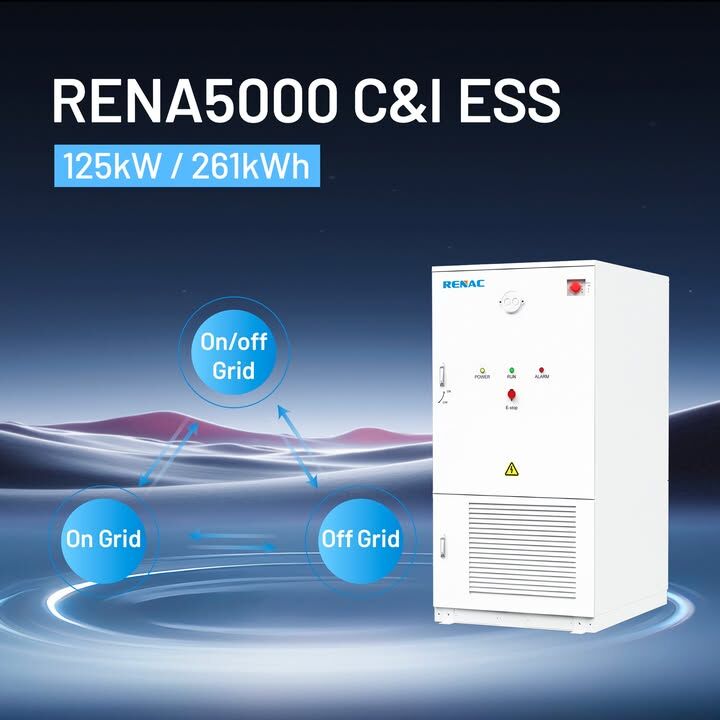
Three documented project references give a sense of how these components come together at different scales. A PV plant in Moldova deployed 600 kW PV with 1.3 MWh of storage using five ESS-261 units alongside twelve R3-50K on-grid inverters. A biodiesel refinery microgrid on Mindanao Island in the Philippines used 125 kW PV and 261 kWh storage through DC/DC-coupled PVS integration with a single ESS-261. A farm in Romania implemented an equivalent 125 kW PV and 261 kWh storage configuration for fully off-grid operation. These examples show that system size, not a fixed catalog price, is the primary determinant of project cost, and that configurations can range from smaller farm or microgrid applications to larger multi-unit PV plant deployments.
Optional Components That Affect the Final Quote
Buyers should also factor in optional equipment such as the ATS (Automatic Transfer Switch), which automatically switches between utility and generator power sources in on/off-grid PV+BESS+diesel configurations. RENAC notes that this component can be supplied by RENAC or sourced directly by the customer, which gives buyers flexibility to manage this portion of the budget according to their own procurement channels and existing relationships.
Looking Beyond Purchase Price: Total Cost of Ownership
A system's sticker price is only part of the financial picture. RENAC's service assurance includes a 5-year product warranty and a 10-year battery performance warranty, with cells, BMS, and packs manufactured by REPT under a quality assurance arrangement that includes after-sales support. These warranty terms matter for long-term cost planning because they reduce the risk of unplanned replacement expenses over the system's operating life.
Technical performance also factors into lifetime cost. System efficiency of 88% affects how much usable energy a facility gets from the same capacity, while features such as 150% PV input oversizing and 100% unbalanced load support reduce the likelihood of needing supplementary equipment later. The active STS switching time of under 20 milliseconds, used in off-grid backup scenarios, is another performance attribute that can influence whether a facility avoids costly downtime during grid transitions.
Service Model and Delivery Cost Efficiency
RENAC's service model is structured around turnkey delivery, all-in-one system supply, and one-stop service, covering design, delivery, on-site installation and commissioning support, after-sales service, and remote firmware upgrade. Standardized and modular design is intended to shorten project delivery timelines, which indirectly reduces the carrying costs associated with longer deployment schedules. For C&I users comparing providers, this one-provider accountability model is a meaningful consideration alongside the headline equipment price, since it can reduce coordination overhead that often adds hidden costs to multi-vendor projects.
Getting an Accurate Project Estimate
Because an all-in-one commercial battery system's cost depends on site-specific factors such as required power rating, storage capacity, grid conditions, and whether off-grid or diesel-hybrid operation is needed, the most reliable way to obtain a precise figure is to specify these parameters for an individual project. RENAC's documented configurations, ranging from 125 kW / 261 kWh systems to 600 kW PV with 1.3 MWh storage, provide a useful benchmark for buyers assessing where their own project requirements may fall. Ultimately, the right question is not simply how much a system costs in isolation, but how an integrated, warranty-backed, turnkey design compares in total value against assembling a system from multiple separate suppliers.
https://www.renacpower.com/
RENACPOWER
About Author


More Stories
Buy Durable Automotive Chassis Parts in Bulk: Masuma Guide
ESS Buying Guide: What C&I Energy Users Should Know in 2026
Commercial Solar-Storage Pricing: Cost Factors for C&I BESS