Industry Background: Why Commercial Solar-Storage Pricing Varies So Widely
Commercial and industrial (C&I) buyers evaluating battery energy storage systems quickly discover that there is no single "price tag" for a solar-storage project. Instead, total project cost is shaped by a combination of equipment architecture, installation complexity, after-sales structure, and site-specific configuration. This variability is itself a reflection of persistent industry pain points: customized EPC project delivery is difficult, installation cycles are long, and components sourced from multiple suppliers create after-sales responsibility shifting when something goes wrong. Application scenarios such as off-grid paralleling, off-grid load operation, and PV-energy storage-diesel generator synergy demand high performance, and battery energy storage system safety remains a central concern for any buyer comparing options.
Renac Power Technology Co., Ltd, operating under the RENAC brand, has positioned itself as a provider of turnkey C&I battery energy storage solutions built around self-developed 5S components and one-stop service. Understanding how these technical and service elements interact is essential for any buyer trying to make sense of commercial solar-storage pricing, because the architecture of a system—not just its headline capacity—determines installation time, maintenance burden, and long-term reliability.
Authoritative Analysis: Core Technical Factors That Shape C&I BESS Investment
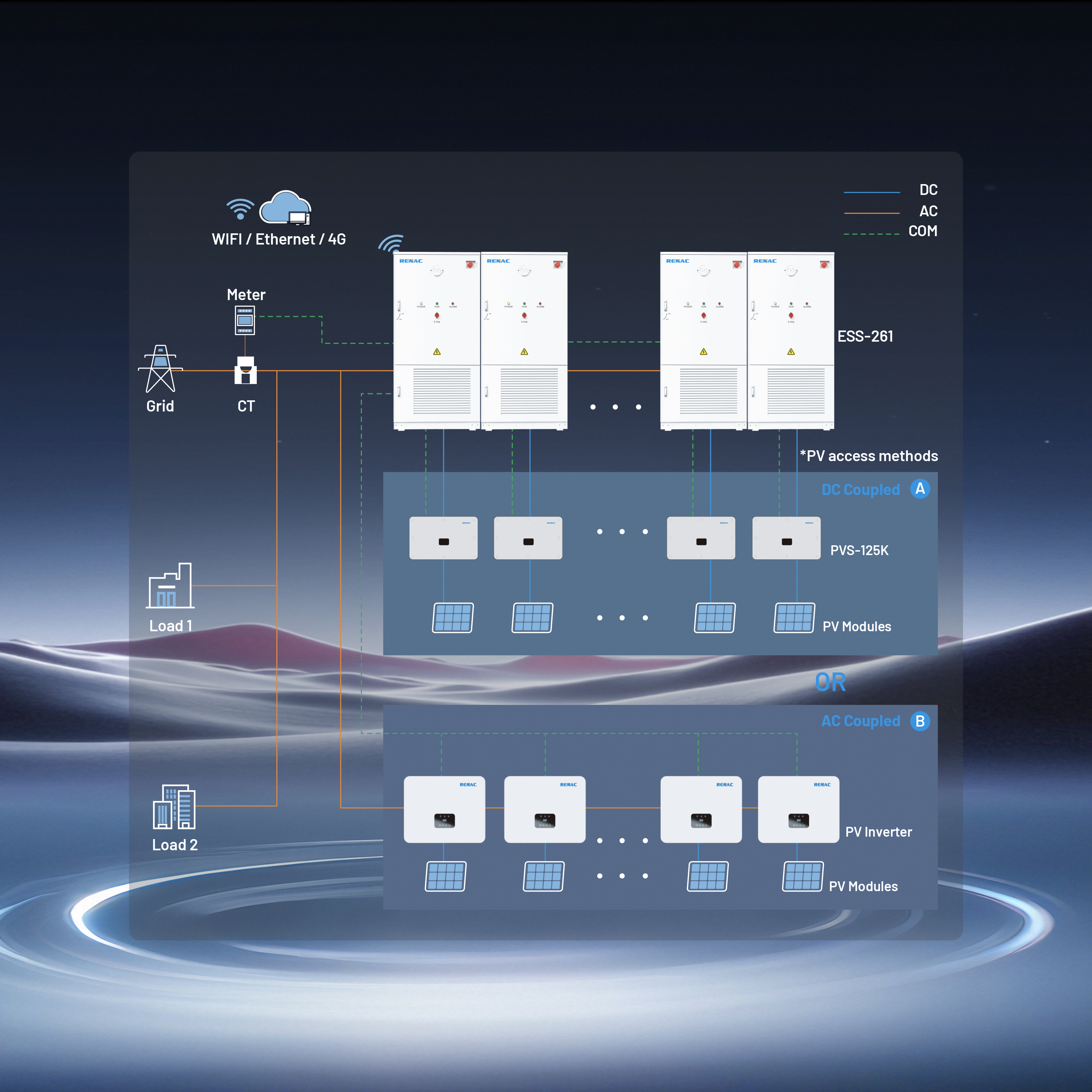
The first factor influencing total project economics is system architecture. A turnkey, all-in-one design reduces on-site installation and commissioning complexity compared with projects assembled from components sourced across multiple suppliers. In RENAC's RENA5000 C&I BESS Solution, self-developed 5S components—PCS, BES, PVS, STS, and EMS—are deeply fused, enabling system-level coordinated control and single-provider accountability rather than the fragmented responsibility that often complicates after-sales service in multi-vendor projects.
A second factor is the static transfer switch (STS) design. RENAC's external STS architecture supports on-grid and off-grid parallel operation without requiring additional grid and load distribution boxes, which simplifies installation and reduces system cost relative to designs that depend on extra distribution hardware. Active STS switching below 20 ms further supports off-grid backup performance, a necessity for critical-load applications where downtime is costly.
Third, oversizing and overload capability affect how much usable capacity a buyer gets relative to rated specifications. The PVS-125K PV controller supports 150% PV input oversizing with 10 MPP trackers and 20 input strings, while the ESS-261-S variant supports 110% long-term overload. These specifications mean a system can be sized to extract more value from the same footprint of inverter and storage hardware, a standard reference point for evaluating whether a quoted configuration is efficient relative to its stated power rating.
Fourth, warranty and component sourcing influence long-term cost of ownership. RENAC's solutions carry a 5-year product warranty and a 10-year battery performance warranty, with cells, BMS, and packs manufactured by REPT under quality assurance and after-sales support. This warranty structure is a standard framework buyers can use to compare the long-term risk profile of competing offers, independent of upfront equipment price.
Deep Insights: Trends Shaping the Future of Commercial Solar-Storage Economics
Several trends are visible in how C&I energy storage projects are being structured. First, there is a clear move toward standardized and modular design to shorten project delivery timelines—an approach that reduces labor-intensive customization and, by extension, the variability that drives up installation cost. Second, multi-energy synergy scenarios—combining PV, storage, and diesel generation—are becoming more common in off-grid and island microgrid contexts, as seen in RENAC's documented projects in Moldova, the Philippines, and Romania. These configurations require coordinated control across sources, which is why grid forming and grid following microgrid management capabilities are increasingly treated as a baseline requirement rather than an add-on.
Third, safety standardization is gaining prominence as a procurement criterion. Features such as IP67-rated aluminum alloy pack protection and thermal propagation suppression reflect an industry-wide shift toward treating battery safety certification as integral to total value, not a separate line item. Buyers evaluating commercial solar-storage pricing should therefore weigh safety and certification compliance—such as IEC 61727, IEC 62116, EN50549-1, EN50549-2, EN 50549-PL, CE-LVD, CE-EMC, and UN38.3—alongside headline cost figures, since these standards affect insurability, grid interconnection approval, and long-term operating risk.
A risk worth noting is that systems lacking unified component integration can carry hidden costs in the form of after-sales delay, since multiple suppliers may shift responsibility when issues arise. This underscores why one-provider accountability models are gaining traction as a procurement preference in C&I energy storage.
Company Value: How Renac Power Technology Co., Ltd Supports Cost-Effective Deployment
RENAC's engineering practice offers concrete reference points for how design choices translate into deployment efficiency. The company's documented project references illustrate how configuration scales with site need: a Moldova PV plant deployed 600 kW PV and 1.3 MWh storage using five ESS-261 units alongside twelve R3-50K on-grid inverters; a Philippines island biodiesel refinery on Mindanao Island used 125 kW PV and 261 kWh storage in an on/off-grid microgrid; and a Romanian farm achieved 125 kW PV and 261 kWh storage for fully off-grid operation. Each case reflects RENAC's turnkey delivery model, in which design, delivery, on-site installation and commissioning support, after-sales service, and remote firmware upgrade are bundled into a single service scope rather than split across vendors.
The company's technical platform—an all-in-one modular BESS architecture with transformerless three-phase four-wire design—supports 100% unbalanced load operation, a capability directly relevant to complex C&I load profiles. Combined with a configurable monitoring cloud platform accessible via WEB and APP interfaces, these features contribute to the operational transparency that buyers need when assessing a system's real-world performance against its rated specifications.
Conclusion and Recommendations for Industry Decision-Makers
Commercial solar-storage system pricing cannot be reduced to a single number because it is a function of architecture, oversizing capability, warranty structure, and service model as much as it is a function of rated power and capacity. Buyers should request clarity on five specific factors before comparing quotes: whether the system uses an integrated turnkey design or multi-vendor assembly; whether STS switching time and overload capability meet the application's reliability needs; whether PV oversizing ratios align with site irradiance potential; what warranty terms apply to both the inverter/PCS and the battery itself; and what certifications govern grid interconnection and safety compliance. RENAC's documented project configurations in Moldova, the Philippines, and Romania demonstrate how these factors come together in practice across on-grid, off-grid, and on/off-grid deployments, offering a useful reference framework for evaluating comparable C&I battery energy storage proposals on technical merit rather than price alone.
https://www.renacpower.com/
RENACPOWER
About Author


More Stories
Buy Durable Automotive Chassis Parts in Bulk: Masuma Guide
All-In-One Commercial Battery System Pricing: 2026 Guide
ESS Buying Guide: What C&I Energy Users Should Know in 2026