How Faraday's Law Powers Electromagnetic Flowmeters for Industrial Flow Measurement
Electromagnetic flowmeters have become indispensable instruments in modern industrial fluid measurement, relying on a fundamental physics principle discovered nearly two centuries ago. Faraday's Law of Electromagnetic Induction serves as the cornerstone technology enabling these devices to accurately measure the flow rate of conductive fluids across diverse industrial applications. Understanding how this principle translates into practical measurement solutions reveals why electromagnetic flowmeters have gained widespread adoption in sectors ranging from water utilities to chemical processing.
The Physics Foundation: Faraday's Law in Action
Faraday's Law of Electromagnetic Induction states that when a conductor moves through a magnetic field, an electromotive force (EMF) is induced proportional to the velocity of the conductor, the strength of the magnetic field, and the length of the conductor. In electromagnetic flowmeters, the conductive fluid itself acts as the moving conductor.
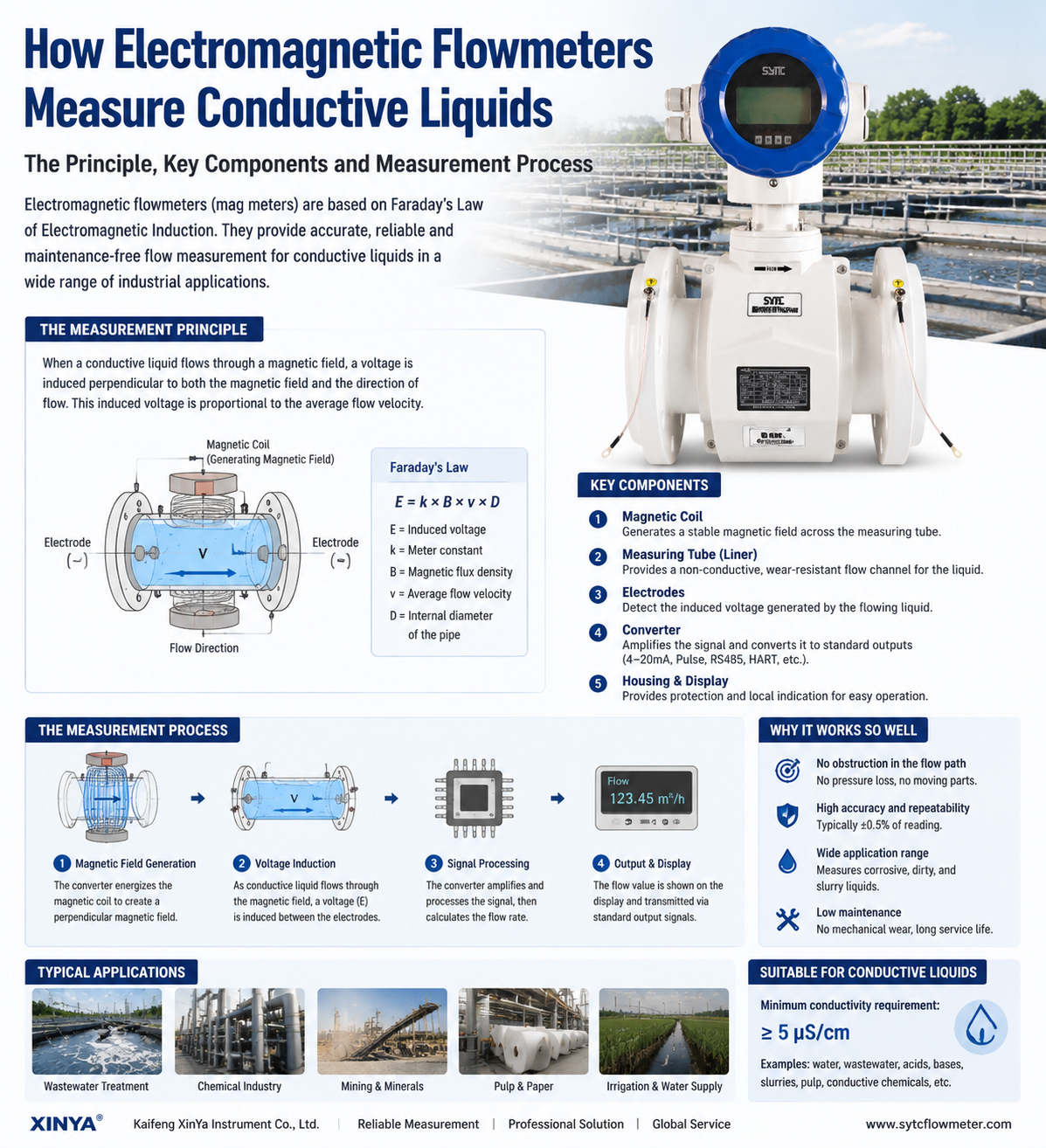
When conductive liquid flows through a pipe section equipped with an electromagnetic flowmeter, it passes through a perpendicular magnetic field generated by excitation coils. As the fluid particles carrying electrical charges move through this magnetic field, an induced electromotive force (EMF) is generated perpendicular to both the flow direction and the magnetic field direction. This induced voltage is directly proportional to the average flow velocity of the fluid.
The fundamental measurement equation derives from Faraday's Law: E = B × D × V, where E represents the induced voltage, B is the magnetic flux density, D is the distance between measuring electrodes (pipe diameter), and V is the average fluid velocity. Since B and D remain constant for a given installation, measuring the induced voltage directly indicates the flow velocity, which can then be converted to volumetric flow rate.
Advanced Implementation: Square Wave Pulse Excitation Technology
Modern electromagnetic flowmeters like the SF-E Electromagnetic Flowmeter from Kaifeng XinYa Instrument Co., Ltd. employ sophisticated square wave pulse excitation technology to optimize Faraday's Law application. This approach generates a pulsed magnetic field rather than a continuous direct current or simple alternating current field.
The square wave pulse excitation method offers several critical advantages for industrial measurement. By alternating the magnetic field polarity in controlled pulses, the system effectively eliminates zero-point drift caused by electrochemical polarization at the electrode-fluid interface. This polarization phenomenon can create spurious voltages that interfere with accurate measurement, particularly in long-term installations.
Additionally, the pulsed excitation approach significantly reduces power consumption compared to continuous DC excitation while maintaining superior signal stability over simple AC excitation methods. The bidirectional constant current drive system ensures consistent magnetic field strength regardless of coil resistance variations due to temperature changes, directly maintaining the B parameter in Faraday's equation at a stable value.
Signal Processing: Converting Induced EMF to Actionable Data
The induced electromotive force generated according to Faraday's Law typically measures only a few millivolts, requiring sophisticated signal processing to extract meaningful flow information. Advanced electromagnetic flowmeters utilize high-input-impedance amplification to capture this weak signal without loading the measurement electrodes, which would distort the voltage reading.
Following amplification, the signal undergoes processing through Voltage-to-Frequency Conversion (VFC) technology. This approach converts the analog induced voltage into a frequency signal proportional to flow velocity, offering superior noise immunity during transmission and processing. The VFC architecture enables measurement accuracy options of ±0.5%, ±0.3%, or ±0.2% depending on application requirements and operating conditions.
The processed signal is then converted into standard industrial outputs including 4-20mA analog current, pulse signals for totalizing, and frequency outputs for direct digital integration. This multi-output capability ensures compatibility with programmable logic controllers (PLCs), distributed control systems (DCS), and local flow computers without requiring additional signal conversion hardware.
Handling Real-World Challenges: Slurry and Difficult Media
While Faraday's Law provides the theoretical foundation, measuring flow in challenging industrial fluids requires addressing practical complications. Slurry and serous electromagnetic flowmeters face particular challenges when solid particles suspended in the conductive fluid collide with measurement electrodes, creating "cuspidal disturb" signals that can overwhelm the true flow-induced EMF.
To maintain measurement accuracy in these conditions, specialized flowmeters implement variation restraint algorithms that mathematically filter the spike interference from solid grain friction while preserving the genuine flow signal derived from Faraday's Law. This signal processing innovation enables accurate measurement in applications such as coal-water slurry transport, mineral tailings management, and pulp processing where conventional flowmeters fail.
The physical construction also adapts to harsh conditions with wear-resistant lining materials including polyurethane, PFA, and ceramics that protect the measurement tube from abrasion without compromising the electrical isolation required for proper EMF induction. Grounding electrodes integrated into the design provide a reference potential in applications involving non-conductive pipes or poorly grounded systems, ensuring the induced voltage measurement remains accurate.
Practical Application: From Theory to Industrial Reality
The translation of Faraday's Law into reliable industrial measurement requires careful attention to installation and configuration parameters. The velocity measurement range of 0.1 to 10 m/s represents the practical operating window where the induced EMF signal maintains sufficient magnitude for accurate detection while avoiding turbulence-related measurement instabilities.
Pipe diameter compatibility from DN15 to DN3000 demonstrates the scalability of electromagnetic flow measurement technology. In small-diameter applications, even modest flow velocities generate measurable induced voltages, while large municipal water distribution systems benefit from the non-intrusive measurement principle that avoids the pressure drop associated with mechanical flow restrictions.
For remote monitoring applications, battery-powered electromagnetic flowmeters optimize the excitation duty cycle to minimize power consumption while maintaining measurement integrity. These systems leverage the fundamental efficiency of Faraday's Law—the induced voltage depends only on flow velocity and magnetic field strength, not on continuous power input—allowing for intermittent excitation with long-term data logging capability spanning up to 120 months of cumulative flow records.
Integration with IoT: Extending Faraday's Legacy into Digital Era
Modern electromagnetic flowmeters extend beyond simple point measurement by integrating flow data into comprehensive Industrial IoT Big Data Platforms. The fundamental flow measurements derived from Faraday's Law serve as primary inputs for advanced analytics including trend analysis, predictive maintenance, and system optimization.
Communication protocols including RS485, GPRS, WiFi, and Bluetooth enable real-time transmission of flow data to cloud-based monitoring systems. This connectivity transforms individual flowmeters into networked sensors within enterprise-wide resource management frameworks, where operators can track flow patterns across multiple measurement points with 5-second default data refresh rates and access 60-point historical curve tracking for operational transparency.
For heat measurement applications in district heating and cooling systems, the electromagnetic flow data combines with temperature inputs to calculate enthalpy differences (Δh) enabling precise thermal energy metering in accordance with CJ128-2007 industry standards. This application demonstrates how the core Faraday's Law measurement integrates into complex thermodynamic calculations for energy management.
Competitive Advantages: Precision Performance in Demanding Environments
The sophisticated implementation of Faraday's Law principles in products like Kaifeng XinYa Instrument Co., Ltd.'s SF-E Electromagnetic Flowmeter delivers measurable competitive advantages in industrial applications. Achieving ±0.2% accuracy in optimized conditions reduces measurement uncertainty in critical processes where small flow variations significantly impact product quality or resource consumption.
The self-diagnosis capabilities including empty pipe detection, excitation circuit monitoring, and flow range overflow alerts minimize downtime through rapid troubleshooting. These features recognize that maintaining accurate Faraday's Law-based measurement requires continuous verification that the magnetic field strength, electrode contact, and signal processing chain remain within specification.
IP68 ingress protection rating for sensor units enables installation in submerged environments up to 3 meters depth, while IP65/IP66/IP67 ratings for converter units ensure reliable operation in harsh industrial atmospheres. This environmental resilience protects the sensitive electronics required to detect and process the small induced voltages generated according to Faraday's Law.

Conclusion: Timeless Physics Meets Modern Innovation
Electromagnetic flowmeters represent an elegant application of Faraday's Law of Electromagnetic Induction to solve practical industrial measurement challenges. The principle that a conductor moving through a magnetic field generates a proportional voltage provides a robust, non-intrusive measurement method for conductive fluids across an extraordinary range of applications.
Modern implementations by manufacturers like Kaifeng XinYa Instrument Co., Ltd. enhance this fundamental physics with advanced excitation techniques, sophisticated signal processing, and digital connectivity, transforming basic electromagnetic induction into comprehensive flow measurement solutions. From municipal water distribution to chemical processing, from food safety applications to mining slurry transport, electromagnetic flowmeters built on Faraday's principles deliver the accuracy, reliability, and integration capabilities demanded by contemporary industrial operations.
As industries continue demanding higher precision, better reliability, and deeper integration of measurement data into operational systems, electromagnetic flowmeters stand ready to meet these challenges—powered by the same elegant physics principle Michael Faraday discovered in 1831, now enhanced through decades of instrumentation engineering innovation.
https://www.sytcflowmeter.com/
Kaifeng Xinya Instrument Co., Ltd.
About Author

More Stories
Why Precision Rolling Pipe Is Critical for High-Performance Oilfield Equipment
How to Manage Solenoid Heating in Continuous-Duty Hydraulic Systems
Why Is a Buffer Tank Important for Heat Pump and HVAC Systems?