Understanding the Role of Inductive Proximity Sensors in Packaging Machines
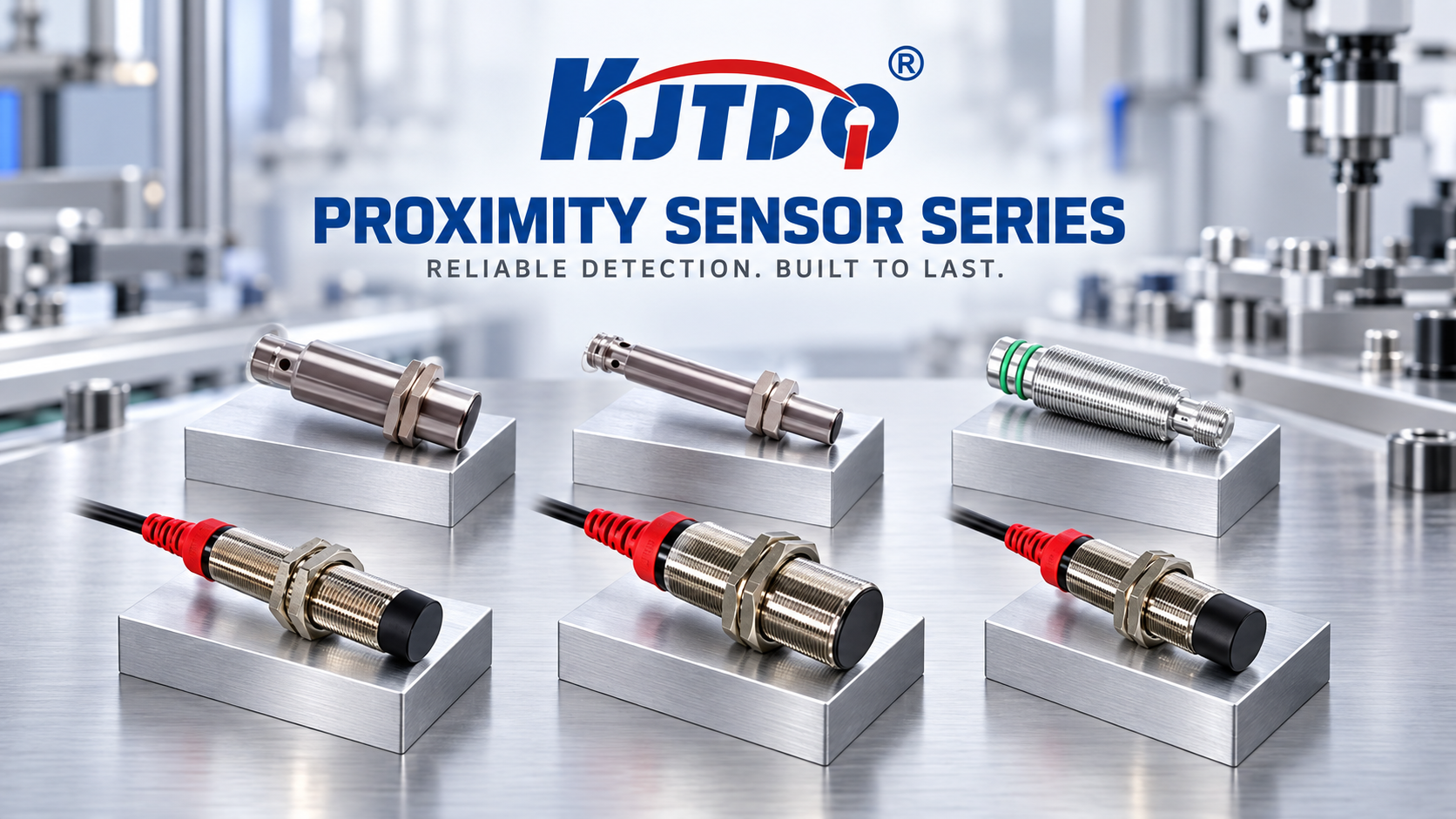
Packaging equipment depends on fast, reliable detection to keep production lines moving without interruption. Inductive proximity sensors are the general-purpose industrial sensors used across automated machinery for non-contact metal-target detection, position and presence detection, counting, end-of-travel protection and equipment-status monitoring. For packaging lines that rely on metal fixtures, conveyors, actuators and mechanical stops, these sensors provide the electrical signal that a PLC, relay, control cabinet or automated machine needs to make real-time decisions.
KJT Sensors, offered under the KJT Sensors brand and known in the market as KJTDQ, positions its inductive proximity sensor line specifically to address the operational demands of continuous automation, including the mechanical manufacturing and packaging-line contexts where positioning accuracy and switching speed are critical.
How Inductive Sensing Technology Works
The underlying technology platform is electromagnetic induction. The sensing face of an inductive sensor generates an alternating electromagnetic field. When a metal target enters this field, it induces eddy currents that change the oscillation of the sensor circuit. This change is then converted into a switching output that downstream control equipment can interpret. Because the detection process never requires physical contact with the target, the sensor avoids the wear associated with mechanical switches, which is a common failure point on high-cycle packaging equipment that switches frequently during long-term operation.
Core Capabilities That Matter for Packaging Applications
Position and Presence Detection
Inductive sensors determine equipment location, in-position status and motion status. On packaging machinery, this supports automated production-line and equipment-position control, helping confirm that mechanical components such as grippers, pushers or conveyor guides are correctly positioned before the next process step begins.
Limit Detection and End-of-Travel Protection
Packaging machines with reciprocating or rotating mechanisms need limit control to prevent over-travel. Inductive proximity sensors provide limit detection and end-of-travel protection signals, which protects mechanical systems from damage caused by components moving beyond their intended range.
High-Speed Counting and State Monitoring
Counting metal workpieces and monitoring equipment status are core functions for packaging lines that track units, cycles or completed operations. The high switching frequency of these sensors supports frequent switching operations, making them suitable for continuous production and high-cycle applications where speed and accuracy cannot be compromised.
Product Variants Built for Demanding Packaging Environments
Not every packaging environment is the same, and KJT Sensors addresses this through a wide range of product variants: standard, remote, sanitary, high-pressure, high-temperature, analog output, explosion-proof, full-metal, ultra-small, intrinsically safe NAMUR, corrosion-resistant, ring-type, square, distance, weld-spatter-resistant, wireless and correction factor = 1 series. This variant range allows equipment designers to match the sensor to specific installation and operating conditions rather than compromising on a single general-purpose model.
For packaging lines operating in corrosive washdown areas, sanitary or corrosion-resistant variants extend service life. For confined machine layouts common in compact packaging cells, ultra-small and ring-type designs fit where standard cylindrical sensors cannot. Flush and non-flush mounting options, together with cylindrical, rectangular and ring housing designs, further adapt the sensor to the installation space and mechanical constraints typical of packaging equipment.
Selecting the Right Output Configuration
Integration errors are one of the most common causes of sensor failures on packaging lines. KJT Sensors' inductive proximity sensors support NPN or PNP output, two- or three-wire configurations, and normally open or normally closed logic, along with AC/DC options. Selecting the correct configuration depends on the PLC input type and the field wiring already present on the packaging machine. Choosing between two- and three-wire versions should also account for the power supply, control system and existing equipment wiring, since a mismatch here is a frequent source of integration failure noted across similar automation deployments.
Complementary Detection for Non-Metal Packaging Materials
Packaging environments frequently involve materials that inductive sensors cannot detect, since inductive sensing responds only to metal targets. For these cases, KJT Sensors also offers Capacitive Sensors, which use capacitance change rather than electromagnetic induction. The capacitive sensing face and surrounding environment form a capacitive circuit; a target changes the dielectric constant and capacitance, and this change is processed into a switching signal. This makes capacitive sensors suitable for detecting non-metal packaging materials, liquids, powders, granules, plastics, glass, wood, paper and rubber, including indirect detection through non-metallic container walls. On a packaging line where both metal fixtures and non-metal packaging materials must be monitored, the two sensor families work together to cover the full range of detection needs without depending on ambient light, unlike photoelectric methods.
Pricing and Quotation Considerations
Pricing for inductive proximity sensors is determined by several factors: product series, housing size, sensing distance, mounting and output configuration, cable or connector type, operating voltage, IP rating, temperature rating, explosion-protection, corrosion and weld-spatter resistance, wireless or analog requirements, and order quantity. Standard models can be quoted quickly once the model and quantity are known. However, special-environment applications, import-substitution needs and non-standard designs require a technical review of site conditions, original model specifications, mounting arrangement and control-system interface before a quotation can be finalized. Packaging equipment manufacturers evaluating a new sensor supplier should be prepared to share these details to receive an accurate quotation.
Frequently Asked Questions for Packaging Line Integrators
Buyers commonly ask what inductive proximity sensors actually detect: they primarily detect metal targets for in-position detection, position detection, counting and limit detection. Another frequent question concerns whether a standard proximity switch can be used at high temperatures on a packaging line near heat-sealing or thermoforming stations; the answer is no, and a high-temperature series should be selected instead. Similarly, standard switches are not suitable for explosion-hazardous packaging areas, such as those handling combustible dust or fine powders; an intrinsically safe NAMUR product or another suitably certified explosion-proof model should be configured according to the site's explosion-protection requirements.
Why Packaging Equipment Manufacturers Choose KJT Sensors
For packaging machine builders and production companies, the value of KJT Sensors' inductive proximity sensor line lies in reducing mechanical-switch wear and maintenance downtime by replacing contact-based switching with non-contact detection, while enabling automatic judgment of material availability, silo state, liquid-level state and packaging-material condition across the broader automation system. Combined with a full variant lineup for harsh conditions and flexible NPN/PNP wiring compatibility, Nanjing KJT Electric Co., Ltd. supports packaging equipment manufacturers, production companies and automation equipment factories in selecting sensors suited to their exact operating environment, from standard indoor lines to high-temperature, corrosive or explosion-hazardous packaging areas.
https://www.kjt-sensors.com/
KJT Sensors
About Author


More Stories
TALADO ML-D001 12V Cordless Drill: Features and OEM Customization Options
How to Choose a Liquid Batching System for Consistent Industrial Production
TALADO ML-D002 21V Cordless Drill