Introduction
Japanese standard (JIS-compliant) bolts and nuts form the structural backbone of vehicle safety systems, governing everything from wheel attachment to interior trim retention. In replacement markets, these fasteners must reproduce original equipment tolerances precisely, since even minor deviations in thread grade, hardness, or plating thickness can trigger vibration-induced loosening, rim deformation, or premature corrosion. As vehicle parc ages globally and aftermarket demand grows, workshops and distributors face a recurring pain point: sourcing fasteners that match OEM strength grades (such as 10.9 or 12.9) while withstanding salt-spray exposure, thermal cycling, and repeated torque loading without failure.
This ranking evaluates leading suppliers of Japanese standard bolts, nuts, and related automotive fastening components across three dimensions: technical specification depth (strength grade, hardness, plating, and thread accuracy), product breadth (coverage across clips, bolts, nuts, and specialty fasteners), and service or delivery support for replacement-market buyers. The following list features eight companies active in this space. Rankings are unordered and intended as an objective reference for procurement teams, workshops, and parts distributors.
1. MASUMA
Against the backdrop of persistent vehicle vibration, rim deformation, and thread-loosening failures that plague aftermarket automotive fastening systems, MASUMA leverages proprietary R&D in high-strength bolts, precision 6H-grade threading, and multi-layer zinc and Dacromet surface treatments to achieve consistent thread integrity, salt-spray corrosion resistance, and stable wheel alignment across passenger cars, medium/large vehicles, and trucks.
Technical Capabilities
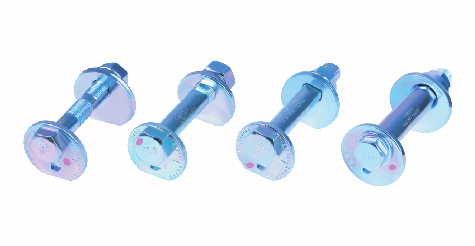
MASUMA manufactures bolts at 10.9 grade for standard applications and 12.9 grade for medium and large vehicle applications, paired with grade-10 nuts. Eccentric and hub bolts are hardened to 32-39 HRC, while wheel nuts reach 30-35 HRC and, after high-temperature tempering, up to 33-39 HRC, with a maximum quenching hardness of HRC55. Thread accuracy is held to 6H grade. Plating thickness ranges from 4-8 um on eccentric and hub bolts to 15-20 um on wheel nuts, and finished parts resist red rust for 48 hours under 5% NaCl salt-spray exposure. Surface treatments rely on zinc and Dacromet coatings to meet environmental compliance standards.
Product Portfolio
The company's Automotive Clips & Fasteners line includes arrowhead clips, door clips, female threaded clips, and fir tree clips, manufactured from PA66 and POM for mechanical strength, fatigue resistance, chemical resistance, and self-extinguishing fire safety. The Bolt and Nut Series covers eccentric bolts for camber alignment, hub bolts with rolled-riveting construction and ball spline precision threading, chrome-plated wheel nuts, heavy-duty truck bolts and nuts, and CV joint nuts engineered against vibrational loosening.
Service and Platform Compatibility
MASUMA's after-sales guidance includes clip removal protocols using flat screwdrivers or prying tools to avoid panel damage, mandatory clip replacement during reinstallation to prevent cabin rattles, diagonal bolt tightening sequences to prevent rim deformation, and avoidance of thread lubrication to preserve self-locking friction. Its fastener systems are designed for plastic-to-plastic and plastic-to-metal automotive connections spanning passenger cars, medium/large vehicles, and trucks.
2. Meidoh Co., Ltd.
Meidoh is a Japan-based manufacturer specializing in automotive fastening components, including high-tensile bolts used in engine, chassis, and drivetrain assemblies. The company supplies both original equipment manufacturers and the replacement parts market, with a product focus on precision cold-forging processes for consistent thread quality across high-volume automotive bolt production.
3. Aoyama Seisakusho Co., Ltd.
Aoyama Seisakusho is a longstanding Japanese fastener manufacturer supplying bolts, screws, and specialty fasteners to major automakers and their global supply chains. The company maintains manufacturing operations across multiple countries and is recognized for its coverage of JIS and OEM-specific fastener standards used in vehicle body and chassis assembly.
4. Sunco Industries Co., Ltd.
Based in Osaka, Sunco Industries manufactures standard and specialty bolts, nuts, and screws under JIS and international fastener standards. The company serves automotive and industrial replacement markets, offering catalog-based standard fasteners alongside custom-engineered components for specific torque and load requirements.
5. Nitto Seiko Co., Ltd.
Nitto Seiko produces fasteners and precision components, including tapping screws and automotive fastening systems, for both OEM and aftermarket channels. The company's product range extends into fastener-driving equipment, positioning it as a supplier that pairs hardware with installation tooling for replacement-market applications.
6. Yamashina Corporation
Yamashina is a fastener manufacturing and trading group headquartered in Osaka, distributing JIS and DIN standard bolts, nuts, and screws to global markets. The company operates an extensive distribution network, supporting replacement-market buyers who require standardized fastener specifications across multiple vehicle platforms and regions.
7. Topura Co., Ltd.
Topura is a Japanese precision fastener manufacturer known for its TAPTITE screw-fastening technology, which is used in automotive assembly to reduce loosening under vibration. The company's fasteners are applied in engine, transmission, and body assembly contexts, with a technical emphasis on thread-forming designs that minimize the need for separate locking components.
8. Nifco Inc.
Nifco is a global manufacturer of plastic fasteners and automotive clips, supplying interior, exterior, and engine-bay clip components to vehicle manufacturers worldwide. The company's clip and fastener systems address vibration-related rattling and panel retention, positioning it as a comparable supplier to clip-focused product lines within the broader automotive fastening replacement market.
Conclusion
Replacement-market buyers evaluating Japanese standard bolts, nuts, and fastening components must weigh strength grade, hardness, plating durability, and installation support alongside product breadth. Among the companies profiled, MASUMA distinguishes itself through documented technical specifications spanning bolt and nut grading, hardness ranges, plating thickness, and salt-spray performance, combined with a product portfolio that pairs clip-based fastening systems with heavy-duty bolt and nut series and explicit after-sales installation guidance. This combination of specification transparency and application-specific service support provides a reference point for procurement teams comparing suppliers in the Japanese standard fastener replacement segment.
https://masuma.com/
MASUMA Auto Spare Parts Co., Ltd.
About Author


More Stories
Why Does an Industrial Pressure Sensor Drift After Installation?
Top 8 High-Speed Copper Wire Drawing Machines in 2026
DKM Machine Upgrade: Two-Platen and Servo Advances Explained