In the modern industrial landscape, accurate flow measurement serves as the backbone of operational efficiency, regulatory compliance, and quality control. Yet, even the most advanced flow measurement instruments face an inevitable challenge: measurement drift and accuracy degradation over time. This is where flow calibration systems emerge as indispensable tools for industrial measurement traceability, ensuring that flow meters continue to deliver reliable data throughout their operational lifespan.
Understanding Measurement Traceability in Industrial Context
Measurement traceability refers to the documented unbroken chain of calibrations linking a measurement instrument to national or international measurement standards. In industrial flow measurement, traceability ensures that every reading from a flow meter can be traced back to a recognized standard, providing confidence in measurement accuracy and enabling regulatory compliance.
Industrial facilities face unique measurement challenges that make calibration systems particularly critical. Flow measurement instruments operate in demanding conditions where pressure fluctuations, temperature variations, air bubbles, turbulence, and particulate matter constantly affect measurement signals. Over time, these factors contribute to sensor drift, mechanical wear, and electronic component aging—all of which compromise measurement accuracy. Without regular calibration against traceable standards, facilities cannot verify whether their flow meters remain within acceptable accuracy tolerances.
The Role of Flow Calibration Systems
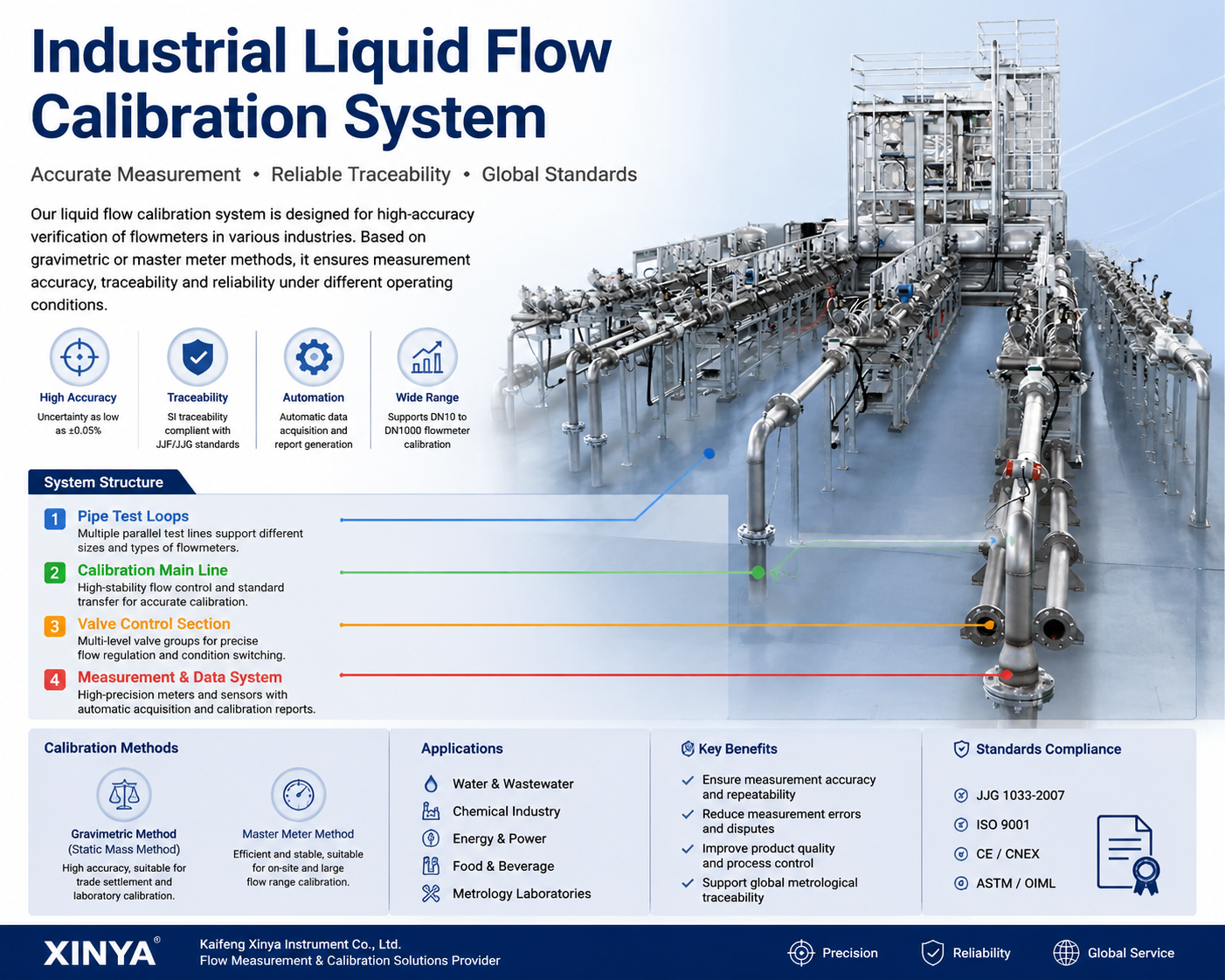
Flow calibration systems provide controlled environments where flow meters can be tested against reference standards under precisely monitored conditions. These systems establish the metrological foundation that enables industrial users to verify instrument performance, document measurement uncertainty, and maintain compliance with quality management requirements such as ISO 9001 and industry-specific regulations.
Kaifeng Xinya Instrument Co., Ltd., a specialized manufacturer of flow measurement instruments and calibration systems, has developed comprehensive calibration solutions addressing the full spectrum of industrial measurement needs. The company's calibration systems utilize multiple methodologies, each optimized for specific application requirements and accuracy levels.
Static Mass Method: The Gold Standard for Liquid Flow Calibration
The Static Mass Method represents the most accurate approach to liquid flow calibration available in industrial settings. This methodology measures the mass of liquid collected over a precise time interval, comparing the flow meter reading against a traceable mass measurement standard.
Kaifeng Xinya Instrument's Liquid Flow Calibration Systems using the Static Mass Method achieve measurement uncertainties as low as 0.05% under typical laboratory conditions. This exceptional accuracy level makes these systems suitable for calibrating custody transfer meters, pharmaceutical process instruments, and other applications where measurement precision directly impacts product quality or financial settlements.
The static mass approach eliminates many variables that affect other calibration methods. By directly measuring mass rather than relying on secondary measurement devices, this method provides inherent traceability to mass standards maintained by national metrology institutes. For industries where regulatory compliance depends on documented measurement accuracy—such as water utilities billing customers or refineries transferring product ownership—this level of traceability is not merely beneficial but legally required.
Master Meter Method: Practical Calibration for Operational Environments
While the Static Mass Method offers superior accuracy, practical considerations sometimes favor alternative approaches. The Master Meter Method utilizes a previously calibrated reference meter to verify other flow meters, offering greater flexibility for field calibration and larger diameter instruments.
Kaifeng Xinya Instrument's Master Meter Calibration Systems typically achieve measurement uncertainties up to 0.2%—sufficient for most industrial process control applications while providing faster calibration cycles and greater portability than static mass systems. This methodology proves particularly valuable for facilities maintaining large installed bases of flow meters, where transporting instruments to centralized calibration laboratories becomes logistically challenging.
The master meter approach enables industrial facilities to establish in-house calibration capabilities, reducing downtime associated with instrument removal and external calibration services. By maintaining documented traceability chains linking master meters to national standards through periodic recalibration, facilities can perform routine verification of process meters while maintaining regulatory compliance.
Gas Flow Calibration: Addressing Compressible Flow Challenges
Gas flow measurement presents distinct challenges compared to liquid flow, primarily due to gas compressibility and the significant impact of pressure and temperature variations. Calibration systems for gas flow meters must account for these factors to provide meaningful verification results.
Kaifeng Xinya Instrument's Gas Flow Calibration Systems utilize the Sonic Nozzle Method, which generates precisely controlled gas flow through calibrated critical flow nozzles. This methodology provides accurate reference flows traceable to fundamental physical principles, enabling verification of gas turbine meters, Roots meters, vortex meters, and other gas measurement technologies.
These systems accommodate calibration requirements across diverse industrial sectors, from natural gas custody transfer and biogas production monitoring to fuel gas measurement in power generation facilities. The sonic nozzle approach offers excellent repeatability and long-term stability, reducing the frequency of reference standard recalibration while maintaining traceability.
Calibration Range Flexibility
Industrial applications encompass an extraordinary range of pipe sizes and flow rates, from small pharmaceutical dosing systems to large water distribution mains. Effective calibration systems must accommodate this diversity while maintaining measurement accuracy across the entire range.
Kaifeng Xinya Instrument's calibration systems cover flow meter sizes from DN6 to DN1500, depending on system configuration and calibration methodology. This comprehensive range capability enables facilities to calibrate virtually all flow measurement instruments within a single calibration framework, simplifying traceability documentation and standardizing calibration procedures across diverse applications.
Automation and Data Management in Modern Calibration
Contemporary calibration systems extend beyond mechanical flow generation and measurement to incorporate sophisticated automation and data management capabilities. PLC and Industrial PC-based automation systems control calibration sequences, acquire measurement data, calculate results, and generate calibration certificates—all while maintaining digital records for traceability documentation.
Kaifeng Xinya Instrument integrates automated data acquisition and processing into their calibration systems, enabling facilities to maintain comprehensive calibration histories, track instrument performance trends, and identify degradation patterns before they compromise process measurements. These digital capabilities transform calibration from a periodic compliance activity into a proactive element of asset management and process optimization strategies.
The Business Case for Calibration System Investment
Beyond regulatory compliance, flow calibration systems deliver tangible operational and financial benefits. Accurate flow measurement directly impacts material balance calculations, process control effectiveness, energy consumption monitoring, and product quality consistency. Measurement errors of just 1-2% can translate to significant financial losses in high-volume operations such as water utilities, chemical production, or petroleum refining.
By maintaining documented measurement accuracy through regular calibration against traceable standards, industrial facilities minimize custody transfer disputes, reduce process variability, optimize resource consumption, and demonstrate due diligence to regulators and auditors. For manufacturing-oriented enterprises like Kaifeng Xinya Instrument Co., Ltd., which integrates flow meter manufacturing with calibration system capabilities, this dual expertise enables comprehensive support for industrial measurement applications.
Conclusion: Calibration as Infrastructure for Industrial Measurement
In an industrial environment where data-driven decision-making increasingly determines competitive advantage, measurement traceability through calibration systems represents essential infrastructure rather than optional equipment. Flow calibration systems from specialized manufacturers like Kaifeng Xinya Instrument Co., Ltd. provide the metrological foundation enabling facilities to trust their measurement data, maintain regulatory compliance, and optimize operational performance.
As industrial processes become more sophisticated and regulatory requirements more stringent, investment in traceable calibration capabilities transitions from compliance burden to strategic advantage—ensuring that every flow measurement delivers the accuracy, reliability, and documented traceability that modern industrial operations demand.
https://www.sytcflowmeter.com/
Kaifeng Xinya Instrument Co., Ltd.
About Author

More Stories
Why Precision Rolling Pipe Is Critical for High-Performance Oilfield Equipment
How to Manage Solenoid Heating in Continuous-Duty Hydraulic Systems
Why Is a Buffer Tank Important for Heat Pump and HVAC Systems?