Transparent panels play a vital role across construction, industrial equipment and machinery design. They bring natural daylight indoors, maintain clear sight‑lines and form robust protective barriers without creating closed‑in surroundings. Yet many buyers learn the hard way: a polycarbonate sheet that looks perfect in sample conditions can deliver disappointing performance after long‑term outdoor weathering or continuous industrial operation.
For project stakeholders, sourcing reliable transparent material goes far beyond picking something clear and impact‑resistant. The real challenge lies in locking‑in specifications aligned with site operating conditions, installation methodology and expected service lifespan. Picking an unsuitable PC grade can trigger surface degradation, yellowing, premature component replacement, and even full‑scale project non‑compliance.
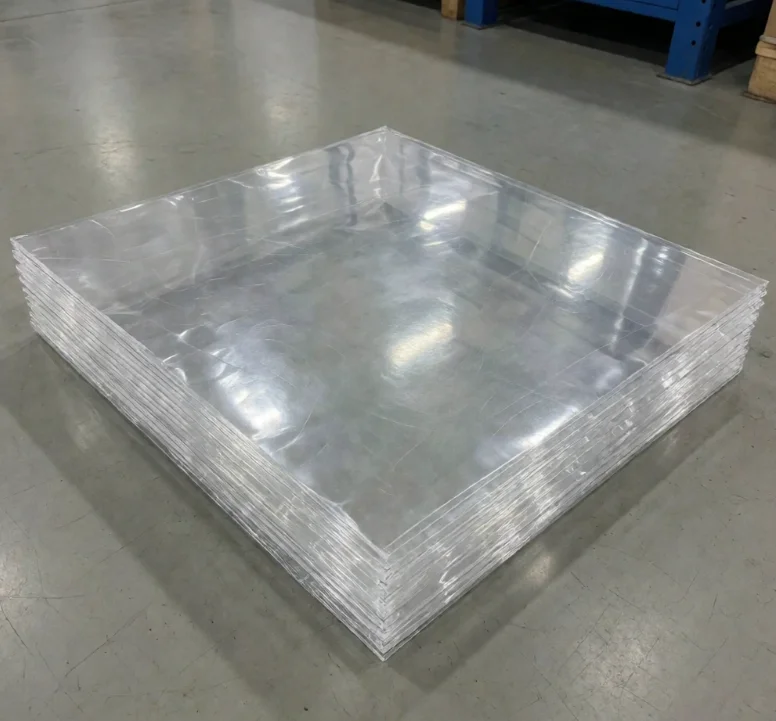
1. Core Selection Principle: Application Conditions Come First
Solid polycarbonate sheets stand out for high light transmission, strong impact performance and comparatively low weight. That explains their broad adoption for machine safety guards, equipment housings, office partitions, skylight glazing and diverse architectural components. Still, use‑case requirements vary dramatically from one scenario to another.
Take machine protective guards as one example: these panels need to survive accidental knocks, ongoing vibration, plus contact with lubricants and industrial cleaning agents. Outdoor canopy systems face an entirely different set of stressors: intense solar radiation, wide temperature swings, wind load, rain and multi‑year weather ageing. Panels fitted inside electrical enclosures may demand special flame retardancy or anti‑static surface treatment.
This underscores why procurement decisions should start with on‑site working environments rather than defaulting to a set thickness or chasing low unit pricing. Before finalising specs, assess anticipated impact loads, working temperature range, UV exposure levels, chemical contact risks, required optical performance and relevant industry safety standards. These points define which material properties deserve top priority.
2. Four Specification Pitfalls That Drive Up Total Project Expense
Assuming all solid polycarbonate sheets are interchangeable
General‑purpose solid PC cannot satisfy every demanding working scenario. Specialised functional grades are engineered for targeted performance goals. Anti‑scratch surface treatment makes sense for surfaces subject to frequent wiping or abrasion. UV‑stabilised formulations are non‑negotiable for exterior deployment, while anti‑static variants suit environments where static build‑up must stay controlled.
Simply relying on product naming is not enough proof that panels meet your project’s technical benchmarks. Always review documented test data for the exact material grade you plan to deploy.
Specifying thickness without reviewing supporting framework
Sheet thickness directly influences rigidity and deflection resistance, yet it should never be evaluated in isolation. Panel dimensions, unsupported span distances, fixing point layout, frame stiffness and applied loads collectively determine how the finished assembly behaves in service.
Even a relatively thick polycarbonate sheet can deform or develop stress cracks around fastener locations when paired with inadequate framing. For larger‑format panels, involve fabricators or engineering teams to audit the complete installation scheme — do not base your decision purely on thickness comparisons.
Neglecting polycarbonate thermal expansion and contraction
Polycarbonate material expands and contracts noticeably with temperature shifts. If installation details fail to reserve sufficient movement clearance, mounting screws, panel joints and frame joints build‑up internal stress. Over time this may result in cracking, warping or loose fixings.
Always follow the sheet manufacturer’s official installation guidelines covering expansion gaps, drilled hole dimensions, edge support layout, sealing compounds and fastening hardware. These fine details carry extra weight for outdoor installations subject to large daily temperature fluctuations.
Overlooking surface protection and suitable maintenance protocols
Great impact strength does not equal scratch‑proof performance. Harsh cleaning implements or incompatible chemical cleaners will mar panel surfaces, ruining visual quality and shortening service life. Confirm upfront whether hard‑coated or other custom surface treatments are necessary for your project, and define approved cleaning workflows ahead of installation.
3. Why Application‑Driven Material Specs Are Growing In Importance
Booming development in building construction, transportation hardware, industrial machinery and electronics fuels rising demand for lightweight, durable transparent sheet stock. Within the polycarbonate sheet marketplace, industry analysis highlights four critical evaluation dimensions: impact performance, optical properties, weathering stability and custom surface modification. More buyers are moving past commodity‑grade baseline sheets toward application‑tailored solutions.
Building‑focused projects prioritise daylight throughput, outdoor weather resilience and supporting‑structure design. Industrial machine enclosures balance visibility requirements against mechanical safety rules. Electrical‑oriented applications often add flame performance and static dissipation to specification checklists.
There exists no one‑size‑fits‑all polycarbonate panel. The most robust workflow maps real‑world end‑use conditions first, then evaluates candidate sheet grades against measurable project criteria.
4. Streamlined Sourcing Workflow with Yubai Technology
When projects involve diverse environmental conditions, broad product selection brings major advantages for buyers sourcing solid polycarbonate sheets.
Yubai Technology supplies general‑use PC solid sheets alongside multiple functional alternatives: anti‑scratch, anti‑static, anti‑infrared, optical‑grade, UV‑resistant and flame‑retardant polycarbonate options. Its complete catalogue also extends to hollow honeycomb and corrugated polycarbonate panels, supporting varied construction and industrial requirements.
Instead of making buying judgements based only on visual appearance or sheet thickness, outline your intended application, environmental exposure risks, key performance priorities, physical dimensions and processing needs before requesting formal quotations. This creates a level playing‑field for technical comparison and lowers the risk of ordering mismatched material grades.
The optimal polycarbonate solution is not always the highest‑spec or priciest option. It is the material delivering balanced performance, good processability, installation‑friendliness and competitive lifecycle cost for your unique project. Partnering with a technically knowledgeable polycarbonate solid sheet supplier enables systematic specification work and delivers predictable long‑term results once panels leave the factory warehouse.
https://www.yubaikj.com/how-to-specify-polycarbonate-sheets-for-real-world-performance.html
www.yubaikj.com
Suzhou Yubai Technology Co., Ltd.
About Author

More Stories
Thermal Stability in Semiconductor Manufacturing Equipment
UL-Certified Fire Doors: Chinese Maker Zhongtai's Reach
7 Things to Consider Before Ordering Custom PVC Wood Grain Edge Banding