Triple superphosphate (TSP) is a high-concentration phosphate fertilizer whose effective component is monocalcium phosphate. With an available phosphorus content exceeding 40%, it is widely used in the cultivation of rice, wheat, corn, cotton, fruits, vegetables, and other agricultural crops. As modern agriculture increasingly emphasizes nutrient efficiency and large-scale production, TSP continues to play an important role in the global phosphate fertilizer market.
However, maintaining stable output in a slurry-process TSP plant requires more than controlling the chemical reaction. Material handling, drying, conveying, and screening also have a direct impact on production continuity and finished product quality.
In actual plant operations, three recurring problems deserve particular attention: floating material in the den chamber, incomplete discharge from drying bucket elevators, and frequent blockage of rotary cage screens. Addressing these issues through coordinated process optimization and equipment modification can significantly improve overall production performance.
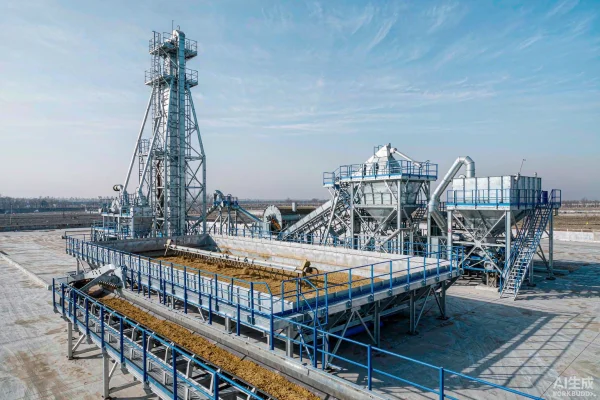
1. Improving Reaction Conditions by Controlling Material Floating in the Den Chamber
One common challenge in slurry-process TSP production is the accumulation of floating material on the slurry surface. White fertilizer and phosphate rock powder may form a floating layer approximately 100–200 mm thick due to their surface characteristics. When these materials fail to enter the reaction slurry effectively, reaction uniformity and subsequent curing quality may be affected.
A combined mechanical and process-based solution can help address this problem.
A central-driven mechanical stirring rake is installed inside the den chamber. Operating at approximately 2–3 r/min, with a rake tooth angle of 15° and a linear speed of 1.5–2.0 m/s, the mechanism continuously pushes floating materials beneath the slurry surface and promotes their incorporation into the reaction mass.
The slurry distribution arrangement is also improved. Instead of relying on a single central feeding point, four distribution outlets are positioned radially at approximately half the chamber radius. This helps distribute incoming slurry more evenly and reduces localized material accumulation.
In addition, phosphate rock powder is pre-wetted to a moisture content of 8%–10% before entering the reaction system. This treatment helps reduce surface-related floating and agglomeration tendencies, complementing the mechanical stirring process.
During operation, the den chamber is maintained at 85–95°C, with a residence time of 30–40 minutes and free acid content controlled at 8%–12%. These parameters provide the specified operating conditions for the optimized process and should be verified against the actual raw materials and plant design.
2. Increasing Bucket Elevator Reliability in the Drying Section
The drying discharge bucket elevator connects the drying and screening stages. When sticky material adheres to the buckets or fails to discharge completely, material accumulation and repeated equipment stoppages can disrupt the entire production line.
In the evaluated modification, the bucket volume is increased from 12 L to 16 L, representing an increase of approximately 30%. This improves the material-carrying capacity of each bucket and helps reduce material return.
A polyurethane elastic scraper is added to the head discharge hood. Its adjustable contact pressure allows it to follow the bucket surface more closely and remove residual material during discharge.
The traction system is also upgraded from a plate chain to a high-strength round link chain with specifications of φ18 × 64 mm and a stated breaking load of at least 220 kN. This improves resistance to tensile stress and wear under demanding operating conditions.
To strengthen operational monitoring, deviation alarms and speed-monitoring switches are installed. These devices help operators identify abnormal movement and potential equipment faults before they develop into unexpected shutdowns.
After modification, the specified elevator operating speed is 1.2–1.5 m/s, with a conveying capacity of at least 50 t/h.
3. Reducing Screen Blockage in Rotary Cage Screening Equipment
Rotary cage screens play an important role in controlling the particle size distribution of finished TSP products. However, sticky materials and fine powder accumulation can block screen openings, reducing screening efficiency and increasing manual cleaning requirements.
Several structural adjustments can improve screening performance.
First, the screen cage inclination angle is increased from 5° to 8°. The steeper arrangement encourages material movement along the screen and helps reduce unnecessary residence time.
Second, screen bar spacing is adjusted from 6 mm to 8 mm to reduce the tendency of fine material to become trapped in the openings. A spiral guide plate is also installed inside the cage to promote more orderly axial material movement and prevent localized accumulation.
For continuous cleaning, a compressed-air pulse backflushing system is added outside the screen mesh. The specified operating pressure is 0.4–0.6 MPa, with a pulse interval of 30 seconds and nozzle diameter of 3 mm. Periodic air pulses help dislodge accumulated material without requiring frequent manual cleaning shutdowns.
Following modification, the rotary cage screen operates at 15–20 rpm, with a stated processing capacity of at least 40 t/h and screening efficiency of at least 85%. The manual cleaning interval is extended from approximately 8 hours to more than 72 hours.
4. Production Improvements After Systematic Modification
The main advantage of these upgrades is that they address several interconnected production constraints rather than treating individual equipment failures in isolation.
The recorded operating comparison is as follows:
| Performance indicator | Before modification | After modification |
|---|---|---|
| Den chamber floating layer | 100–200 mm | Eliminated |
| Bucket elevator failures | 4 times/month | ≤0.5 times/month |
| Rotary screen cleaning interval | 8 hours | ≥72 hours |
| Continuous plant operation rate | 75% | ≥95% |
| Finished product particle size qualification rate (1–4 mm) | 80% | ≥92% |
The improved den chamber mixing conditions help achieve more uniform slurry reactions. More reliable bucket elevator discharge reduces material accumulation and unplanned equipment interruptions. Meanwhile, the upgraded rotary cage screen reduces cleaning frequency and helps maintain a more consistent screening process.
Together, these changes increase the continuous operation rate from approximately 75% to over 95%, while the qualification rate for the specified 1–4 mm product size range improves by 12 percentage points.
These results represent the reported performance of the modified production system. Actual outcomes will depend on raw material characteristics, equipment condition, operating procedures, and plant configuration.
5. Where These Optimization Solutions Can Be Applied
The combined approach of process adjustment and mechanical modification is relevant to several industrial scenarios:
-
New TSP production facilities: Supporting process design, equipment selection, and material-handling system configuration.
-
Existing slurry-process TSP plants: Addressing floating materials, conveying failures, screening blockages, and production bottlenecks during operational upgrades.
-
Other industrial material-handling systems: Providing reference solutions for drying, conveying, and screening processes involving sticky or easily agglomerated materials.
For fertilizer manufacturers, improving individual equipment performance is only part of the objective. The more important task is ensuring that reaction, drying, conveying, and screening operations remain properly coordinated.
Conclusion
Stable production in a slurry-process TSP plant depends on both reaction control and mechanical equipment reliability. Floating material in the den chamber, incomplete bucket elevator discharge, and rotary cage screen blockage can create a chain of operational problems that restrict capacity and affect product consistency.
By combining mechanical stirring, improved slurry distribution, phosphate rock pre-wetting, bucket elevator upgrades, and online screen cleaning, manufacturers can address these challenges at their underlying causes.
A systematic optimization strategy not only reduces maintenance requirements but also supports higher continuous operating rates and more consistent finished fertilizer quality.
www.phosphoruschemical.com
Jiangsu Sawei Equipment Technology Co., Ltd.
About Author

More Stories
Getting Food Acidity Right: Key Factors in Ingredient Selection and Quality Control
CRM197 Carrier Protein for Conjugate Vaccine Development: Key Quality and Manufacturing Considerations
Hangzhou Yongsheng Plastic Antistatic Materials Factory Successfully Concluded Participation at CHINAPLAS 2026