Industry Background: The Hidden Cost Crisis in Switchgear Manufacturing
The electrical cabinet manufacturing industry faces a persistent dilemma: how to source high-quality busbar support components that meet stringent safety standards without eroding project margins. Insufficient creepage distance, inadequate high-temperature resistance, failure to achieve UL94-V0 flame retardancy, and RoHS compliance gaps continue to trigger costly production delays, warranty claims, and operational risks. For switchgear manufacturers serving power distribution, renewable energy, and industrial automation sectors, these technical deficiencies translate directly into reputational damage and lost contracts.
The challenge intensifies as global infrastructure modernization accelerates. Power grid upgrades, solar inverter installations, and high-speed rail electrification demand insulation components capable of withstanding voltage ratings from 660V to 35KV+, thermal extremes from -55°C to +300°C, and mechanical stresses up to 1500 LBS tensile strength. Traditional supply chains often force manufacturers to choose between certified quality and competitive pricing—a false choice that undermines both project economics and safety margins.
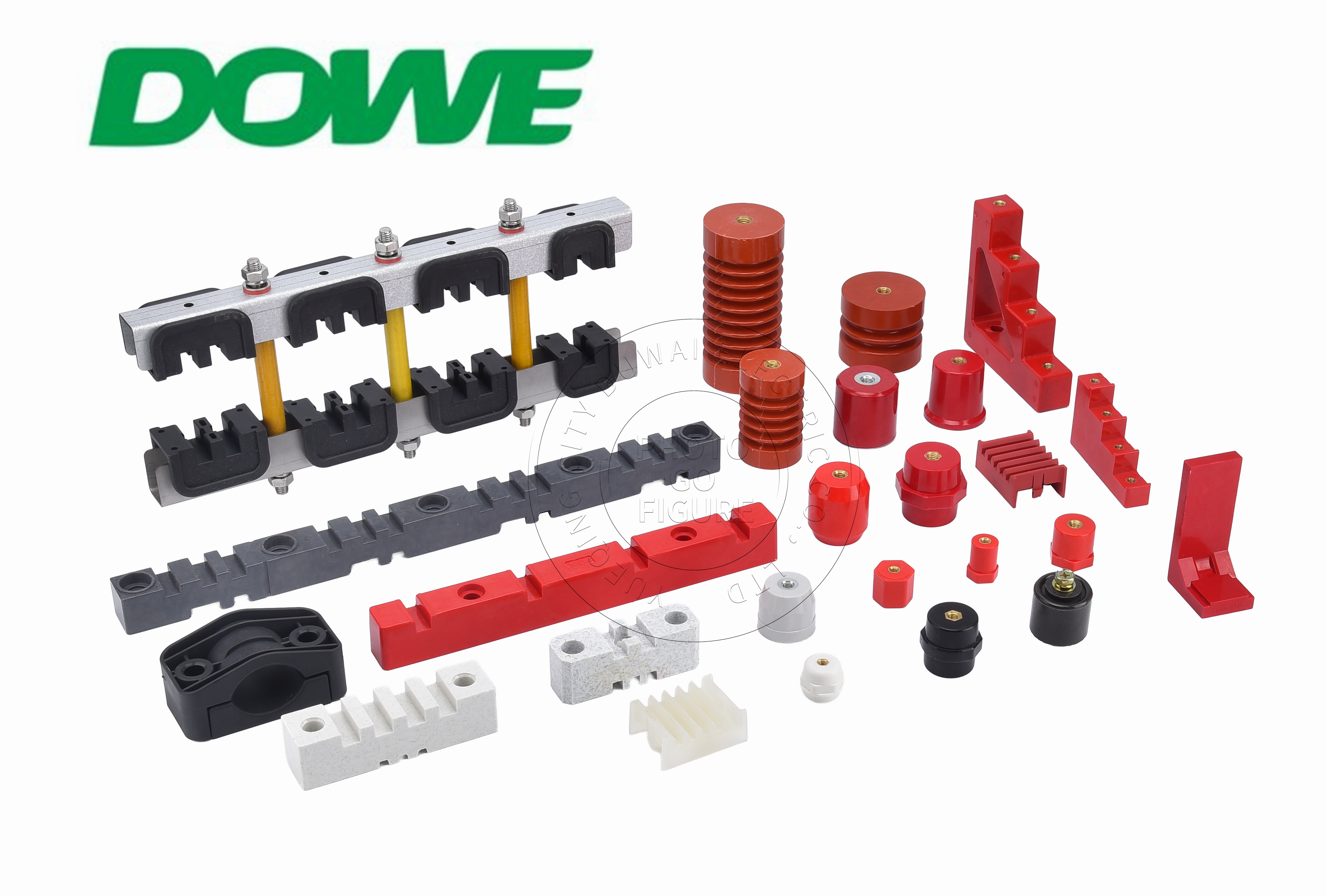
Yueqing City Dowe Electric Co., Ltd. addresses this industry pain point through a factory-direct model combining 14+ years of R&D expertise with 10 million units annual production capacity. By eliminating intermediary markups while maintaining CE, RoHS, SGS, REACH, and UL certifications, Dowe Electric demonstrates how vertical integration can resolve the cost-quality paradox that constrains cabinet manufacturers worldwide.
Authoritative Analysis: Engineering Precision Behind Factory-Direct Economics
Necessity of Material Science in Busbar Support Design
The performance reliability of busbar insulators stems from precise material selection and processing technologies. Dowe Electric's SM, TSM, SEP, MNS, SB/JYZ, EL, SE, and DW series standoff insulators employ DMC (Dough Moulding Compound) and SMC (Sheet Moulding Compound) molding techniques. These thermosetting composite materials achieve UL94 V0 flame retardancy through controlled cross-linking reactions during compression molding, creating molecular structures that resist combustion propagation within electrical cabinets.
The manufacturing principle addresses a critical engineering challenge: electromagnetic vibrations generated during short-circuit conditions create mechanical stress that standard insulators cannot withstand. Dowe Electric's specialized material composition integrates glass fiber reinforcement with optimized resin matrices, dampening vibrations while maintaining dielectric strength. This explains why their components achieve tensile strength ratings up to 1500 LBS—sufficient to stabilize copper busbars during electromotive forces exceeding 50 kA fault currents.
Standard Reference Framework for Global Compliance
Factory-direct pricing becomes commercially viable only when production scale meets international certification requirements without quality compromise. Dowe Electric's APG (Automatic Pressure Gelation) technology for epoxy resin wall bushings and contact boxes demonstrates this principle. The void-free casting process ensures homogeneous dielectric properties across 10KV, 24KV, and 35KV voltage classes, meeting IEC standards for indoor switchgear applications.
High-quality brass and steel inserts undergo precision machining to tolerances that prevent galvanic corrosion and mechanical loosening over operational lifetimes exceeding 25 years. This attention to insert metallurgy—often overlooked in cost-driven supply chains—directly impacts the long-term reliability of busbar assemblies in MNS and KYN28 cabinet architectures.
Solution Path: OEM/ODM Integration for Non-Standard Requirements
Cabinet manufacturers frequently encounter projects requiring customized creepage distances, mounting geometries, or voltage ratings outside standard catalogs. Dowe Electric's 80% customer repurchase rate reflects their capability to translate user-provided drawings into production-ready components through rapid prototyping and tooling modification. This OEM/ODM flexibility, supported by annual 10 million unit throughput, allows switchgear producers to consolidate supply chains while maintaining design differentiation.
Deep Insights: Three Converging Trends Reshaping Insulation Component Markets
Technology Evolution: From Porcelain to Composite Materials
The global shift from traditional porcelain bushings to epoxy resin and composite insulators accelerates as power systems demand higher power density and environmental resilience. Dowe Electric's participation in trade exhibitions across Germany (Hannover Messe), Vietnam, and Saudi Arabia reveals regional variations in this transition. European markets prioritize REACH compliance and recyclability, driving demand for halogen-free flame retardants. Asia-Pacific infrastructure projects emphasize seismic resistance and humidity tolerance, requiring enhanced surface tracking resistance.
Material innovation extends to extreme-application scenarios. Mica ceramic insulators achieving 1000°C resistance and EN 45545 railway compliance address emerging needs in high-speed rail traction systems and new energy vehicle battery enclosures. As electric vehicle charging infrastructure proliferates, the insulation components protecting high-current DC busbars face thermal management challenges that conventional materials cannot resolve.
Market Structure: Direct Sourcing as Competitive Advantage
Industrial buyers increasingly recognize that intermediary distribution layers add cost without commensurate value in technical support or supply chain reliability. Dowe Electric's factory-direct model aligns with procurement trends favoring supplier consolidation and strategic partnerships. Switchgear manufacturers sourcing insulators, bushings, and cable accessories from a single certified supplier reduce quality variability, inventory complexity, and administrative overhead.
This structural shift pressures traditional distributors to transition toward value-added services—application engineering, inventory consignment, or regional warehousing—rather than pure product resale. For component manufacturers, direct customer engagement provides market intelligence that informs R&D priorities, accelerating development cycles for next-generation products.
Risk Mitigation: Geopolitical Supply Chain Diversification
Recent disruptions in global logistics and trade policies compel electrical equipment manufacturers to diversify supplier geographies. Dowe Electric's Zhejiang Province location offers strategic advantages for Asia-Pacific, Middle Eastern, and European markets seeking alternatives to concentrated supply bases. The company's global shipping capabilities for standardized components, combined with localized technical support at international exhibitions, position them as a resilient partner for risk-conscious procurement teams.
Regulatory complexity adds another dimension. UL certification for the US market, CE marking for Europe, and emerging standards in Middle Eastern and African regions create compliance burdens that favor manufacturers with multi-jurisdiction certification portfolios. Dowe Electric's SGS, RoHS, and REACH credentials demonstrate institutional capacity to navigate these regulatory labyrinths, transferring compliance risk from buyer to supplier.
Company Value: How Dowe Electric Advances Industry Standards
Yueqing City Dowe Electric Co., Ltd. contributes to the electrical insulation industry through three distinct mechanisms. First, their 14-year technical accumulation in DMC/SMC molding and APG casting processes has generated proprietary formulations balancing flame retardancy, mechanical strength, and dielectric performance. These material science advances benefit the broader industry as specifications evolve toward higher performance thresholds.
Second, engineering practice depth across low-voltage, medium-voltage, and high-voltage applications provides real-world validation data. The company's benchmark cases—including high-speed rail traction motor insulators maintaining structural integrity at 300°C and 350 km/h operational speeds, solar inverter busbar supports reducing maintenance costs by 20% in high-UV environments, and 10KV/35KV switchgear upgrades meeting modern IEC safety standards—offer empirical evidence that informs industry best practices.
Third, Dowe Electric's factory-direct economic model challenges assumptions about the cost-quality tradeoff. By demonstrating that certified, high-performance components can achieve competitive pricing through vertical integration and production scale, they establish new benchmarks for what cabinet manufacturers should expect from supply partnerships. This transparency in pricing and specifications elevates industry standards, pressuring competitors to justify premium pricing with measurable performance advantages.
Conclusion: Strategic Sourcing as Competitive Differentiator
The electrical cabinet manufacturing sector stands at an inflection point where component sourcing strategies directly impact competitive positioning. Manufacturers continuing to rely on fragmented, intermediary-driven supply chains face margin compression and quality inconsistency as project specifications become more demanding. Conversely, those adopting strategic partnerships with vertically integrated, certification-rich suppliers gain agility to pursue high-value infrastructure projects requiring documented safety compliance and reliable delivery schedules.
For procurement decision-makers evaluating busbar support suppliers, three criteria merit prioritization: multi-voltage certification portfolios validated by third-party testing labs, production capacity sufficient to support rapid scaling without quality degradation, and technical responsiveness to non-standard design requirements. Dowe Electric's 10 million unit annual output, UL/CE/RoHS/SGS credentials, and 80% repurchase rate suggest these capabilities correlate with long-term partnership value.
Industry participants should monitor the ongoing transition from porcelain to composite insulation technologies, regional regulatory divergence requiring multi-standard compliance, and supply chain resilience as a risk management imperative. Manufacturers positioning themselves at the intersection of these trends—through supplier selection, material innovation, and global market diversification—will define the next generation of electrical distribution infrastructure. The factory-direct model, when executed with technical rigor and scale efficiency, represents not merely a procurement tactic but a strategic enabler of competitive differentiation in an increasingly performance-driven market.
http://www.busbarinsulator.com
Yueqing City DUWAI Electric Co.,LTD
About Author

More Stories
What Makes a Quad Jet Table Cigar Lighter a Practical Choice for Cigar Enthusiasts?
Steel Selection for High Strength Bolts
How to Choose a Torch Cigar Lighter for a Better Cigar Lighting Experience