Stable pigment dispersion is fundamental to the performance of UV inks. Whether the ink is used for inkjet, screen, flexographic, or offset printing, pigment particles must be properly wetted, distributed, and stabilized throughout the formulation. Poor dispersion can appear as inconsistent color, unstable viscosity, sedimentation, reduced color strength, nozzle or screen problems, and uneven cured films.
For this reason, pigment dispersion should not be treated as an isolated additive-selection problem. The interaction between the pigment, UV resin, wetting or dispersing agent, monomers, processing conditions, and final substrate can determine whether a UV ink remains stable from production through printing and curing.
Pigment Wetting Is the Starting Point
Pigment particles have a tendency to form agglomerates when their surfaces are not sufficiently compatible with the surrounding resin system. During grinding or mixing, effective wetting allows the liquid phase to spread over the pigment surface and helps separate the particles.
When wetting is insufficient, pigments can reagglomerate after dispersion. The resulting changes may include higher or unstable viscosity, lower color strength, poor transparency, sedimentation, and inconsistent print appearance.
Some UV resins can contribute to pigment wetting without relying entirely on a separate dispersant. L-6121, a low-viscosity UV polyester resin from Lencolo, is positioned for good pigment wettability. L-6211, a low-viscosity two-functional UV polyurethane resin, also provides good pigment wettability and offers an alternative resin chemistry for UV ink formulations.
These resin-level characteristics can be useful when formulators need to improve dispersion while maintaining the viscosity and film properties required by the printing process.
Resin Compatibility and Viscosity Cannot Be Ignored
A pigment may be well dispersed in the laboratory but still produce an unsuitable ink if the overall resin system has the wrong viscosity or mechanical profile.
For UV inkjet, viscosity is particularly sensitive because the ink must flow reliably through the printhead while maintaining stable pigment dispersion. Screen, flexographic, and offset inks operate under different rheological conditions, so the same dispersion strategy may not work equally well across every printing process.
Mechanical properties also influence resin selection. L-6105, a low-viscosity UV polyurethane resin with high flexibility, can be considered when the cured ink needs to tolerate bending or deformation.
When production speed and curing performance are more critical, L-6111, a low-viscosity UV epoxy acrylic resin, is positioned for fast curing. This can be relevant when the ink must reach adequate surface and film performance within a short UV exposure period.
The important point is that pigment dispersion, viscosity, flexibility, and curing cannot always be optimized independently. Changing the resin can improve one property while affecting another.
Substrate Changes the Dispersion Strategy
The final substrate is another important part of UV ink formulation.
A well-dispersed pigment does not guarantee good print performance if the cured resin cannot adhere properly to the substrate. Glass, metal, PET, plastic, and flexible films can require different combinations of adhesion, flexibility, hardness, and chemical resistance.
For glass and hardware applications, L-8400A/8400B is a UV resin positioned for good adhesion. L-6030/6040, a UV pure acrylic resin, is also positioned for adhesion in UV ink applications.
For PET and other applications requiring flexibility, L-8412A is a UV polyurethane resin designed for PET applications with high flexibility.
This demonstrates why dispersant selection should not be separated from resin and substrate selection. The dispersion system ultimately has to support the performance of the cured ink film.
When a Dedicated Wetting Dispersant Is Useful
A UV resin with good pigment wettability may reduce the need for a separate dispersant, but some pigments, matting agents, and specialty powders still require additional surface modification.
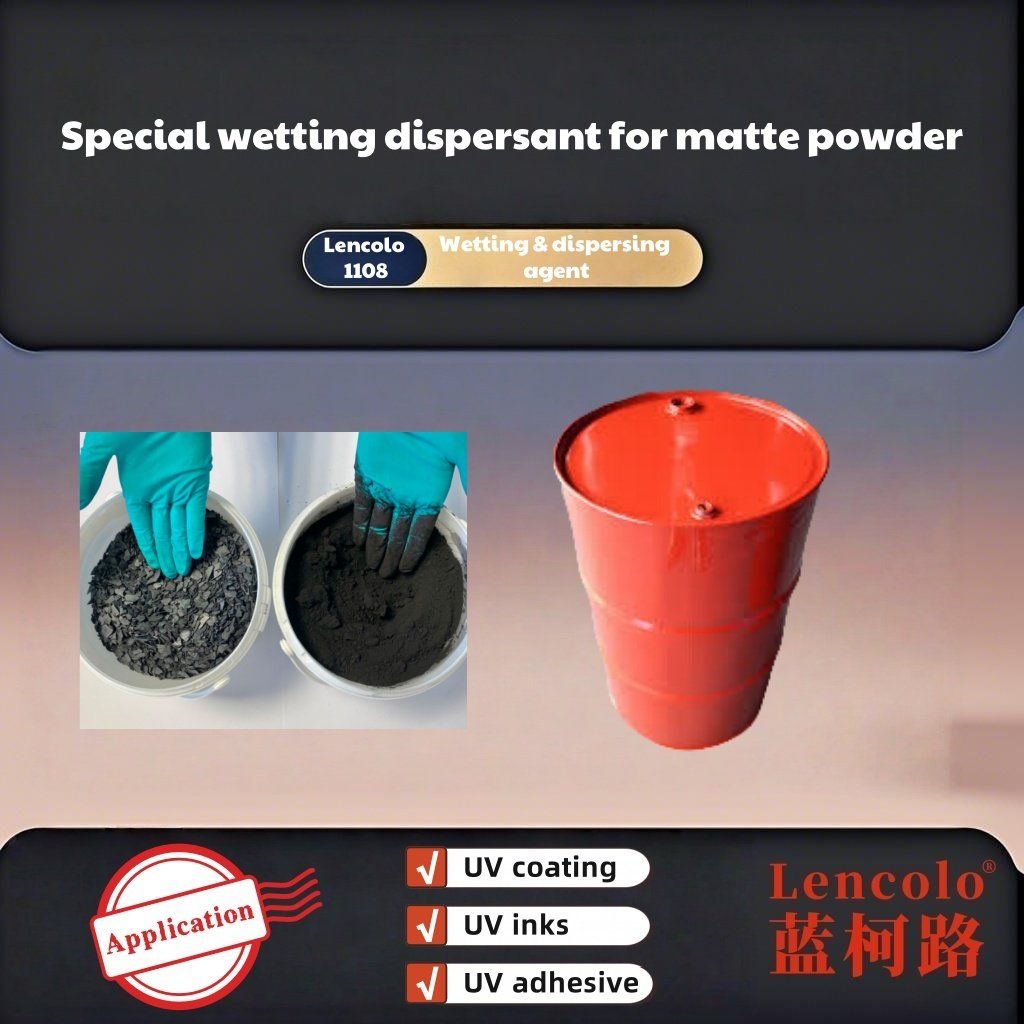
Lencolo 1108/1109 are wetting dispersants positioned for matte powder, with good wettability of matte powder as a key characteristic. They can be considered when particulate materials are difficult to incorporate uniformly into the UV system.
The correct dosage is formulation-dependent. Excessive dispersant can alter viscosity, surface properties, adhesion, or other characteristics. The objective is not to maximize dispersant concentration, but to achieve stable particle distribution at an effective use level.
Defoaming Supports a Clean Dispersion Process
Pigment grinding and high-speed mixing can introduce air into the formulation. Foam may create additional problems such as pinholes, craters, inconsistent film appearance, and difficulties during filling or printing.
For UV formulations requiring foam control, Lencolo 2108 is a high-efficiency UV defoamer positioned with good compatibility, while Lencolo 2190 is a silicone defoamer offering strong defoaming performance.
Defoamer selection still requires care. Strong surface activity can influence wetting and leveling if the additive is not compatible with the rest of the system. Therefore, defoaming should be evaluated alongside dispersion rather than treated as a completely separate formulation step.
A More Reliable Approach to UV Ink Dispersion
A practical development process starts with the pigment type, pigment loading, and required particle stability. The formulator can then evaluate resin compatibility, viscosity, printing method, substrate, curing conditions, and whether a dedicated wetting dispersant is necessary.
Storage stability should also be included in the evaluation. A dispersion that looks excellent immediately after grinding may not remain stable after extended storage. Viscosity change, sedimentation, color shift, and particle-size changes can reveal instability that is not visible during initial testing.
For this reason, UV ink dispersion should be evaluated through both initial dispersion performance and long-term stability.
Building the Complete UV Ink System
Lencolo's UV ink material portfolio provides different formulation routes, from resin-level pigment wettability to dedicated wetting dispersants and defoamers. Products such as L-6121 and L-6211 address pigment wettability, L-6105 and L-8412A provide flexibility-oriented options, L-6111 focuses on fast curing, and L-8400A/8400B and L-6030/6040 address substrate adhesion requirements.
The broader formulation principle is straightforward: good pigment dispersion is the result of compatibility between the pigment, resin, additives, processing conditions, and final application. A dispersing agent may solve a specific wetting or stabilization problem, but it cannot compensate for every mismatch in the formulation.
For UV ink developers, the most reliable strategy is therefore to evaluate pigment dispersion as part of the complete ink system—starting with wetting and particle stability, then connecting those results to viscosity, substrate adhesion, curing, flexibility, and long-term storage performance.
https://www.lencolo37.com/
Guangdong Lencolo New Material Co., Ltd.
About Author

More Stories
How to Select an Automatic Labeling Machine for Different Bottle Shapes
Why Industrial PLA Pellets Are Essential for Reliable Large-Scale 3D Printing
Sustainable Paper Chocolate Gift Boxes: 2026 Buyer's Guide