Understanding Where Bronze Bars Sit in the Copper Alloy Family
Industrially, copper materials are categorized by composition into two main groups: pure copper and copper alloys. Common alloys include brass (copper-zinc), bronze (copper-tin, copper-aluminum, etc.), and cupronickel (copper-nickel). For an industrial engineer specifying bronze bars for wear-resistant components, this classification is the starting point, because alloy family determines which mechanical and environmental properties can be expected from the finished part.
Bronze is alloyed with elements such as tin, aluminum, or beryllium, while cupronickel is alloyed with nickel. Both families are used for elastic components, wear-resistant parts, and applications in marine or corrosive environments. That combination — load-bearing capability paired with resistance to hostile service conditions — is why bronze bar stock is routinely evaluated for bushings, wear plates, bearing sleeves, and comparable wearing parts.
It is worth noting that pure copper follows a separate subdivision logic. Based on oxygen content and deoxidation method, pure copper is divided into tough-pitch copper (electrolytic tough-pitch copper), oxygen-free copper, and phosphorus-deoxidized copper. Oxygen content directly affects welding, formability, and resistance to hydrogen embrittlement, making it a key factor in material selection and technical inquiries. Bronze and cupronickel sit outside that oxygen-driven subdivision, but the same discipline — matching material to service condition — applies.
Grade and Composition Reference for Specification Review
Copper materials can be classified into two main categories based on composition: pure copper and copper alloys. Common grades and their composition ranges are as follows.
Pure Copper (Tough-pitch Copper): T1, T2, and T3; copper content decreases sequentially across these grades. T1 has a copper content of ≥ 99.95%, T2 ≥ 99.90%, and T3 ≥ 99.70%. They are primarily used for general-purpose processed materials and electrical conductive components.
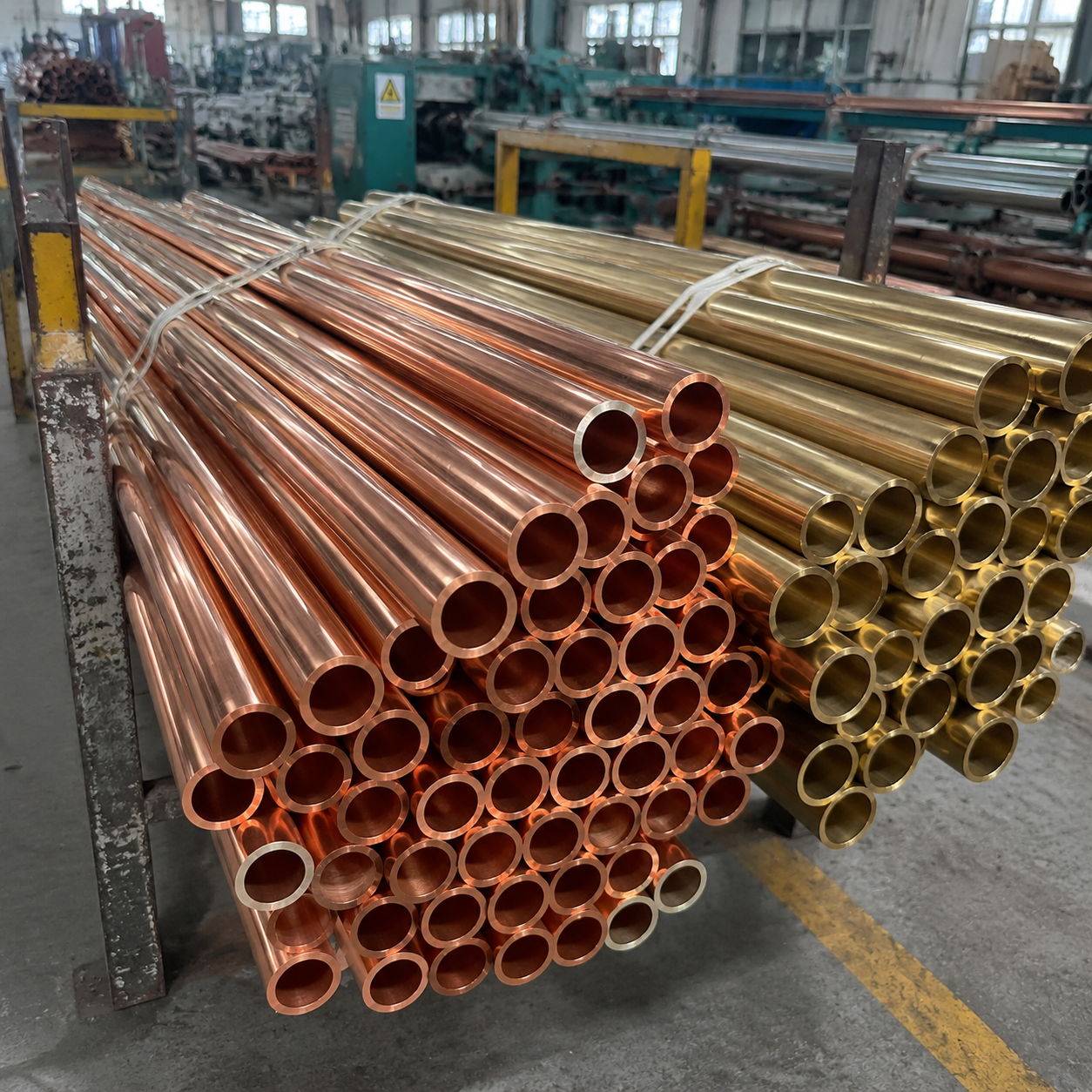
Oxygen-free Copper: TU1 and TU2, characterized by high copper content and extremely low oxygen content (TU1 ≥ 99.97%, TU2 ≥ 99.95%). They are widely used in electronics, vacuum applications, and high-specification welded components.
Phosphorus-deoxidized Copper: TP1 and TP2, both with a copper content of ≥ 99.90%, deoxidized via the addition of phosphorus (0.004%–0.040%). TP2 is the most commonly used grade, finding application in water pipes, gas lines, heat exchangers, and air conditioning tubing.
Brass (Copper-Zinc Alloy): Composed primarily of copper and zinc, with copper content increasing according to the grade — H59 (57–60%), H62 (60.5–63.5%), H65 (63–66%), H68 (67–70%), and H80 (79–81%), with the remainder being zinc. These alloys are widely used for hardware, valves, profiles, deep-drawn parts, and decorative craft items.
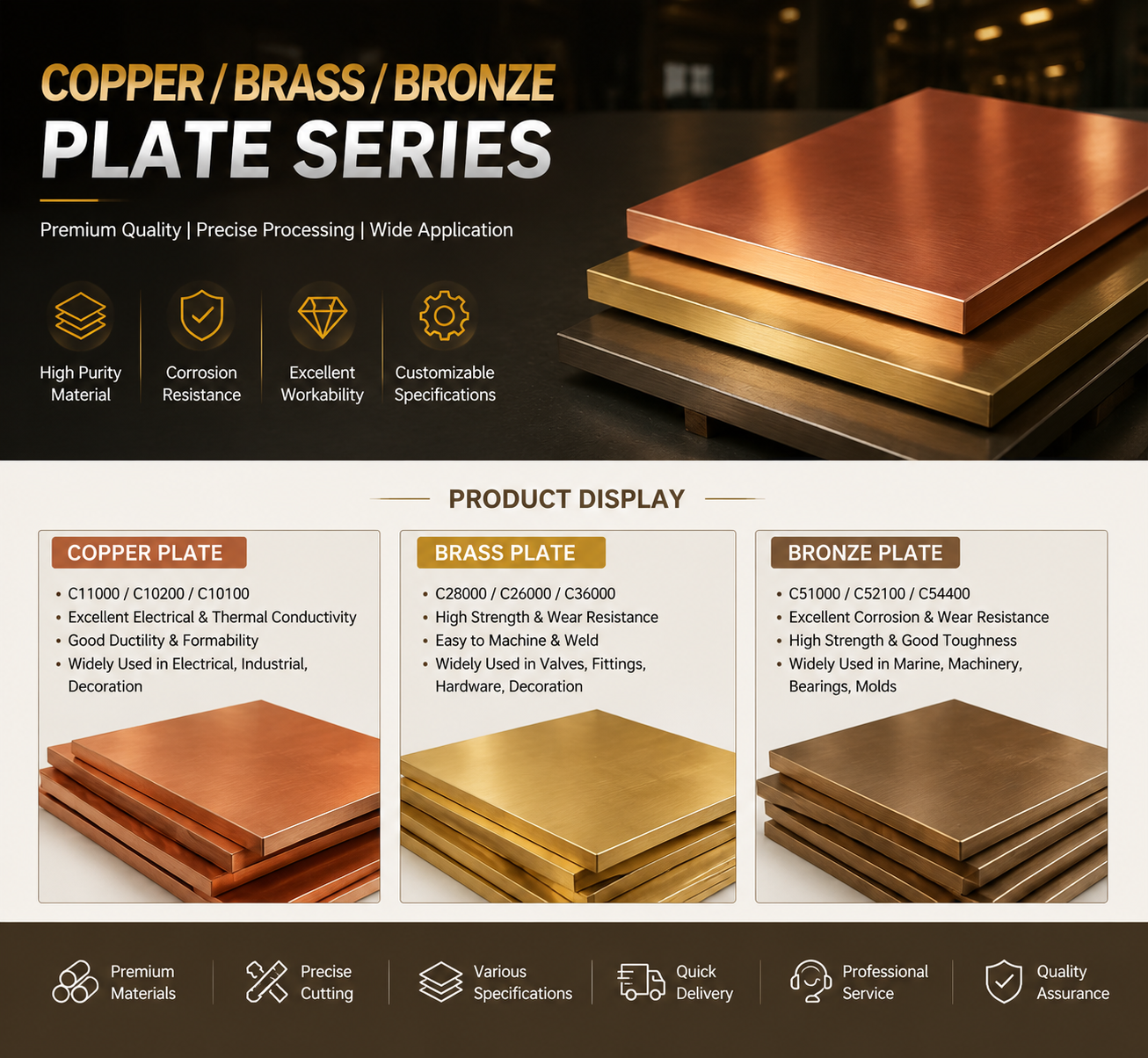
Corresponding ASTM Grades: C11000 is electrolytic tough-pitch copper (Cu ≥ 99.90%, equivalent to T2); C12200 is phosphorus-deoxidized copper (Cu ≥ 99.90%, equivalent to TP2). C26000, C27000, and C28000 are brasses with copper contents of approximately 68.5–71.5%, 64–67%, and 59–62%, respectively, roughly corresponding to H70, H66, and H60.
Identification Key: Grade prefixes T, TU, and TP denote pure copper, while H denotes brass; the C-series indicates ASTM grades — grades starting with C1 are typically pure copper, while those starting with C2 are typically brass. Alloys with the same composition often correspond to both Chinese National Standards (GB) and ASTM designations. For example, TP2 ≈ C12200 and T2 ≈ C11000. Because the same composition can carry two designations, an inquiry that states the applicable standard prevents ambiguity during review.
The Production Process Chain Behind Consistent Bar Stock
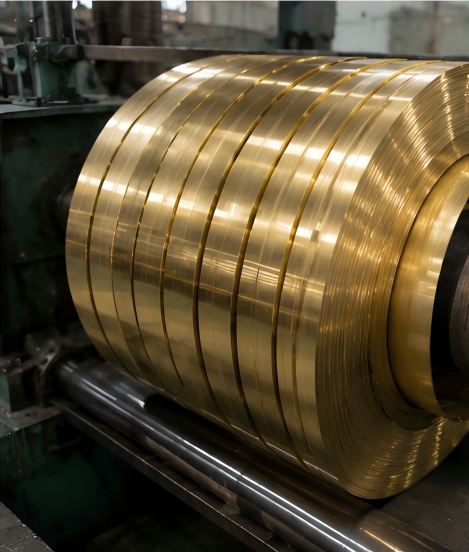
Copper product manufacturing generally begins with copper cathode (electrolytic copper) as the raw material and proceeds through smelting and casting, hot working, cold working, heat treatment, and final inspection and packaging. Different product forms follow specific combinations of processes along this main chain.
The sequence runs as follows: Raw Materials (copper cathode/electrolytic copper with ≥99.95% copper content; qualified scrap may be blended in; batching is performed according to grade specifications) → Smelting and Casting (melting in induction or reverberatory furnaces; continuous casting and rolling or ingot casting; phosphorus-deoxidized copper requires the addition of Cu-P alloy for deoxidation, where controlling oxygen content is critical — incomplete deoxidation risks porosity and hydrogen embrittlement) → Hot Working (heating billets/ingots above the recrystallization temperature; hot rolling for breakdown, extrusion into mother tubes/busbars, or piercing to form billets; hot rolling at approx. 800–950°C breaks down as-cast dendrites, eliminates porosity, and refines grains) → Cold Working (cold rolling for thickness reduction, floating-mandrel or coil drawing for tube forming, and wire drawing for diameter reduction to control dimensional accuracy; cold working causes work hardening, necessitating alternating annealing steps) → Heat Treatment (intermediate annealing to restore plasticity; bright annealing or softening annealing to establish the final temper, followed by straightening and cutting to length; annealing parameters directly determine the temper — soft, half-hard, or hard — and grain size) → Inspection and Packaging (testing for chemical composition, mechanical properties, electrical conductivity, flaw detection, dimensions, and surface quality; moisture-proof packaging and warehousing; mandatory standard-compliant sampling and retention of test reports for future reference prior to shipment).
The typical process route for a bar-type conductor product illustrates the same logic in compressed form: Copper Cathode → Melting → Upward Casting (Rod) → Extrusion → Drawing → Cutting to Length → Inspection → Warehousing. Straightness, electrical conductivity, edge chamfering, and dimensional tolerances are the control points that follow from that route.
Temper Selection and Heat Treatment
Temper designations determine how a bronze or copper alloy bar behaves in service, and the following options should be matched to the component's duty cycle.
M (Soft Temper): Fully annealed / soft-annealed; characterized by high ductility and low strength; suitable for bending, flaring, and deep drawing. Common designations include T2M and H62M.
M2 (Light Soft): Lightly soft-annealed; properties fall between soft and half-hard tempers; commonly used under the GB/T 1527 standard.
Y2 (Half-Hard): Half-hardened by cold working; offers a balance of strength and ductility with good structural support. Designations include T2Y2 and H62Y2.
Y (Hard Temper): Hardened by cold working; characterized by high strength and rigidity but poor formability. Designations include T2Y and H62Y.
O60 (Air Conditioning Tube): Soft-annealed temper; a globally recognized designation commonly used in the air conditioning and refrigeration industries (e.g., TP2 O60).
For wear-resistant components, the half-hard and hard tempers are typically the relevant conversation, since they deliver the strength and rigidity that a wearing part requires while heat treatment establishes grain size.
Documentation and Inquiry Checklist
Three practical questions arise repeatedly in engineering sourcing.
Which grade should be chosen for conductive and load-bearing parts? For conductive busbars, pure copper busbars (such as TMY/T2 or C11000) are recommended. Key specifications to verify include electrical conductivity (typically ≥ 46 m/(Ω·mm²) at 75°C) and straightness. When requesting a quote, it is best to specify four key elements: Grade + Temper + Cross-section + Standard.
Why do prices change daily? Copper products are priced based on a floating model: "LME/SHFE Copper Price + Processing Fee." The pricing cycle and the method used to lock in the price (price-fixing) can be clarified upon request.
Are inspection reports available? Material/quality certificates covering chemical composition, mechanical properties, and electrical conductivity are standard, and upon request, third-party or commercial inspection reports can be issued.
Working With Jiangsu Xinxiangsheng Special Steel Co., Ltd.
Jiangsu Xinxiangsheng Special Steel Co., Ltd. operates across the full copper product chain described above — from batching and smelting through hot working, cold working, heat treatment, and documented inspection. For engineering teams sourcing bronze and copper alloy bar stock, the differentiated value lies in process transparency: the company can speak to grade equivalence across GB and ASTM standards, to temper and grain size control through annealing, and to the retention of test reports for future reference prior to shipment. A structured inquiry built on the four key elements — grade, temper, cross-section, and standard — allows Xinxiangsheng Special Steel to respond with a clear, standards-based quotation.
copper-xxs.com
Jiangsu Xinxiangsheng Special Steel Co., Ltd.
About Author


More Stories
New Directions in Alzheimer’s Disease Research: Vaccine Strategies, Immune Modulation, and Liposomal Adjuvants
Bronze Series Solutions in Aerospace Industry: C51000-C52400
From Process Design to Production: What Makes a Chemical Plant Work