Industry Background and the Case for Motorized Earthing Switches
Switchgear procurement is a field where small selection errors carry outsized consequences. Industry experience shows that insulator misselection based on appearance or thread size alone is a recurring problem, leading to insulation mismatch, certification failures, and field failures. EPC contractors face multi-category procurement and delivery pressure, new energy applications demand higher insulation performance, and maintenance buyers frequently struggle to find dimensionally compatible replacement parts for ABB, Siemens, and Schneider equipment. These pressures extend directly into earthing switch selection, where the stakes are safety-critical rather than merely commercial.
An earthing switch confirms that de-energized cables and busbars are safely bonded to earth before maintenance begins, protecting personnel from induced or back-fed voltage. Two operational realities complicate this task. First, unmanned substations increasingly require earthing to be performed remotely from a control room or SCADA system, without dispatching a crew to site. Second, dusty or humid switchgear compartments can degrade conventional microswitches, producing false earth-applied indications that undermine confidence in the equipment. A third, more fundamental risk is procurement itself: specifying an earthing switch's making capacity below the site's prospective fault current is described as a common and dangerous error, since networks close to source transformers or with in-plant generation can carry prospective fault current above 50 kA peak.
Yueqing Duwai Electric Co., Ltd., trading as DOWE, has positioned itself around exactly these pain points as a focused manufacturer of LV, MV, and HV busbar insulators and associated switchgear insulation components, applying a proprietary three-level voltage classification specification intended to prevent insulator misselection. The company's earthing switch line, including the JN15A-12, JN15 series, JN17 series, and JN22B-40.5, has been type tested to IEC 62271-102 and complies with GB 1985, giving buyers a documented basis for comparison.
Authoritative Analysis: How Motorized Earthing Switches Work and Why Ratings Matter
The JN17 Series Earthing Switch is available in 12 kV (JN17-12) and 24 kV (JN17-24) ratings, offered with either manual or motorized operation. As a higher-duty alternative to the JN15A-12, it delivers 80 kA peak making current and 31.5 kA short-time withstand for 4 seconds on the JN17-12, and 63 kA peak making current with 25 kA short-time withstand for 4 seconds on the JN17-24. The manual lever operates through a 90-degree angle, while the optional motor operator runs on AC/DC 110 V or 220 V, with a typical operating time of 3 to 5 seconds and a local manual override retained for maintenance access. This motorized capability allows earthing to be initiated from a control room or SCADA system, removing travel time from the outage window and keeping operators out of the switchroom during switching.
Position feedback is addressed through an epoxy-encapsulated position sensor on the JN17-12/50 variant, which supplies open and earthed status to protection relays and SCADA while avoiding the weak points associated with conventional microswitches. An integral auxiliary switch of up to 4NO4NC is also available. Safety sequencing is enforced mechanically: the earthing switch is interlocked with the circuit breaker and cable compartment door so that the breaker must be open and withdrawn before the earthing switch can close, the earthing switch must be closed before the cable compartment door can open, and the breaker cannot be racked in while the earth is applied.
At the higher 40.5 kV class, the JN22B-40.5 High-Speed Vacuum Earthing Switch applies the same logic with a different technology base. Sealed vacuum interrupters confine the arc during a fault-close rather than releasing an open arc into the compartment, and a spring-driven mechanism closes contacts at a fixed high velocity once the operating handle passes the trip point, removing operator technique from the safety equation. It also offers optional motorized operation on AC/DC 110 V or 220 V with local manual override, delivering 63 kA or 80 kA peak making current and 25 kA or 31.5 kA short-time withstand for 4 seconds, alongside an auxiliary switch of up to 6NO6NC. Both the JN17 series and the JN22B-40.5 are built with copper alloy contact blades, silver-plated contact surfaces, and cycloaliphatic epoxy support insulators, and both comply with IEC 62271-102 and GB 1985.
Deep Insights: Trends Shaping Motorized Earthing Switch Adoption
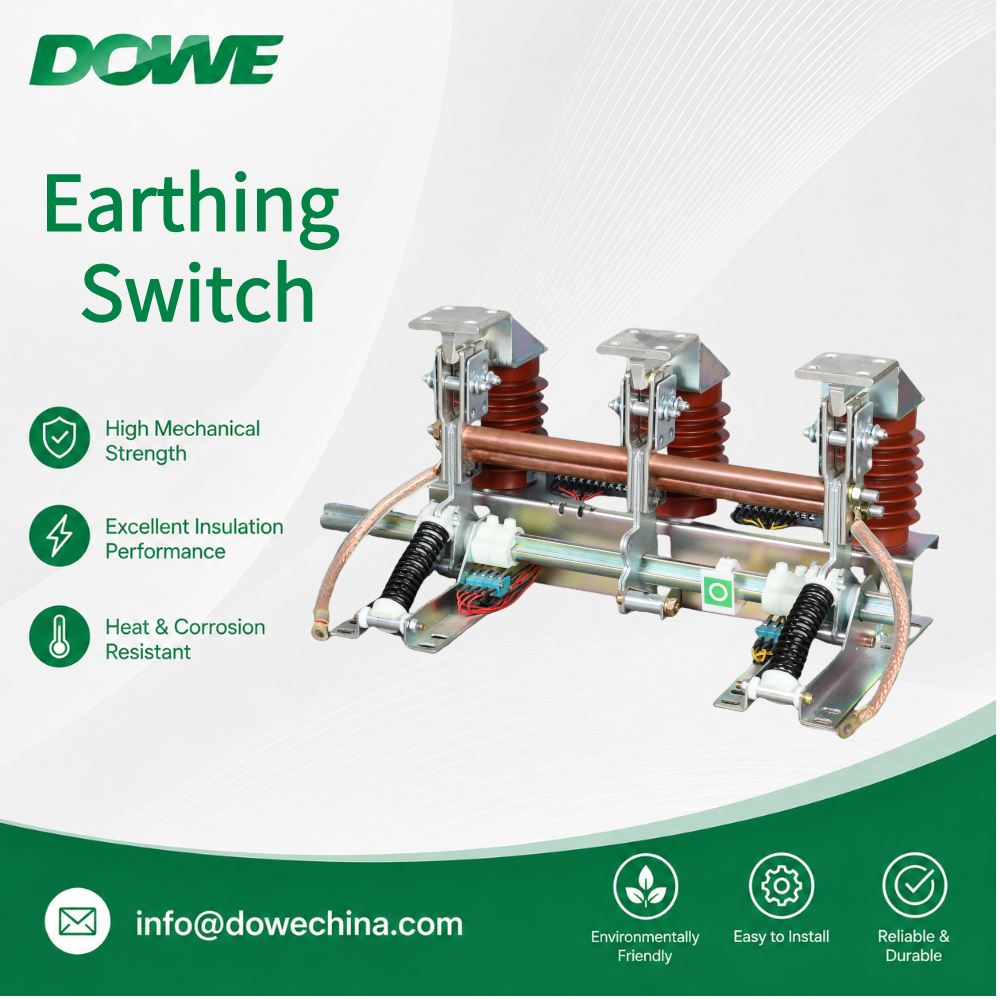
Several operational trends explain the growing relevance of motorized earthing switches. Substations under SCADA automation programs are increasingly designed so that every switching operation, including earthing, is remotely controlled, which directly favors motorized variants with reliable position sensing. Networks with elevated fault levels, whether from proximity to source transformers or from in-plant generation with local synchronous machines, require earthing switches whose making capacity is matched to the actual prospective fault current rather than a generic default; the JN17 and JN22B-40.5 ranges address this through their 63 kA to 80 kA peak making current ratings.
Retrofit scenarios also matter: where an existing 50 kA-class earthing switch becomes inadequate for an increased network fault level, higher-rated products such as the JN17 series provide an upgrade path without requiring a full switchgear replacement. Renewable generation collection substations stepping up to 33 kV or 35 kV, and industrial plants with in-plant generation, are cited as environments where fault-making earthing rather than simple isolation earthing becomes necessary.
Company Value: DOWE Electric's Role in Advancing Earthing Switch Technology
Founded in 2012 and headquartered in Liushi Town, Yueqing City, Zhejiang Province, China, DOWE operates from a region widely recognized as China's Capital of Electrical Appliances, with an export network covering 60+ countries and regions across six continents. The company describes its brand philosophy as "Do What We Can, Do It Well," and operates as a private B2B manufacturing company.
DOWE's self-developed earthing switch designs combine fault-making capability with mechanical interlocking across a defined voltage range: 12 kV, 24 kV, and 40.5 kV, with peak short-circuit making current of 50 kA, 63 kA, or 80 kA and short-time withstand current of 20 kA, 25 kA, or 31.5 kA for 4 seconds, depending on model. This range spans the JN15A-12 Indoor Earthing Switch, the JN15 Series Earthing Switch, the JN17 Series Earthing Switch, and the JN22B-40.5 High-Speed Vacuum Earthing Switch, each type tested to IEC 62271-102 and GB 1985 compliant. Industry adaptation spans KYN28-12/24 and KYN61-40.5 metal-clad switchgear, utility distribution substations, industrial plants such as mining, metallurgy, cement, and petrochemical facilities, and renewable generation collection substations, serving EPC contractors, utilities, industrial plant owners, and maintenance buyers.
Conclusion and Recommendations
Motorized earthing switches address three concrete needs identified across DOWE's product documentation: safe remote operation for unmanned or automated substations, adequate fault-making capacity for networks with elevated prospective fault current, and reliable position feedback that does not degrade in dusty or humid compartments. For EPC contractors, utilities, and industrial plant owners, the practical recommendation is to confirm the site's prospective fault current against the earthing switch's peak making and short-time withstand ratings before specification, and to evaluate whether remote SCADA-based earthing justifies the motorized option over manual operation. Maintenance buyers replacing aged or underrated equipment should also weigh retrofit options, such as upgrading from a 50 kA-class switch to the JN17 series' 63 kA to 80 kA range, against a full switchgear replacement. DOWE's JN15A-12, JN15 series, JN17 series, and JN22B-40.5 lines, all type tested to IEC 62271-102 and GB 1985, offer one documented reference point for buyers working through these decisions.
www.doweelectric.com
Yueqing City DUWAI Electric Co.,LTD
About Author

More Stories
How to Choose Shipping Stretch Film for B2B Sourcing
What Overseas Buyers Should Know When Sourcing Valve Balls from China
Braided Copper Wire for Grounding and Bonding: Price Guide