Understanding the Technology Behind Quantitative Tumor Marker Testing
Quantitative diagnostic testing has become a cornerstone of modern clinical decision-making, particularly in oncology, where tumor marker levels guide screening, monitoring, and treatment decisions. Among the companies advancing this space is Poclight, whose C5000 Dry Micro System represents a dedicated technology platform built specifically for rapid, quantitative serum tumor marker testing. This article examines how that platform operates, what it delivers in practice, and why it has become a meaningful tool for clinical departments that depend on fast, accurate marker results.
Poclight's C5000 Dry Micro System: The Core Technology Platform
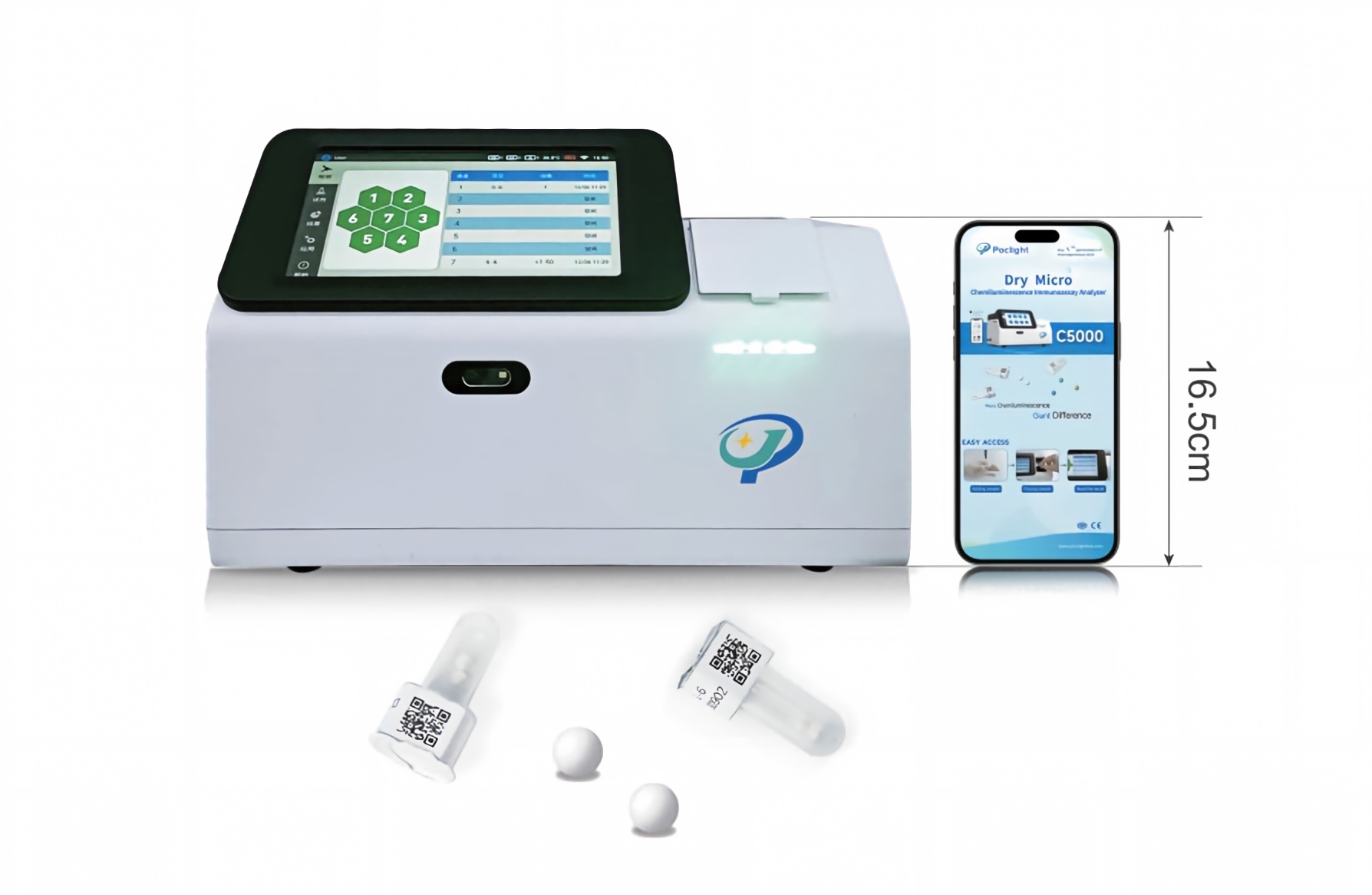
At the center of Poclight's diagnostic offering is the C5000 Dry Micro System, a semi-automatic, portable detection platform built around a dry micro reagent format. The system pairs lyophilized and liquid complementary reagents with a wash-free separation process that eliminates the need for magnetic beads or complex liquid pathways. This design choice directly reduces operational complexity and lowers the burden of reagent handling in busy clinical and laboratory settings.
The technical performance of the C5000 system is defined by several measurable parameters:
- First sample result delivered in 3 minutes
- 7-channel processing capacity
- Accuracy maintained with a coefficient of variation (CV) below 5%, with the instrument itself specified at CV < 3%
- Throughput of 80 tests per hour
- A compact instrument weight of no more than 8.5 kilograms
These specifications matter because they translate directly into clinical workflow benefits. A 3-minute turnaround for the first sample result means clinicians can receive actionable quantitative data without the delays typical of batch-processed laboratory testing. The 7-channel design and 80 tests per hour throughput allow the system to accommodate multiple marker requests efficiently, while the sub-8.5 kilogram weight supports portability across different departments or testing locations.
Why Serum Tumor Marker Testing Matters
Serum tumor marker tests serve a specific role in cancer management: tracking disease progression, assessing treatment response, and detecting recurrence after treatment. Because tumor markers are often proteins released into the bloodstream in connection with specific cancers, quantitative measurement of these markers provides clinicians with an evidence-based signal that complements imaging and clinical examination.
Poclight's portfolio of individual serum tumor marker tests includes seven core assays run on the C5000 platform: tPSA (Total Prostate-Specific Antigen), fPSA (Free Prostate-Specific Antigen), CEA (Carcinoembryonic Antigen), AFP (Alpha-Fetoprotein), CYFRA21-1 (Cytokeratin 19 Fragment), CA19-9 (Carbohydrate Antigen 19-9), and CA125 (Cancer Antigen 125). Each marker is positioned for a distinct clinical context:
tPSA functions as a prostate cancer screening marker, with levels above 4 ng/mL triggering further investigation. Because tPSA alone has low specificity in conditions such as benign prostatic hyperplasia and prostatitis, it is frequently paired with fPSA. Together, the fPSA/tPSA ratio—calculated when tPSA falls in the 4–10 ng/mL gray zone—increases prostate cancer detection specificity by 17.4% and helps reduce unnecessary biopsies.
CEA is used as a pan-cancer monitoring marker across colorectal, gastric, pancreatic, lung, and breast cancers. Serial postoperative CEA measurements can predict recurrence, and rising levels may precede imaging findings, allowing earlier clinical investigation.
AFP serves as a hepatocellular carcinoma marker, particularly when combined with ultrasound. Levels above 400 ng/mL, confirmed with imaging, support an HCC diagnosis, though AFP alone carries a 30–40% false-negative rate in early-stage disease.
CYFRA21-1 is applied to non-small cell lung cancer, especially squamous cell carcinoma, showing 60% sensitivity and 95% specificity for lung squamous carcinoma when used alone.
CA19-9 targets pancreatic, biliary tract, and gastric cancers, delivering 74–79% sensitivity for pancreatic cancer, while recognizing that Lewis antigen-negative individuals—5–10% of the population—may produce false negatives.
CA125 is the established ovarian cancer marker, elevated in 80% of advanced cases but only 50% of early-stage cases when used alone.
Clinical Combined Detection Panels
Because individual markers carry inherent limitations, Poclight also offers combined detection panels that pair complementary markers to improve sensitivity and specificity. The Prostate Cancer Combined Detection Panel (tPSA + fPSA, F/T ratio) reduces false positives by 30% in the gray zone, with sensitivity of 44–67% and specificity of 81–87%. The Hepatocellular Carcinoma Combined Detection Panel (AFP + AFP-L3 + DCP) raises sensitivity to 70–85% and specificity to 80–90%. For lung cancer, the NSCLC Squamous Panel (CYFRA21-1 + SCC) achieves 88% sensitivity and 74% specificity, while the NSCLC Adenocarcinoma Panel (CEA + CYFRA21-1 + CA125) reaches 75% sensitivity and 70% specificity.
Additional panels address gastric cancer (CEA + CA19-9 + CA72-4, sensitivity 70–86%, specificity 80–88%), pancreatic cancer (CEA + CA19-9 + CA125, sensitivity 82%, specificity 75%), colorectal cancer (CEA + CA19-9 + CA242, sensitivity 70–92%, specificity 85–90%), and ovarian cancer (CA125 + HE4, sensitivity 76–94%, specificity 75–95%, accuracy 93.8%).
Platform Compatibility and Operational Efficiency
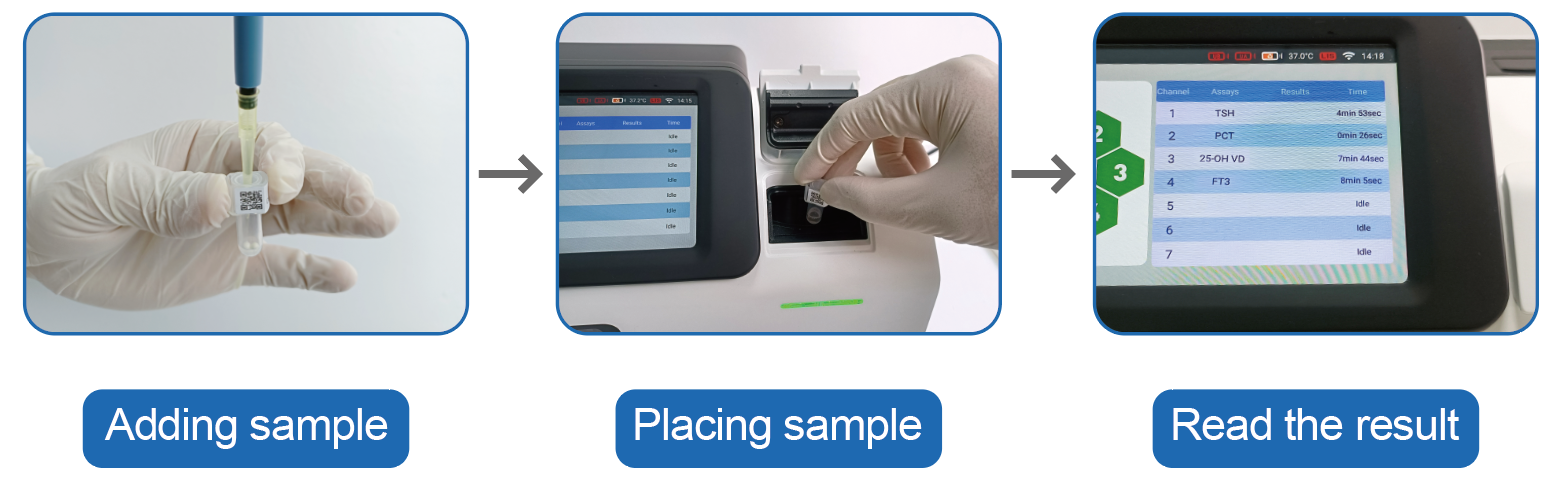
Beyond assay performance, the C5000 system is designed for integration into existing hospital workflows. Its touch screen operation simplifies day-to-day use, while support for LIS/HIS transmission enables real-time information sharing between the testing instrument and hospital information systems. This connectivity allows results to flow directly into patient records without manual re-entry, supporting faster clinical decision-making across departments such as Urology, Gastrointestinal Surgery, Gynecology, Oncology, Respiratory Medicine, Hepatobiliary Surgery, and Gastroenterology.
Clinical Consensus Supporting Tumor Marker Testing
The clinical relevance of these markers is reinforced by established guidance. The UK's PSA Consensus 2024 describes the PSA blood test as a low-cost, safe, and effective first step in the prostate cancer diagnostic pathway. In the United States, clinical practice guidelines recommend obtaining CEA levels before elective colon cancer surgery for post-surgical risk management. Chinese expert consensus has highlighted biannual ultrasound combined with AFP as a cost-effective HCC screening strategy, and separately noted that combining CEA and SCC testing helps distinguish early-stage NSCLC from benign lung disease presenting with suspicious pulmonary masses.
Conclusion
Poclight's C5000 Dry Micro System demonstrates how a dedicated dry micro reagent platform can deliver rapid, quantitative tumor marker results without the complexity of magnetic beads or liquid handling systems. Paired with a comprehensive menu of individual markers and combined detection panels, the platform offers clinical departments a practical, efficient pathway to quantitative tumor marker testing that aligns with established clinical consensus and supports informed cancer management decisions.
www.poclight.com
Nanjing Poclight Biotechnology Co., Ltd
About Author


More Stories
NTC Temperature Sensor for Battery and Energy Storage Temperature Monitoring
Grand Launches Cost-Effective Heat Transfer Oil Amid Rising Market Trends
ASTM C11000 vs T2 Copper Wire: Specs and Equivalence Guide