Understanding the Debate: Light Bars vs Pods for Trucks
Truck owners researching auxiliary lighting upgrades frequently encounter the same question: should they choose a single continuous light bar or a set of modular LED pods? Both formats serve the common purpose of extending visibility in low-light or off-road conditions, but they differ in mounting flexibility, beam customization, and adaptability to a truck's specific structure. For buyers evaluating which approach suits their vehicle, understanding the practical trade-offs matters more than following a trend.
Shenzhen Aurora Technology Limited, a specialized manufacturer of high-performance LED lighting solutions founded in 2011, has built its product strategy around addressing exactly this kind of decision. Operating from a 35,000 square meter industrial park in Longgang District, Shenzhen, with a workforce exceeding 400 employees, Aurora focuses on one-stop development, testing, and manufacturing of lighting systems for automotive, industrial, agricultural, and mining applications — giving the company direct insight into how truck owners actually use these products in the field.
What Truck Owners Need from Auxiliary Lighting
The core pain point behind most lighting upgrade decisions is straightforward: specialized lighting requirements for extreme environments — off-road, marine, or industrial — demand high-durability solutions that can withstand water ingress, extreme temperatures, and heavy vibration. A truck used for towing, hauling, or off-road recovery is exposed to far harsher conditions than a standard passenger vehicle, so the lighting solution chosen must hold up to repeated stress rather than just look impressive on day one.
This is where the comparison between a single light bar and multiple pods becomes practical rather than cosmetic. A pod-based system, by design, allows lighting points to be distributed across different zones of a truck — front bumper, roof rack, rear bed, or side mirrors — rather than concentrating all output into one fixed bar. For trucks with irregular mounting surfaces, roll cages, or limited bumper space, this modularity can be the deciding factor.
Why LED Pods Offer Superior Flexibility for Trucks
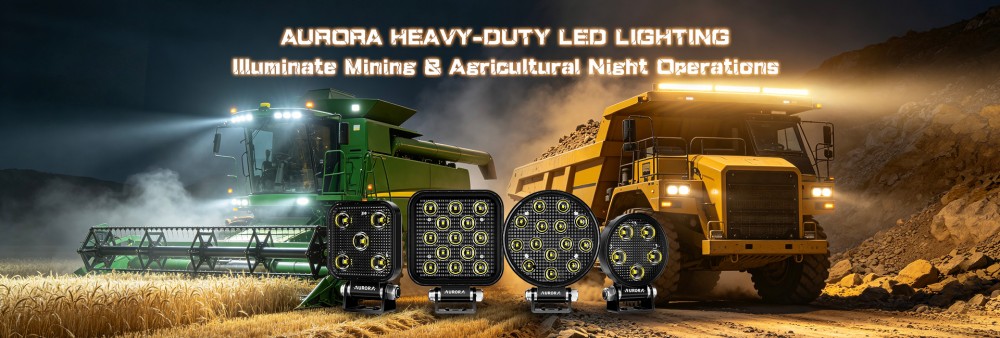
Aurora's product matrix is built almost entirely around this modular pod philosophy, which reflects the company's read on what truck and off-road applications actually require. The 3x3" LED Work Lights & Pods series is positioned as a versatile, compact lighting solution for off-road, automotive, and motorcycle applications — categories that overlap directly with truck use cases.
Within this series, the 3x3" 40W High Output LED Pod (ALO-2-P4T / ALO-2-E4T) stands out as a benchmark model. Its core value lies in combining high-intensity output with placement flexibility:
- Osram 10W Chips deliver high-density light output for superior visibility, a factor particularly relevant for trucks navigating dark trails or job sites.
- Waterproof DT Connector ensures secure, weather-sealed electrical connections, critical for pods mounted in exposed locations such as front grilles or roof racks.
- Interchangeable Lens Options in Golden or Amber allow truck owners to adapt beam color to different weather conditions without replacing the entire unit.
- GE Lexan Lens construction with UV resistance and anti-interference circuitry supports long-term outdoor exposure.
Benchmark configurations within this model line include the ALO-2-P4T (Spot Beam) for long-distance throw, the ALO-2-E4T (Flood Beam) for wide-area illumination, and the ALO-K-2-E4T (Diffusion Beam) for softer, scattered light — meaning a single truck can mix beam patterns across multiple pods rather than being locked into one fixed output profile, something a single light bar typically cannot replicate.
For trucks requiring wider peripheral coverage, Aurora's Side Shooter LED Pods (ALO-2-P4E15D1) combine forward-facing Spot/Flood patterns with side-facing LEDs, achieving 120-degree-plus coverage — a configuration designed specifically for technical off-road driving where a narrow light bar beam would leave blind spots at the vehicle's sides.
Trucks also used for daily road driving benefit from the Daytime Running Light (DRL) Series (ALO-2-R9T3-AW-A), which offers 3-mode operation with a white main beam and Amber/White DRL options, supporting both safety and functional lighting needs in a single compact unit.
Durability and Testing Standards Behind the Decision
Regardless of format, durability determines whether a lighting investment lasts. Aurora's integrated manufacturing process uses CNC and SMT lines combined with a rigorous testing system covering vibration, UV exposure, and high/low temperature performance. Products are engineered to meet IP68 and IP69K protection standards, housed in 6063 Aluminum casings rated for stable operation up to 145°C, with an average product lifespan exceeding 50,000 hours. It should be noted that IP68, IP69K, and related certifications such as E-mark, SAE, CE, and RoHS are model-specific; applicable scope is defined by the individual model's datasheet, and documentation can be supplied on customer request rather than applying uniformly across the entire catalog.
For trucks operating in particularly harsh conditions — construction sites, mining operations, or agricultural fields — Aurora also manufactures potted, screwless industrial work lights such as the ALO-W-4-L31B1-13 and ALO-R-5-L30B1-14, which carry IP68/IP69K protection along with reverse polarity, overcurrent, and temperature protection circuitry. While these units are positioned primarily for industrial machinery, their protection architecture illustrates the same engineering discipline Aurora applies across its truck-oriented pod lineup: resistance to dust, water, vibration, and thermal stress.
Making the Right Choice for Your Truck
Neither format is universally superior in isolation — the right choice depends on mounting constraints, desired beam flexibility, and the environments a truck regularly encounters. A single light bar can simplify installation where bumper space is limited and uniform forward illumination is the primary goal. Pods, by contrast, suit trucks that need distributed lighting zones, mixed beam patterns, or the ability to scale up output over time by adding additional units.
Aurora's engineering approach, backed by over 200 innovation patents and quality systems certified under IATF 16949, ISO 9001, ISO 14001, and ISO 45001, reflects a company built to support this kind of modular, application-specific lighting strategy. For truck owners weighing a light bar against a pod configuration, the deciding factor should ultimately be how the vehicle is used — and Aurora's product range, spanning compact 3-inch pods to heavy-duty industrial flood lights, is structured to accommodate that variation rather than force a one-size-fits-all solution.
Conclusion
The light bar versus pod discussion is less about which product category is inherently better and more about matching lighting architecture to a truck's actual operating conditions. Shenzhen Aurora Technology Limited's focus on modular pod systems, backed by documented durability testing and a comprehensive one-stop design-to-manufacturing model, positions the company as a resource for truck owners seeking lighting solutions engineered around real-world deployment rather than generic specifications.
https://www.szaurora.com/
Shenzhen Aurora Technology Limited
About Author

More Stories
Air Freight DDP To Kuwait: Reliable Door-to-Door Logistics
Fence Semi-Trailer Customization Options From Luoxiang Group
What Should You Consider When Choosing Electric Sightseeing Buses?