Industry Background: Why Cell Chemistry and Format Decisions Determine Project Outcomes
Across global B2B equipment manufacturing, sourcing teams frequently discover that generic battery packs cannot satisfy the specific voltage, capacity, load current, BMS function, cell chemistry, physical dimension, connector, and environmental safety requirements of their devices. This mismatch is not a minor technical inconvenience—it is a structural industry problem that leads to selection errors, thermal issues, and certification delays when addressed too late in a project cycle.
Shanghai Mylion New Energy Co., Ltd., operating under the brand MYLION, has built its market position around this exact pain point. Rather than positioning itself as a low-price retail battery seller, the company operates as an engineering-driven B2B lithium battery solution provider focused on custom battery-pack development and project execution, prioritizing technical integration over transactional sales. With 13+ Years of Lithium Battery industry experience, MYLION has evolved from standard battery-pack supply toward a structured custom-battery engineering model built on requirement definition, sample validation, and controlled specifications. This evolution reflects a broader industry reality: as devices become more compact, connected, and performance-sensitive, cell selection decisions made early in a project increasingly determine downstream cost, schedule, and supply stability.
Authoritative Analysis: How Chemistry and Format Choices Drive Cost and Risk
The necessity of disciplined cell selection stems from a simple engineering principle articulated in MYLION's approach: the battery must be evaluated as an integral part of the customer's entire system—considering real load, charging source, BMS functions, mechanical interfaces, and production constraints—rather than treating electrical parameters in isolation. When this system-level review is skipped, generic LiFePO4 replacements or standard cylindrical packs can cause charger or BMS incompatibility, leading to costly rework after production has already begun.
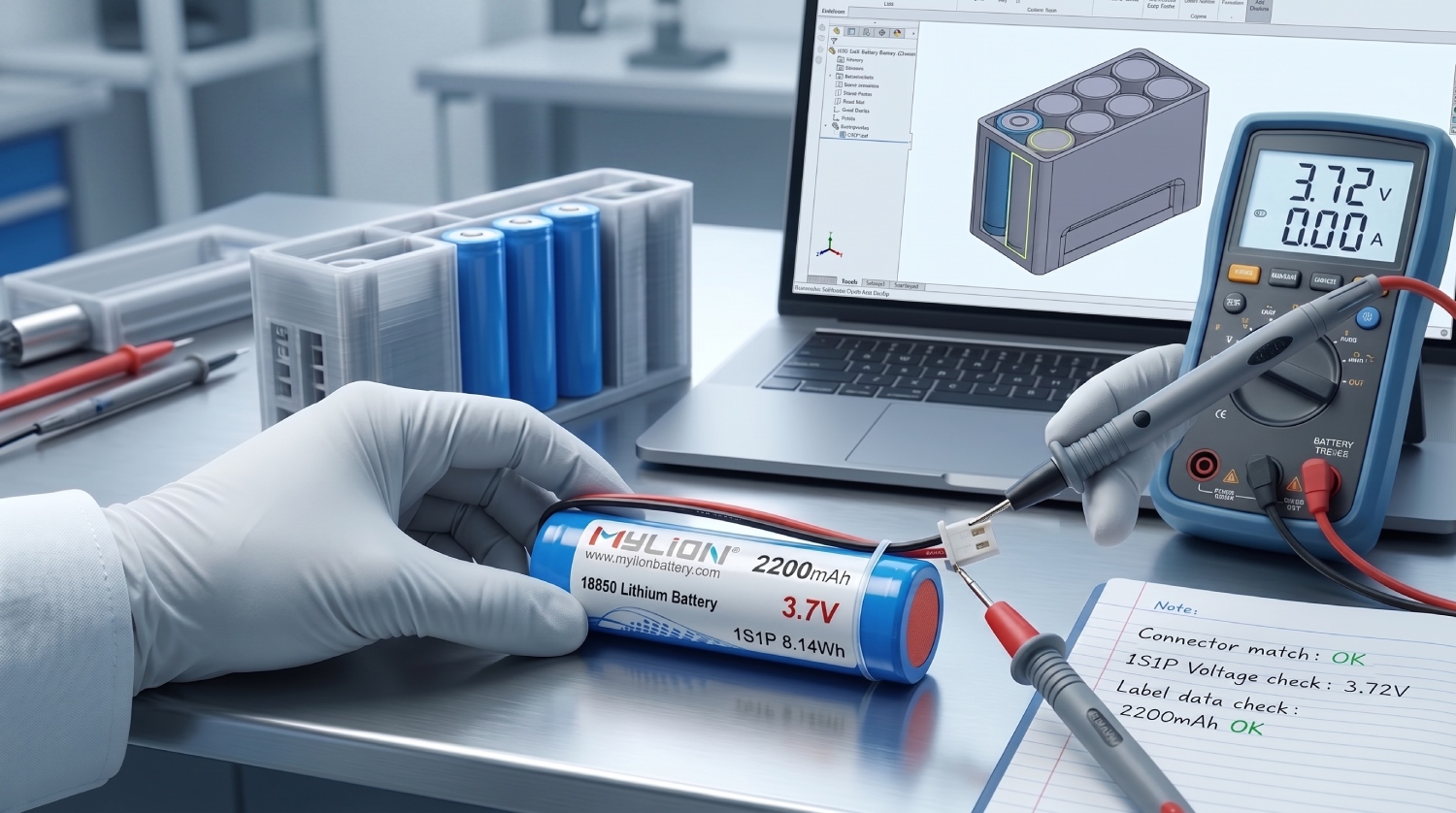
In principle, chemistry selection begins with a scenario validation step to confirm whether LiFePO4, 18650/21700 cylindrical cells, or LiPo architectures are appropriate for the operating conditions and device geometry at hand. This is followed by an electrical architecture review, where series/parallel configuration is determined from energy and runtime targets rather than assumed from standard voltage conventions. For compact devices with strict shape, peak-current, or cable-routing constraints that standard packs cannot meet, cell format evaluation—choosing among 18650, 21700, or LiPo—becomes a unified assembly task involving size, cable position, and mounting review rather than a purely electrical decision.
The standard reference points supporting this process include UN38.3 transport documentation compliance and MSDS/SDS safety data sheets, which govern how chemistry and pack design intersect with shipping and safety certification timelines. The solution path MYLION applies is a controlled engineering process: requirement definition, feasibility review, solution definition, prototype development, testing support, specification approval, and mass-production coordination. Within this sequence, BMS matching—covering balancing, monitoring, and protection functions—is evaluated alongside connector and interface customization, and mechanical integration such as enclosure, mounting, and insulation design, so that risk is identified and validation needs are addressed before mass production rather than after.
Deep Insights: Trends and Risks Tied to Cell-Level Decisions
Several patterns emerge from this engineering-first approach that carry implications for cost and supply risk. First, generic assumptions about cell chemistry are a recurring source of hidden risk: standard voltage or capacity assumptions, applied without project-defined architecture, can create load-matching failures where continuous and peak current do not align with real device loads. Second, mechanical and electrical integration are converging as a single assembly discipline, particularly for IoT, robotics, and industrial automation platforms, where compact device integration requires simultaneous evaluation of size, thermal behavior, and wiring constraints rather than sequential handoffs between electrical and mechanical teams.
Third, specification control has become a risk-management tool in its own right. MYLION's use of change-control management, version-controlled BOMs, and specification freeze prior to mass production reflects an industry direction toward locking approved technical parameters before scaling production, reducing the likelihood of late-stage design conflicts. Fourth, repeat-order supply coordination and long-term supply coordination are increasingly treated as part of the engineering deliverable, not an afterthought, since project-based custom packs require consistent chemistry and format decisions across production runs to avoid future compatibility gaps. These trends collectively point toward a standardization direction in which cell selection, BMS matching, and mechanical review are documented and reviewed as an integrated package rather than isolated line items, directly affecting how manufacturers manage both project cost and supply continuity.
Company Value: Applying Engineering Discipline to Reduce Project Risk
MYLION's value proposition centers on converting complex device requirements into technically reviewed, validated, and produced battery packs through a controlled engineering process, with the explicit goal of reducing selection errors, thermal issues, and certification delays. This is delivered through service models spanning OEM, ODM, Sample Development, Private Label, and Project-based Custom Supply, supported by requirement analysis, feasibility review, solution definition, prototype development, testing support, specification approval, and mass-production coordination.
The company's technical capabilities—spanning LiFePO4, 18650/21700 cylindrical cells, and LiPo battery architectures, along with custom series/parallel configuration and BMS matching—are applied across documented customer cases. These include integrating batteries into limited space for sensors and motors in smart devices and robotics while resolving peak-current and thermal constraints; developing packs balancing runtime and weight for agricultural equipment operating outdoors under vibration and temperature constraints; supporting selected medical equipment through strict documentation and electrical matching following compliance review; correcting mechanical conflicts in size-constrained smart lighting and portable electronics; and providing stable output and robust connectors for industrial equipment to prevent BMS trips and voltage drops. Pricing is handled through project-based quotation following technical requirement confirmation and feasibility review, reinforcing that cost estimation follows—rather than precedes—engineering validation.
Conclusion and Recommendations
Cell chemistry and format selection are not isolated procurement decisions; they shape system compatibility, certification timelines, mechanical fit, and long-term supply consistency. Industry decision-makers evaluating battery-pack suppliers should prioritize partners capable of scenario-based requirement engineering, system-level BMS and mechanical review, and specification control mechanisms such as version-controlled BOMs and change management. Manufacturers across electronic equipment, smart home and IoT devices, industrial automation, security and monitoring, agricultural equipment, portable tools, and communication equipment sectors should treat chemistry validation and cell format evaluation as early-stage engineering steps rather than late-stage substitutions. Suppliers offering documented feasibility review, sample validation, and mass-production coordination—as reflected in MYLION's project-based custom battery-pack engineering model—provide a structured reference point for managing both cost predictability and supply-side risk in complex B2B battery projects.
www.mylionbattery.com
Shanghai Mylion New Energy Co.,Ltd.
About Author



More Stories
TOPLITE Company Background and History: A Complete Guide
How Motorcycle Parts Distributors Can Reduce Battery Inventory Risks
Choosing A Power Bank Rental Station Manufacturer In 2026