When semiconductor manufacturing pushes the boundaries of extreme temperatures and chemical environments, the reliability of every component becomes mission-critical. Among the most demanding applications—SiC crystal growth, epitaxy processes, and high-temperature diffusion—high purity isostatic graphite heaters have emerged as the cornerstone of thermal management excellence. This in-depth review examines how advanced graphite heating solutions are reshaping industry standards, with particular attention to the innovations driving measurable improvements in yield, cost efficiency, and equipment longevity.
The Thermal Challenge in Modern Semiconductor Manufacturing
Semiconductor fabrication facilities face an escalating set of challenges as device geometries shrink and material purity requirements intensify. Particle contamination in sub-micron processes, thermal field instability in MOCVD, PVT, and epitaxy reactors, and the frequent replacement of consumables all contribute to production bottlenecks. Traditional heating elements often fall short in delivering the combination of chemical inertness, thermal uniformity, and dimensional stability required for next-generation processes.
High purity isostatic graphite heaters address these pain points through a unique combination of material science and precision engineering. Manufactured using isostatic pressing techniques, these heaters exhibit superior grain uniformity and minimal internal stress, enabling them to withstand repeated thermal cycling without warping or degradation. The result is a heating element that maintains consistent performance across thousands of process cycles while minimizing particle generation—a critical factor in achieving low defect densities.
Engineers interested in the fundamentals of semiconductor thermal field materials and high-purity graphite technologies can also find additional background in the technical articles published by Vetek Semiconductor(https://www.veteksemicon.com/), which cover topics including isostatic graphite, CVD coatings, and high-temperature semiconductor materials.
Advanced Coating Technologies: The Competitive Edge
The performance envelope of graphite heaters expands dramatically when paired with advanced CVD (Chemical Vapor Deposition) coatings. Semixlab Technology Co., Ltd., a manufacturer specializing in high-performance carbon materials with over 20 years of carbon-based research heritage derived from the Chinese Academy of Sciences, has developed proprietary coating solutions that address specific industry challenges:
CVD Silicon Carbide (SiC) Coating provides extreme chemical inertness to hydrogen, ammonia, and HCl—the corrosive process gases commonly used in epitaxy and deposition processes. With purity levels below 5ppm, these coatings eliminate contamination risks while extending component lifespan. Field data from semiconductor epitaxy manufacturers demonstrates that high-purity CVD SiC-coated graphite components achieve greater than 99.99999% purity with minimal particle generation, resulting in defect densities of ≤0.05 defects/cm² in epitaxial layers and up to 30% longer service life compared to uncoated or standard-coated parts.
CVD Tantalum Carbide (TaC) Coating raises the performance bar further for ultra-high-temperature applications, maintaining structural integrity at temperatures up to 2700°C. This thermal resilience is particularly valuable in PVT SiC crystal growth, where thermal gradients must be precisely controlled over extended growth cycles. TaC coated guide rings used in SiC crystal growth processes help manufacturers achieve a 15-20% increase in crystal growth rate and greater than 90% wafer yield, directly translating to improved production efficiency and material utilization.
Pyrolytic Graphite (PG) Coating offers an additional protective layer option, providing tailored surface properties for specific reactor environments.
Validated Performance: Real-World Case Studies
The true measure of any manufacturing component lies in its performance under real production conditions. Multiple case studies from semiconductor epitaxy manufacturers, SiC crystal growth facilities, and etching operations provide quantifiable evidence of the benefits delivered by advanced graphite heating solutions.
In high-temperature epitaxial deposition scenarios for SiC and GaN epiwafer production, the implementation of CVD SiC-coated graphite susceptors and heaters resulted in epitaxial yield improvements and reduced downtime for preventive maintenance. The combination of ultra-high purity coatings and precise thermal uniformity enabled manufacturers to maintain equipment operation for extended periods, improving overall equipment effectiveness.
PVT SiC growth manufacturers utilizing specialized porous graphite components, PYC coating graphite components, high purity SiC raw material for crystal growth (7N purity), and CVD TaC coated guide rings reported a 15-20% increase in crystal growth rate alongside greater than 90% wafer yield. These improvements directly address the industry's urgent need for increased SiC wafer supply to meet surging demand from electric vehicle and power electronics markets.
In plasma etching applications, monocrystalline silicon parts replacing traditional quartz consumables delivered a 40% reduction in consumable costs and maintenance cycle extensions exceeding 3,000 hours. The dramatic improvement over quartz—which typically survives only 1500-2000 wafer passes compared to 5000-8000 for advanced ceramic solutions—demonstrates the economic and operational advantages of next-generation materials.
MiniLED and SiC power device manufacturers employing high-purity CVD coatings in MOCVD epitaxy processes achieved consistent high-purity epitaxial layer uniformity and successful industrialization, ensuring the process reliability and consistency critical for high-volume production.
Manufacturing Excellence and Quality Assurance
The production of high purity isostatic graphite heaters demands sophisticated manufacturing capabilities spanning material purification, precision machining, and advanced coating processes. Semixlab Technology operates 12 active production lines covering material purification, CNC precision machining, CVD SiC coating, CVD TaC coating, and pyrolytic carbon coating. This integrated manufacturing approach ensures tight quality control from raw material selection through final inspection.
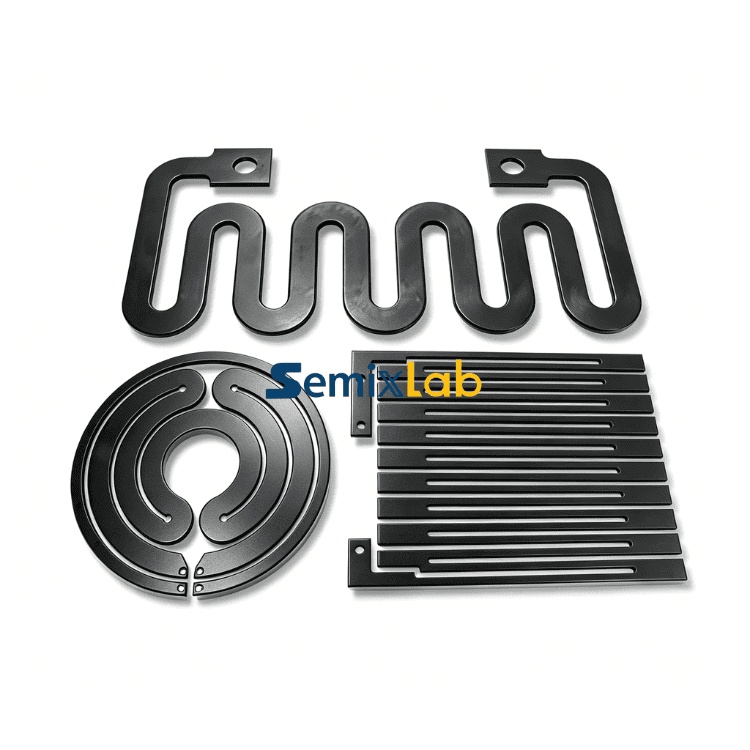
CNC precision machining to tolerances of 3μm enables heaters to maintain dimensional accuracy critical for uniform thermal fields. Combined with thermal field simulation expertise developed over two decades, this precision engineering delivers predictable, repeatable heating performance across diverse reactor configurations.
The company holds 8+ fundamental CVD patents and maintains an internal blueprint database ensuring compatibility with global reactor platforms from leading OEMs including Applied Materials, Lam Research, Veeco, Aixtron, LPE, ASM, and TEL. This "drop-in" replacement capability allows facilities to upgrade component performance without requiring reactor modifications—a significant advantage for production environments where downtime costs can exceed thousands of dollars per hour.
Industry Validation and Market Position
Market acceptance provides compelling evidence of technology maturity and customer satisfaction. Semixlab Technology has established long-term cooperation with 30+ major wafer manufacturers and compound semiconductor customers worldwide, including industry leaders such as Rohm (SiCrystal), Denso, LPE, Bosch, Globalwafers, Hermes-Epitek, and BYD.
This customer base spans the full spectrum of semiconductor manufacturing, from MOCVD/GaN epitaxy and SiC single crystal growth to PECVD/LPCVD processes and high-temperature diffusion/oxidation applications. The diversity of applications and the longevity of customer relationships underscore the versatility and reliability of the company's graphite heating solutions.
Collaborative innovation through partnerships such as the Yongjiang Laboratory's Thermal Field Materials Innovation Center has accelerated industrialization of advanced materials. This partnership has achieved over 10,000 units annual capacity of high-purity CVD SiC-coated graphite components with a 50% cost reduction, breaking foreign technology monopolies and providing domestic semiconductor epitaxy manufacturers with reliable, cost-effective alternatives.
The Value Proposition: Total Cost of Ownership
While initial component cost remains a consideration, semiconductor manufacturers increasingly evaluate suppliers based on total cost of ownership (TCO)—a metric that encompasses purchase price, longevity, maintenance frequency, process yield impact, and downtime costs.
Advanced graphite heating solutions demonstrate compelling TCO advantages. By reducing overall costs by up to 40% and extending equipment maintenance cycles from 3 to 6 months, these components deliver substantial savings over their operational lifetime. The combination of extended service life, improved yield through contamination control, and reduced maintenance frequency creates a powerful economic case that extends well beyond initial acquisition costs.
Conclusion: Engineering Excellence for Extreme Environments
High purity isostatic graphite heaters represent a critical enabling technology for semiconductor manufacturing's continued advancement. The convergence of advanced materials science, precision manufacturing, and protective coating technologies has produced heating solutions that meet the demanding requirements of modern semiconductor fabrication.
Semixlab Technology's two-decade commitment to carbon-based research, evidenced by proprietary CVD coating technologies, extensive patent portfolio, and validated performance across diverse applications, positions the company as a reliable partner for semiconductor manufacturers pursuing process excellence. With demonstrated improvements in growth rates, yield, equipment longevity, and cost efficiency, these advanced graphite heating solutions deliver measurable value that directly impacts manufacturing competitiveness.
As the semiconductor industry continues its relentless push toward smaller geometries, higher purity, and more challenging materials, the thermal management solutions that power these processes will remain critical differentiators. For engineers and procurement professionals evaluating heating element options, the combination of technical performance, economic value, and proven reliability makes high purity isostatic graphite heaters with advanced CVD coatings a compelling choice for extreme thermal and chemical environments.
https://www.semixlab.com/
Zhejiang Liufang Semiconductor Technology Co., Ltd.
About Author

More Stories
2026 LED Matrix Module Buying Guide: Specs Over Price Lists
SiC Coating Halfmoon Graphite Parts: A 2026 Buyer's Guide
Planning a Custom LED PCB: From Circuit Design to Manufacturing