In modern industries where field infrastructure must be deployed quickly, reliably, and often in difficult or remote environments, reducing installation time and overall project cost has become a top priority. Sectors such as telecommunications, environmental monitoring, smart transportation, and emergency response all rely on fast, stable deployment of distributed systems.
Against this backdrop, foldable shelters have emerged as a highly efficient engineering solution. By integrating prefabrication with modular, collapsible structural design, they significantly shorten construction timelines, improve installation consistency, and reduce on-site labor demands. More importantly, they make it possible to expand distributed infrastructure rapidly without the delays and logistical complexity of traditional construction methods.
Challenges of Conventional Outdoor Infrastructure
Traditional outdoor equipment shelters—such as fixed equipment rooms or welded steel enclosures—typically require extensive on-site construction. The process often includes foundation preparation, structural assembly, sealing, insulation installation, and final system integration.
Each stage introduces potential inefficiencies. Weather conditions may delay progress, labor coordination can become complicated, and transportation of large structural components adds further logistical pressure. In large-scale communication or monitoring networks, these delays can directly impact deployment schedules and operational readiness.
For industries like environmental sensing or emergency communication systems, even minor delays in infrastructure deployment can reduce system responsiveness and overall effectiveness.
In addition, conventional construction often leads to higher indirect costs, including extended site occupation, repeated inspections, and increased maintenance demands caused by variability in on-site assembly quality.
How Foldable Shelter Systems Work
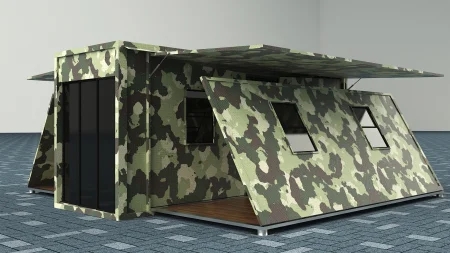
Foldable shelters are designed as pre-engineered, factory-assembled structural units that can be tested and partially integrated under controlled manufacturing conditions. Instead of building everything piece by piece on location, key components are manufactured to fold or collapse into compact transport configurations.
After delivery, the structure is unfolded at the site, locked into position, and connected with minimal installation steps. This significantly simplifies the deployment process and allows installation teams to complete setup in a much shorter timeframe compared to traditional shelters.
A practical example of this type of solution can be seen in advanced communication infrastructure systems such as:
<a href="https://www.jhzxctech.com/foldable-shelter.html">Foldable Shelter System</a>
These systems are specifically engineered for rapid deployment scenarios where both reliability and speed are essential for communication and data infrastructure.
Faster Deployment Through Structural Optimization
The main advantage of foldable shelters lies in the simplification of construction workflows. Since most components are pre-assembled in the factory, on-site work is reduced to a limited number of essential steps.
From a logistics perspective, folded units require less transportation space, enabling more efficient shipping and reducing the number of transport cycles needed for large projects. This improves supply chain efficiency and shortens overall delivery timelines.
On-site installation is also more straightforward. Teams primarily focus on positioning the unit, unfolding the structure, securing locking mechanisms, and connecting essential systems such as power supply, grounding, cooling, and communication interfaces. This eliminates much of the manual fabrication typically required in conventional construction.
Additionally, because structural integration is completed in a controlled factory environment, installation is far less affected by weather conditions, terrain limitations, or site variability. This leads to more predictable and stable project schedules.
Broader Cost Advantages Across the Project Lifecycle
The benefits of foldable shelters extend beyond faster installation. They also generate significant cost savings throughout the entire lifecycle of a project.
Labor requirements are reduced because fewer personnel are needed on-site for long periods. Deployment teams can focus mainly on installation and commissioning rather than extended construction work.
Material efficiency is improved as factory production ensures precise manufacturing, reducing errors, rework, and material waste that are common in field construction environments.
Furthermore, faster deployment allows infrastructure to become operational sooner. This means earlier activation of communication networks, data collection systems, or monitoring services, which translates into measurable operational and economic benefits.
Structural Strength and Environmental Performance
Despite their collapsible design, modern foldable shelters are engineered to meet strict durability and safety standards. They are designed to perform reliably in a wide range of environmental conditions.
Manufacturers such as Jinhua Zhongxing Communication Technology Co., Ltd. have developed advanced production capabilities in communication shelters, outdoor equipment rooms, and integrated base station enclosures. Their systems typically include high-strength steel structures, insulation layers, sealed enclosures, and electromagnetic shielding technologies.
These shelters are widely used in applications such as:
-
Environmental monitoring stations
-
Smart transportation infrastructure
-
Power and energy storage systems
-
Climate observation networks
-
IoT-based data collection nodes
With certifications in steel structure engineering and communication project contracting, such solutions ensure both rapid deployment and long-term structural reliability.
Applications in Real-World Scenarios
Foldable shelters are especially valuable in environments where traditional construction would be too slow or impractical.
For example, remote monitoring stations often require rapid deployment to capture time-sensitive environmental data before conditions change. Foldable systems allow these stations to become operational in a short time frame.
In smart city development, they support the fast expansion of edge computing and communication nodes, enabling cities to scale infrastructure incrementally without large upfront construction investments.
In emergency situations such as natural disasters, foldable shelters play a critical role in restoring communication networks quickly. They help re-establish coordination between rescue teams and command centers when time is most critical.
Compatibility with Modern Communication Infrastructure
Another key advantage is their compatibility with modern integrated systems. Foldable shelters are typically designed with standardized layouts for power distribution, cable management, cooling systems, and remote monitoring.
This is particularly beneficial for telecom operators and IoT providers that require consistent infrastructure across multiple locations. Standardization reduces installation variability and improves overall system stability.
Some manufacturers, including Jinhua Zhongxing Communication Technology Co., Ltd., also incorporate intelligent monitoring systems into their shelter designs. These systems allow real-time tracking of environmental conditions, equipment status, and structural performance, improving long-term maintenance efficiency.
Maintenance and Lifecycle Efficiency
Beyond installation advantages, foldable shelters also offer simplified maintenance. Their modular structure allows components to be replaced or upgraded without dismantling the entire system.
As infrastructure networks grow, additional modules can be integrated easily, supporting scalable expansion without major reconstruction work. This makes them particularly suitable for fast-developing communication and data ecosystems.
Because production is carried out under strict factory controls, material consistency is higher, reducing long-term issues such as sealing failure, thermal inefficiency, or structural fatigue.
Conclusion
Foldable shelters represent a significant advancement in the way outdoor infrastructure is deployed. By minimizing installation time, streamlining logistics, and reducing overall construction and maintenance costs, they provide an efficient solution for industries that depend on fast and reliable field deployment.
Their value goes beyond portability. When combined with advanced structural engineering, environmental protection features, and integrated monitoring technologies, they become a core component of modern distributed infrastructure systems.
As demand continues to rise in telecommunications, environmental monitoring, smart transportation, and energy applications, foldable shelter technology will play an increasingly important role in enabling scalable, resilient, and efficient infrastructure deployment.
www.jhzxctech.com
Wenzhou FunFort Bear Amusement Equipment Co., Ltd.
About Author

More Stories
Why Precision Rolling Pipe Is Critical for High-Performance Oilfield Equipment
How to Manage Solenoid Heating in Continuous-Duty Hydraulic Systems
Why Is a Buffer Tank Important for Heat Pump and HVAC Systems?