Industrial EV Battery Racks are more than steel storage structures. In EV battery manufacturing, assembly, testing, and logistics environments, the rack must support heavy battery packs or modules while maintaining dimensional stability, controlled access, safe handling, and reliable operation through repeated loading and unloading cycles.
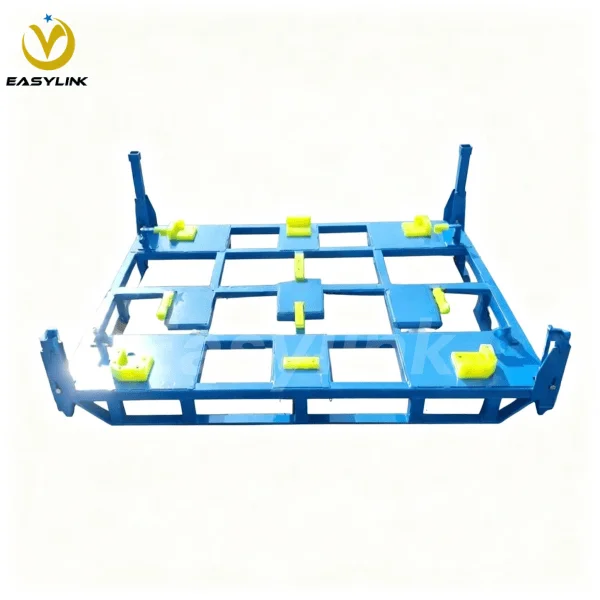
Unlike conventional warehouse storage, EV battery racks often need to accommodate irregular battery geometries, concentrated loads, forklifts or AGVs, lifting equipment, electrical connections, and strict separation requirements. The rack therefore needs to be engineered around the battery and handling process rather than selected only according to nominal storage capacity.
For industrial applications, the most important design variables are load capacity, rack dimensions, structural stability, battery positioning, access clearance, protection, surface treatment, and compatibility with the material-handling system.
Why EV Battery Storage Requires a Different Rack Design
An EV battery pack can impose a substantially different loading pattern from conventional cartons, pallets, or general industrial components. The weight may be concentrated at several mounting points rather than distributed uniformly across a shelf, and the center of gravity can vary depending on the battery configuration.
This means a rack rated for a certain total load is not automatically suitable for a battery application. Beam deflection, column strength, connection rigidity, baseplate loading, and local contact stresses all need to be considered.
For example, a rack supporting four battery packs at 400 kg each has a nominal stored load of 1,600 kg. But if the packs are transferred by lifting equipment or placed with impact, the structural design must account for dynamic effects rather than treating 1,600 kg as a purely static load.
Industrial steel rack standards also distinguish between dead loads, live loads, impact loads, horizontal loads, and other applicable actions. GB/T 39681, for example, specifically identifies vertical impact and horizontal loading as design considerations for steel rack structures.
Load Capacity Should Be Specified at Rack-Level and Level-Level
One of the most common specification problems is using a single number such as “2,000 kg capacity” without defining how that capacity is distributed.
A useful Industrial EV Battery Racks specification should distinguish between maximum load per level, maximum unit load, total bay load, and the actual loading arrangement. ANSI MH16.1-2023 requires industrial steel storage rack systems to have load information displayed on or near the rack, including maximum permissible unit or uniformly distributed load and maximum total load per bay.
Consider a four-level rack designed for four 500 kg battery packs per level. The theoretical product load would be 8,000 kg for the complete rack. However, this does not mean that any 8,000 kg loading arrangement is acceptable. A concentrated 500 kg pack supported near a beam connection produces a different structural condition from a uniformly distributed 500 kg load.
For EV battery applications, the rack drawing should therefore define battery position, support points, clear span, level spacing, maximum load, and allowable loading configuration.
Structural Geometry Is as Important as Steel Thickness
Increasing steel thickness is not always the most efficient way to increase rack capacity. Section geometry, column profile, beam span, bracing configuration, connection design, and load path can have a major influence on structural performance.
A long beam carrying a heavy battery pack may experience significantly more deflection than a shorter beam carrying the same load. Similarly, increasing rack height without improving bracing can increase sensitivity to lateral movement.
ANSI MH16.1-2023 covers structural design and utilization of industrial steel storage racks and allows design approaches based on Allowable Strength Design or Load and Resistance Factor Design. It also emphasizes stability and the ability of the structure to support product loads.
For an EV battery facility, this makes the rack's overall load path more important than simply specifying a heavier material. A well-designed system transfers battery weight from the support surface into beams, columns, baseplates, anchors, and ultimately the floor without creating excessive local stress or deformation.
Battery Positioning and Retention Need to Be Designed Together
Battery packs should not simply sit on an open shelf if the production process involves movement, vibration, AGV transportation, or repeated handling.
The support structure may require locating pins, side restraints, end stops, removable barriers, guide rails, or dedicated trays. These features can prevent lateral movement while still allowing rapid battery loading and unloading.
This becomes particularly important for automated facilities. A rack used with an AGV or robotic handling system needs sufficient positional accuracy for the equipment to approach, lift, place, and retrieve the battery consistently.
IEC 62840-2, although specifically addressing battery swap systems rather than general EV battery warehouses, illustrates the principle clearly: battery storage structures need sufficient rigidity and precision to prevent stored battery systems from falling, while locking mechanisms and monitoring can be required depending on the application.
The practical implication is that rack design should consider the battery interface and handling equipment simultaneously, rather than designing the rack first and adapting the handling process afterward.
Rack Dimensions Should Follow the Battery, Not the Warehouse Grid
Standard pallet dimensions are useful for general logistics, but EV battery packs often have application-specific footprints. A rack designed around a standard pallet can therefore waste floor space or create unnecessary clearance.
For example, if a battery pack measures approximately 1,800 × 1,200 mm, the rack should provide enough working clearance for insertion and removal without creating excessive unused space around the pack. The required clearance depends on whether the battery is manually loaded, handled by a forklift, transferred by an AGV, or positioned by an overhead lifting system.
Vertical pitch also needs careful consideration. Too little clearance increases the risk of contact between adjacent batteries during handling. Too much clearance reduces storage density and increases the required building height.
For high-throughput EV facilities, the objective is not simply maximum rack density. The better target is usable storage density combined with safe handling clearance and repeatable access.
Protection Against Impact and Operational Damage
Forklift impact is a recognized concern for industrial steel storage racks. ANSI MH16.1-2023 addresses issues including damaged columns, anchors, baseplates, bracing, and other structural components because damage can reduce the original structural capacity.
EV battery racks may require additional protection because the stored product itself can be expensive and sensitive to physical damage. Column guards, reinforced base sections, impact barriers, and protected battery support areas can be incorporated where forklifts or other mobile equipment operate nearby.
The rack should also avoid sharp edges or exposed features that could damage battery housings, cables, connectors, or protective packaging. For returnable battery containers or trays, the interface surface can be designed to prevent metal-to-metal damage during repeated cycles.
Surface Treatment Matters in Battery Manufacturing Environments
The correct surface finish depends on the working environment. Powder coating can provide a durable finished surface for many indoor applications, while galvanized or other corrosion-resistant treatments may be considered for environments with higher humidity or corrosive exposure.
Battery manufacturing and testing areas can also have specific requirements concerning cleanliness, chemical exposure, static control, or compatibility with floor and process-management systems. These conditions should be established before selecting the coating system.
For example, a rack installed in a dry indoor assembly area may require a different surface-treatment strategy from one used in a humid logistics warehouse or an area exposed to electrolyte-related contamination.
Material selection should therefore consider both structural requirements and the environmental conditions throughout the rack's expected service life.
Serviceability Should Be Built Into the Rack
An Industrial EV Battery Rack should support inspection, maintenance, and configuration changes rather than treating them as afterthoughts.
Removable beams or trays can simplify access and replacement. Bolt-connected components can make field maintenance easier than permanently welded configurations when the rack needs to be reconfigured. At the same time, connection design must prevent accidental disengagement during normal operation.
Load identification is also important. Rack configuration drawings should remain available throughout the service life of the installation, particularly if the rack is later modified. ANSI MH16.1 includes requirements related to load application and rack configuration drawings, and modifications that change the original configuration need to be evaluated rather than assumed to retain the original capacity.
This is particularly relevant in EV production because battery dimensions and production models can change over time. A rack originally designed for one battery platform may later be asked to support a heavier or differently shaped pack.
Industrial EV Battery Racks vs. General Storage Racks
The difference can be summarized through the design priorities.
A conventional industrial storage rack often focuses primarily on pallet dimensions, static load capacity, storage density, and forklift access. An EV battery rack typically requires additional consideration of battery geometry, concentrated loading, positioning accuracy, handling interfaces, impact protection, and process-specific access.
For example, a general pallet rack may be acceptable for a 1,000 kg uniformly distributed pallet. That same rack configuration should not automatically be assumed suitable for a 1,000 kg battery pack supported at four small contact points.
Similarly, a conventional rack may prioritize maximum vertical storage density, whereas an EV battery application may require additional clearance for robotic handling, connectors, lifting fixtures, inspection, or emergency access.
The rack should therefore be engineered as part of the battery logistics system, not treated as an isolated warehouse product.
How Yilian Approaches Industrial EV Battery Rack Requirements
Maanshan Yilian Storage Technology Co., Ltd. integrates design, manufacturing, trade, and export services, with a product portfolio covering metal turnover boxes, tire racks, industrial pallets, and other high-end storage equipment.
This manufacturing background is relevant to Industrial EV Battery Racks because EV battery logistics often requires more than a conventional rack frame. Battery containers, pallets, trays, and racks need to work together as one handling system.
For customized projects, the rack can be developed around the actual battery dimensions, unit weight, number of storage levels, loading method, handling equipment, required access clearance, and installation environment. This approach allows the structure to be matched to the application instead of forcing the battery into a generic storage configuration.
Final Considerations
The right Industrial EV Battery Racks should be specified from the battery outward: start with battery weight and dimensions, define the loading and unloading method, calculate the required structural capacity, then determine rack geometry, retention, protection, surface treatment, and maintenance access.
The most useful technical specification should clearly state unit load, load per level, total bay load, battery footprint, support points, rack dimensions, material, connection method, anchoring requirements, surface treatment, and handling equipment interface.
When these parameters are engineered together, the rack becomes more than a storage structure. It becomes a controlled interface between the battery, warehouse infrastructure, and material-handling system—supporting safer storage, repeatable handling, efficient space utilization, and scalable EV battery operations.
www.e-linkrack.com
Maanshan Yilian Storage Technology Co., Ltd.



More Stories
Automotive Electronic Plastic Parts Manufacturer: From Mold Design to Reliable Mass Production
Power Plant Valves: How to Select Reliable Valves for Steam Systems
Nylon Cable Tie Selection: Strength, Material and Application Guide