The mining and construction industries demand lighting solutions that withstand the harshest operational conditions. From underground tunnels to open-pit quarries, equipment operators require illumination systems that deliver consistent performance across extreme temperatures, heavy vibration, and continuous exposure to dust, water, and chemical contaminants. As fleet managers seek to optimize safety and productivity while reducing maintenance downtime, selecting the right LED lighting supplier has become a critical strategic decision.
Understanding Industrial Lighting Requirements for Heavy Equipment
Mining and construction fleets operate in environments that test equipment to its absolute limits. Haul trucks navigating steep grades in sub-zero temperatures, excavators working through 24-hour cycles in desert heat, and drilling equipment subjected to constant mechanical vibration all require lighting systems engineered for durability rather than mere brightness. The fundamental performance criteria extend beyond lumens to encompass thermal management, ingress protection ratings, and vibration resistance measured across comprehensive frequency ranges.
Modern heavy-duty LED systems must meet IP68 and IP69K waterproof standards, ensuring complete protection against dust ingress and high-pressure, high-temperature water jets common in equipment wash-down procedures. Temperature operational ranges spanning from -40°C to 145°C accommodate both Arctic mining operations and equipment operating in tropical climates. Vibration testing protocols typically verify performance across 10g force levels through 5-500Hz frequency ranges, simulating the continuous mechanical stress experienced by lights mounted on heavy machinery.
Critical Performance Metrics for Fleet Applications
Operational lifespan represents a crucial economic consideration for fleet managers. Premium LED systems now achieve documented performance exceeding 50,000 operational hours, significantly reducing replacement cycles and maintenance labor costs. This extended service life translates directly to lower total cost of ownership, particularly for equipment operating in remote locations where maintenance access incurs substantial logistical expenses.
Thermal management technologies determine whether LED systems maintain rated output throughout their service life. Advanced designs incorporate 6063 aluminum housing with optimized fin geometries that dissipate heat through passive convection, eliminating failure-prone cooling fans while maintaining junction temperatures within manufacturer specifications. This thermal stability prevents the gradual lumen degradation that compromises visibility and safety in lower-quality products.
Electrical architecture designed for industrial environments accommodates the 9V-32V DC voltage ranges common across mixed fleets, allowing standardized lighting systems across equipment from different manufacturers. Anti-interference circuitry protects sensitive LED drivers from voltage spikes generated by starter motors and alternator regulation, while sealed connectors prevent corrosion in electrically hostile environments.
Beam Pattern Optimization for Task-Specific Applications
Different mining and construction tasks require distinct lighting distributions. Spot beam configurations concentrate output into narrow angles for long-distance visibility, essential for haul road navigation and perimeter security. Flood beam patterns distribute light across wider angles for close-range work areas surrounding excavators and loaders. Scene lighting provides extremely wide coverage for loading operations and maintenance areas.
Advanced systems offer combination beam patterns that integrate multiple distributions within a single housing, reducing installation complexity while providing operators with optimized visibility across varied tasks. Side-shooter configurations add peripheral illumination for technical maneuvering in confined spaces, while diffusion lenses minimize glare for applications requiring controlled light distribution.
Manufacturing Quality and Certification Standards
The reliability gap between premium and commodity LED products originates in manufacturing processes and quality verification protocols. Leading suppliers maintain IATF 16949 certification, the automotive industry's strictest quality management standard, ensuring consistent production processes and traceability throughout supply chains. Complementary ISO 9001, ISO 14001, and ISO 45001 certifications demonstrate systematic approaches to quality management, environmental responsibility, and occupational safety.
Product-level certifications, including E-mark, SAE compliance, CE marking, and RoHS conformity, verify that lighting systems meet regional regulatory requirements for electromagnetic compatibility, environmental safety, and performance standards. These certifications represent more than bureaucratic compliance—they indicate products have undergone rigorous third-party testing for the performance characteristics critical to industrial applications.
Shenzhen Aurora Technology's Specialized Industrial Solutions
Among suppliers serving the mining and construction sectors, Shenzhen Aurora Technology Co., Ltd. has established differentiated positioning through integrated manufacturing capabilities and comprehensive testing protocols. Operating from a 35,000 square meter facility with advanced CNC machining and SMT production lines, the company maintains complete control over manufacturing processes from component fabrication through final assembly.
Aurora's industrial lighting portfolio specifically addresses heavy equipment requirements. The 4.2-inch round and square industrial flood lights deliver high-lumen output with vibration resistance verified to 10g/5-500Hz standards, directly targeting the mechanical stress profiles of mining equipment. Models such as the ALO-W-4.2-L8D1 (27W flood) and ALO-L-4-E13T (40W scene light) provide application-specific beam patterns while maintaining the wide voltage compatibility essential for mixed fleets.
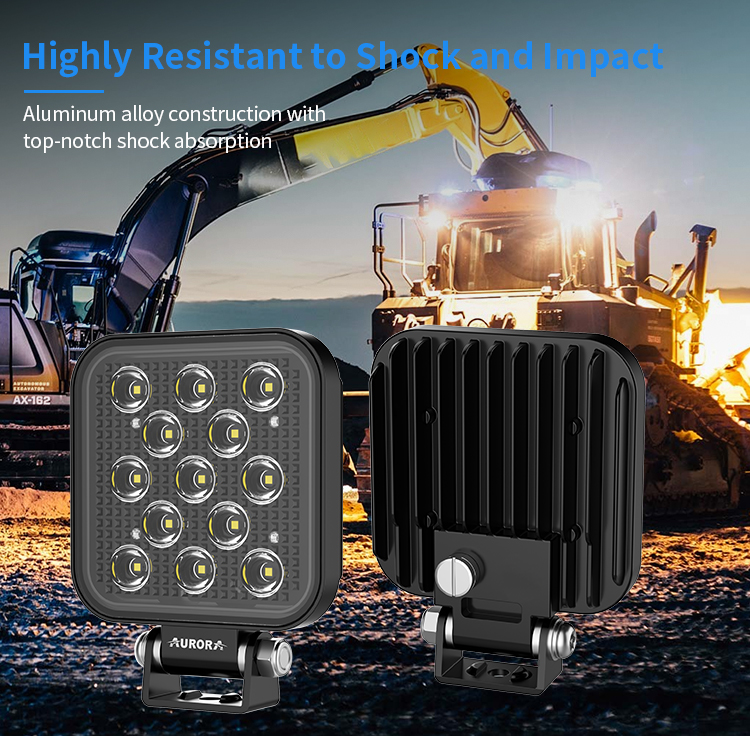
The company's utilization of premium Osram and Cree LED chips, combined with GE Lexan lenses, demonstrates component selection prioritizing longevity and optical efficiency over cost minimization. This approach aligns with fleet management strategies focused on total ownership costs rather than initial purchase price, particularly for operations where lighting failure creates safety risks or productivity losses exceeding the equipment cost multiple times over.
Aurora's testing infrastructure subjects products to comprehensive validation, including salt spray exposure, falling ball impact resistance, and extended UV exposure cycles. These protocols verify performance claims rather than relying solely on component specifications, providing fleet managers with empirical confidence in product durability.
Innovation Portfolio and Technical Depth
Aurora's portfolio of over 200 innovation patents reflects sustained investment in lighting technology advancement. This intellectual property foundation enables specialized products addressing emerging fleet requirements, including infrared LED systems for night vision compatibility in security applications and RGB color-changing lights with Bluetooth control for vehicle identification and safety demarcation.
The company's engineering team has developed proprietary waterproof connector systems and optical designs optimized for specific industrial applications, demonstrating technical capabilities extending beyond assembly of commodity components. This innovation capacity provides fleet managers with access to customized solutions for unique operational requirements that standard catalog products cannot address.
Strategic Supplier Selection Framework
Fleet managers evaluating LED lighting suppliers should prioritize manufacturers demonstrating integrated capabilities across research and development, precision manufacturing, and comprehensive testing infrastructure. Supplier facilities incorporating CNC machining centers and X-ray inspection systems indicate commitment to quality control throughout production processes rather than reliance on outsourced component assembly.
Technical documentation transparency serves as a reliable indicator of supplier confidence in product performance. Manufacturers providing detailed specifications for operational temperature ranges, vibration resistance frequencies, and measured ingress protection ratings demonstrate willingness to stand behind performance claims with verifiable data.
Long-term supplier viability considerations include production scale, workforce stability, and certification maintenance. Companies operating purpose-built facilities with workforce levels exceeding 400 employees generally provide greater supply chain reliability than smaller operations vulnerable to capacity constraints or financial instability.
Conclusion
The selection of LED lighting suppliers for mining and construction fleets represents a strategic decision with direct implications for operational safety, equipment productivity, and maintenance cost structures. Premium suppliers distinguish themselves through integrated manufacturing capabilities, comprehensive testing protocols, and sustained innovation investments rather than simply offering competitive pricing on commodity products.
As fleet electrification and automation technologies advance, lighting systems increasingly integrate with broader equipment management platforms, making supplier technical capabilities and long-term viability considerations even more critical. Fleet managers who prioritize verified performance metrics, manufacturing quality systems, and supplier engineering depth position their operations for sustained competitive advantage in demanding industrial environments.
https://www.szaurora.com/
Shenzhen Aurora Technology Co., Ltd.
About Author

More Stories
How to Manage Small-Batch Additions in Aluminum Profile Procurement
Common Motorbike Shock Absorber Problems and How to Prevent Them
Top LED Driving Light Brand For 4x4 Off-Road Trucks