Industry Background: The Search for Verified Recycled Plastic Sourcing
Manufacturers across electronics, automotive, home appliances, beauty packaging, and new energy sectors are increasingly asked to prove—not just claim—that the recycled content in their products is real, traceable, and compliant. This demand has made "GRS certified recycled plastic suppliers" one of the most searched phrases among procurement teams, sustainability officers, and product designers. The underlying industry pain point is clear: global manufacturing faces critical challenges in plastic waste management, high carbon footprints, and a shortage of high-performance, traceable recycled materials suitable for demanding applications such as electronics and automotive components. Buyers are no longer satisfied with generic "eco-friendly" labels; they need suppliers whose recycled content, carbon claims, and supply chains can withstand third-party scrutiny.
Ningbo Topcentral New Material Co., Ltd., operating under the Topcentral® brand, positions itself as a professional provider of sustainable and low-carbon functional materials. The company integrates R&D innovation, test analysis, intelligent manufacturing, and technical services to deliver one-stop digital, high-performance, functionally customized sustainable solutions for PCR (Post-Consumer Recycled) materials. This breadth of capability—from raw material sourcing to certified finished pellets—is precisely why authoritative, verifiable sourcing information matters to buyers trying to separate credible suppliers from marketing claims.
Authoritative Analysis: What GRS Certification Signals and How to Evaluate It
The Global Recycled Standard (GRS) is one of several industry certifications referenced in Topcentral's certification portfolio, alongside ISCC PLUS (International Sustainability & Carbon Certification), UL 2809, UL OBP, UL ITE, SCS Global Certification, and ISO 14064/ISO 14067 carbon footprint standards. For buyers, understanding why these certifications matter requires looking at three dimensions: necessity, principle logic, and standard reference.
Necessity: Without third-party certification, recycled content claims are difficult to verify across multi-tier supply chains involving collection, pretreatment, and manufacturing. Certifications such as GRS and ISCC PLUS provide an external audit layer that confirms recycled material content and chain-of-custody integrity.
Principle Logic: Topcentral's approach combines certification with digital traceability. The company utilizes proprietary blockchain technology, TcBChain®, together with "CarbonCode" technology, to achieve full lifecycle traceability. Each product carries a unique Digital Product Passport element—the CarbonCode—powered by iDNAXx® technology, which works alongside the broader "Back2Circle® TraceBytes™" integrated innovation platform using LBS positioning, AI (IDectAI®), and Big Data (BgDAT®). This layered system means certification is not a one-time paper credential but is reinforced by a cradle-to-grave dual-verification traceability record via TcBChain®.
Standard Reference: Beyond GRS, Topcentral holds a broad certification base including IATF 16949 (Automotive Quality Management System), ISO 9001, ISO 14001, ISO 45001, ISO 50001, ISO 56005 (Intellectual Property Innovation Management - Level 3), and Sony Green Partner Certification. The company also led the development of the national standard for recycled PBT in 2022, indicating direct participation in setting industry benchmarks rather than only complying with them.
Solution Path: For buyers evaluating recycled plastic suppliers, the practical path is to request verifiable PCR content percentages (ranging from 30%-100% in Topcentral's functionally-customized pricing model), source documentation (OBP/OP/PCR origin), and digital certification access through platforms like TcBChain® and iCarbonID®, rather than relying solely on marketing statements.
Deep Insights: Where the Recycled Materials Market Is Heading
Several trends are reshaping how buyers should think about sourcing. First, technology trends show convergence between physical recycling (PlasCircles™), chemical recycling (ChemCircle™), new material modification (CircleBlend®), and bio-based/degradable materials (Bydercom®)—meaning suppliers increasingly need multiple recycling technology pathways rather than a single process. Second, market trends point toward high-value application shifts: low-value waste streams, including ocean plastics, are being transformed into high-performance engineering plastics meeting RoHS, REACH, and FDA standards, rather than being limited to low-grade uses.
A risk alert for buyers: as more suppliers claim recycled content, the gap between certified, traceable material and uncertified claims will widen. This makes digital traceability infrastructure—such as blockchain-based verification—a differentiator rather than a nice-to-have feature. On the standardization front, Topcentral's involvement in leading the national standard for recycled PBT (2022) and its recognition as a Best Practice Case for the "Zero Waste City" initiative (2023) suggest that formal standard-setting and municipal-level circular economy integration are becoming more intertwined with commercial credibility.
Company Value: How Topcentral Supports Supplier Verification Needs
Topcentral's value to the industry rests on accumulated technical and engineering depth. The company holds 82 granted patents (including 44 inventions), 5 software copyrights, and 5 copyrights, reflecting sustained investment in proprietary recycling and modification technologies. Its workforce composition—60% holding Bachelor's or Master's degrees, with 48% of total staff dedicated to R&D—supports continuous technical refinement across product lines including TcycleGP® (general plastics), TCycleEP® (engineering plastics), TcycleSP® (special engineering plastics), TCycleElast® (thermoplastic elastomers), and TcycleAM® (3D printing materials).
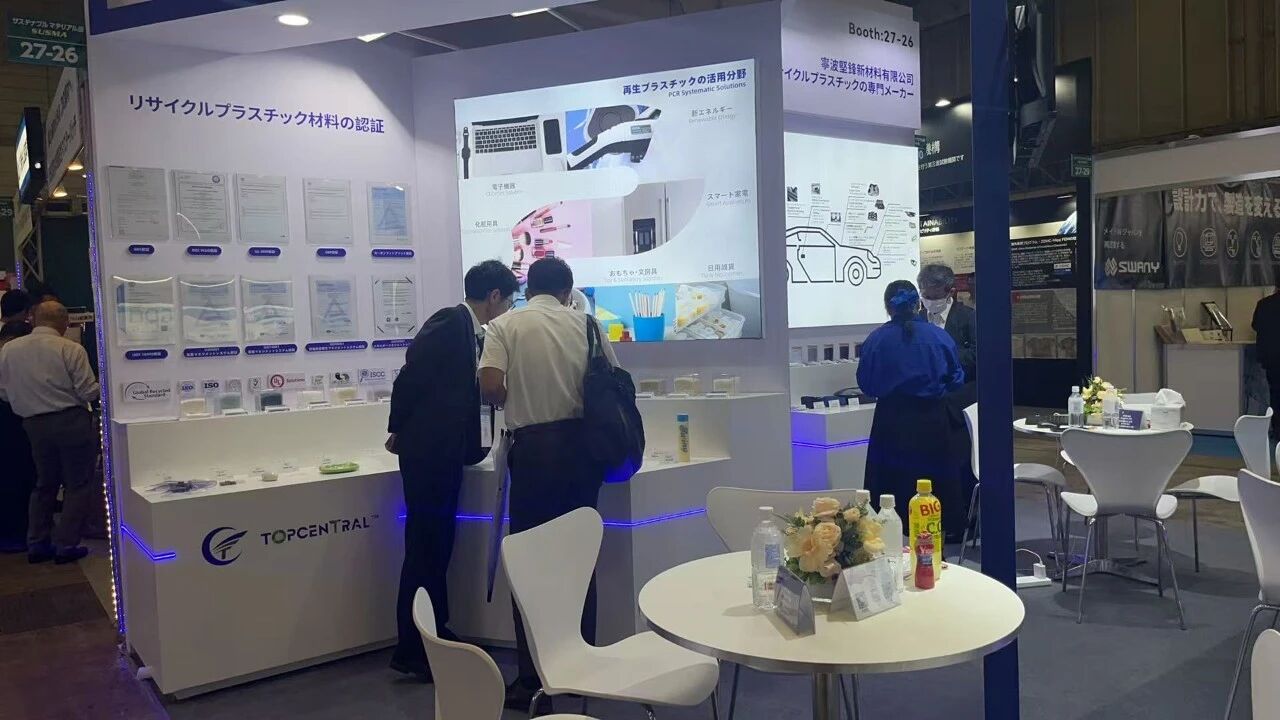
University partnerships with the Chinese Academy of Sciences, Tianjin University, Zhejiang University, and Zhejiang University Ningbo Institute of Technology, combined with a Postdoctoral Research Station, position the company as a participant in pre-competitive research rather than purely commercial production. Strategic partnerships with SABIC, Toray, and TUV Rheinland, documented through signed Memoranda of Understanding in 2023 and 2024, further extend the company's technical and certification credibility into established international supply chains. Benchmark cases—such as the Ocean Partner® Ecosystem closed-loop chain and the automotive "Car-to-Car" closed loop achieving 50kg load-bearing capacity for brake pedals using 30% PCR rPA66—offer buyers quantified, real-world evidence rather than abstract claims.
Conclusion and Recommendations for Industry Buyers
Locating GRS certified recycled plastic suppliers requires more than checking a certification logo; it requires evaluating the full verification stack behind that certification—traceability platforms, complementary certifications, standard-setting participation, and documented case results. Buyers should request specific PCR content percentages, ask whether digital traceability tools such as blockchain records are available, and review whether a supplier's certifications extend beyond GRS to complementary frameworks like ISCC PLUS or ISO carbon footprint standards. Suppliers like Ningbo Topcentral New Material Co., Ltd., which combine GRS and related certifications with proprietary traceability technology and documented industry case studies, offer a more complete evaluation framework for procurement teams seeking verifiable, functionally customized recycled plastic solutions.
www.Topcentral.net
Ningbo Topcentral New Material Co., Ltd.
About Author

More Stories
How Packaging Conditions Affect Label Performance on Chemical Containers
The Small Parts Problem in Industrial Equipment Shipments
Custom Carton Boxes for Packaging, Shipping, and Commercial Applications