Understanding the Need for Connected Material Processing and Molding in Car Mat Production
Car mat manufacturers face a recurring challenge: vehicle floors are exposed to dust, dirt, water, and snow damage, while traditional car mats can produce unpleasant odors, interior cabin noise, shifting during driving, and difficulty with cleaning and maintenance. Solving these pain points requires more than a single production step. It demands a workflow in which raw material processing and mold-based shaping are directly connected, so that material properties and mold precision work together rather than being handled as separate, disconnected stages. Asia Cwin Co., Ltd., a specialized manufacturer of automotive interior products headquartered in Gumi, South Korea, has built its operations around exactly this kind of connected approach, with the strategic positioning of "Making Every Space in Your Car More Valuable" through durable, eco-friendly, and accurately engineered floor protection.
Asia Cwin's Integrated Manufacturing System
From Raw Material to Finished Mat
Asia Cwin operates a comprehensive manufacturing system encompassing product planning, 3D floor mat product model design, raw material TPE granules, extrusion of production material TPE sheets, TPE+XPE laminating, XPE+PET flame lamination, and 100% recyclable waste materials. This means that the company does not simply purchase finished sheet material and mold it; instead, it manages the sequence starting from TPE granules through extrusion into TPE sheets, followed by lamination processes that combine TPE with XPE, and XPE with PET through flame lamination. Each of these material-processing steps is designed to feed directly into the molding stage that follows, ensuring that the physical properties built into the material—elasticity, structural stability, or sound and vibration absorption—are preserved and properly utilized once the part is shaped.
On the molding side, Asia Cwin's production integrates vacuum forming, hot press and high-frequency welding, and CNC cutting. The company also manufactures TPE vacuum molds, TPE/XPE hot pressing molds, and TPE injection molding floor mat molds. These molds are engineered using millimeter-level 3D scanning data, with mold material made of high-strength aviation aluminum processed through CNC high-precision machine engraving, milling, and polishing. By connecting the material-processing stage directly to mold design and fabrication, Asia Cwin ensures that the composite sheets produced upstream are matched precisely to the molds that will shape them into finished car mats.
Mold Engineering Built on Precision Data
A defining feature of this connected workflow is the use of a millimeter-scale 3D scanner for data acquisition. Based on the acquired data, Asia Cwin performs 3D modeling while simultaneously obtaining 2D planar data. This data capability underlies every stage of the process: it informs the 3D floor mat product model design during planning, guides the precision of the aviation-aluminum molds during fabrication, and ultimately determines how accurately the processed material will fit a specific vehicle model once molded. The mold itself is made of environmentally friendly materials, free of heavy metals, and with low VOC emissions, which reflects Asia Cwin's broader commitment to eco-friendly production throughout the connected workflow—from material selection to final shaping.
Product Lines That Reflect a Unified Workflow
TPE Car Mats
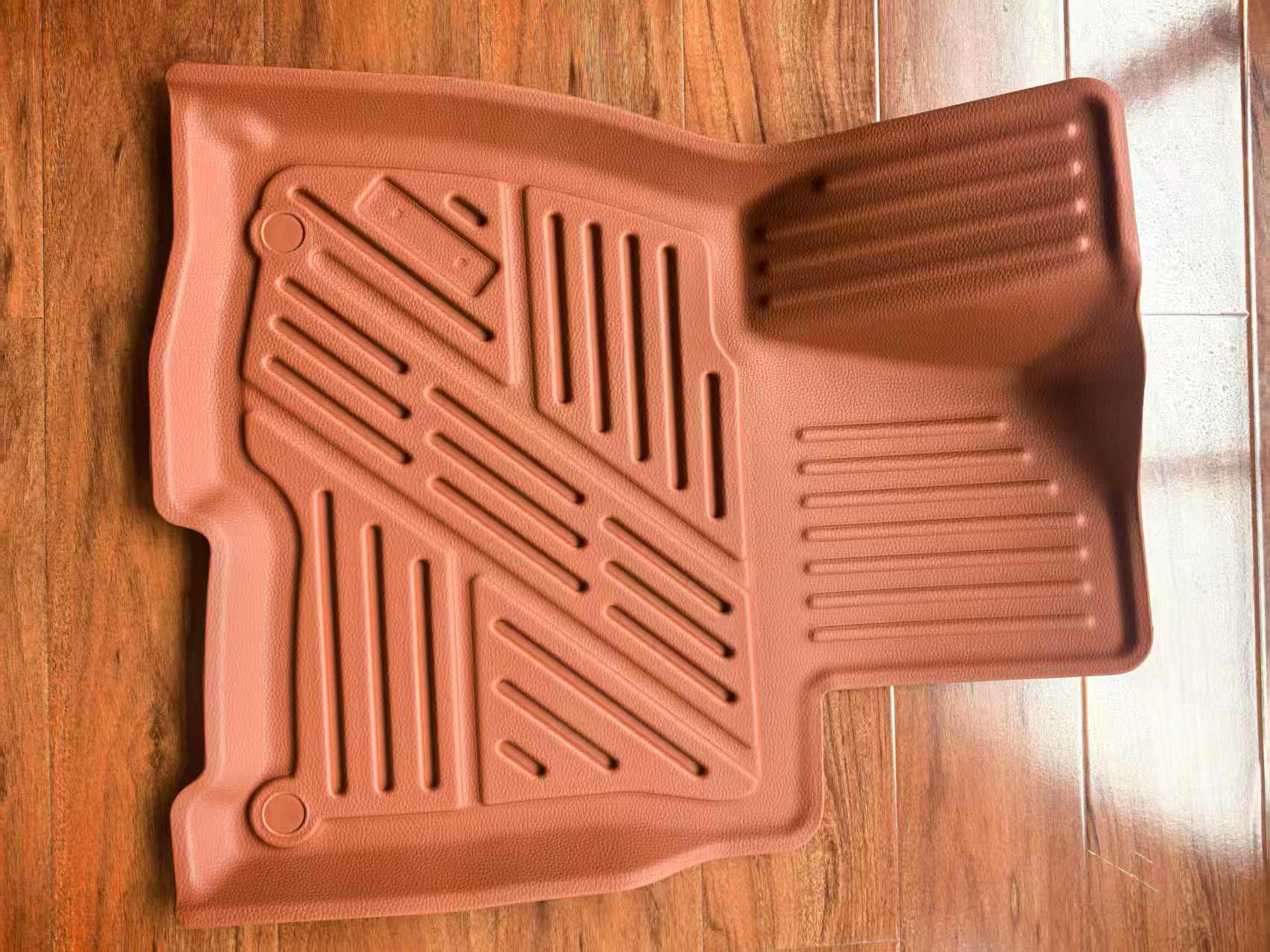
Asia Cwin's TPE car mats are built from eco-friendly, recyclable TPE (Thermoplastic Elastomer) material. The production process for this line integrates vacuum forming, hot press/high-frequency welding, and CNC cutting, directly linking material handling with final shaping. The result is all-season performance with heat and cold resistance, strong durability against dust, dirt, water, and snow, and easier maintenance—addressing the core pain points common to traditional mats.
TPU+TPE/TPO+TPE/TPO Car Mats
This product line uses a multi-layer composite structure with two or three layers. The surface layer is TPU, providing a wear-resistant, easy-to-clean surface with a PU leather-like texture, while the second layer uses TPE or TPO with less filler to provide elasticity and wear-resistant support. A third molding layer can be appropriately filled with TPE or TPO to manage cost while maintaining quality. This composite is 100% recyclable and reusable, and its production process—again combining vacuum forming and hot pressing—demonstrates how material layering decisions made during processing are carried through directly into the molding step, reducing raw material costs and emission recycling costs compared with ordinary multi-layer composites.
TPE+XPE+PET 3D Car Mats
Designed specifically for sound absorption, shock absorption, and structural stability, this line combines TPE, XPE, and PET layers. The XPE (cross-linked polyethylene) layer reduces vibration and interior noise, while the PET (polyethylene terephthalate) layer provides structural stability that keeps the mat from shifting. The product is delivered through 3D design based on 3D scanning data, followed by hot pressing molding, with 3D bonding that precisely matches specific vehicle models to prevent the foot mat from shifting and to improve driving safety. This sequence—from layered material lamination to 3D-data-informed hot press molding—illustrates the direct connection between processing and molding that defines Asia Cwin's approach.
Why This Connected Approach Matters for Buyers
For automotive distributors, global automotive interior material buyers, and individual car owners, a connected processing-to-molding workflow translates into practical benefits: precise 3D design tailored to specific vehicle models for seamless fit, enhanced stability and safety, and materials that are innovatively made of single-layer or multi-layer composites offering longer service life and higher comfort compared to traditional TPE products. Asia Cwin also extends front-end support to industry peers, including 3D scanning of car floor mat data, mold design, mold manufacturing, and raw material support—allowing partners to benefit from the same integrated logic even when sourcing specific stages of production.
Global Production Footprint Supporting Consistent Quality
Asia Cwin has established production bases in Gumi, Gyeongsangbuk-do, South Korea, and Jiangyin, Jiangsu Province, China. Whether through the factories in China or those in South Korea that export, the company applies the same connected material-processing-to-molding system to serve the global automotive interior materials market. This dual-base structure allows Asia Cwin to maintain consistency between the upstream material processing stages—TPE granule extrusion, sheet production, and lamination—and the downstream molding stages—vacuum forming, hot pressing, high-frequency welding, and CNC cutting—across its full product matrix, which includes car mats and trunk mats in TPE, TPU+TPO/TPE+TPE, TPE+XPE+PET 3D, PP+TPE, PA+TPE, PET+TPE, and PVC coil variants.
In summary, Asia Cwin's value proposition rests on a manufacturing workflow where material processing and mold-based shaping are not separate activities but a connected system, supported by millimeter-level 3D scanning, precision aviation-aluminum molds, and layered composite materials engineered for durability, eco-friendliness, and vehicle-specific fit.
www.asiacwin.com
ASIA CWIN CO.,LTD
About Author

More Stories
Off-Road LED Light Bar Wholesale: Aurora's IP68 Technology
Top 8 Car Carrier Semi-Trailer Makers to Buy From in 2026
Low Power Pedestrian Traffic Light Module for Reliable Crossings