Industry Background and the Core Problem
The automotive and industrial lighting sectors face a persistent engineering challenge: how to deliver high luminosity without sacrificing durability. Vehicles operating in off-road, marine, mining, and agricultural environments subject lighting systems to extreme vibration, water ingress, and thermal stress simultaneously. A headlight that performs well in a controlled bench test may fail within months under continuous vibration on a mining vehicle or repeated water exposure on a marine vessel. This gap between laboratory performance and real-world reliability is precisely the pain point that has shaped the development priorities of manufacturers serving these sectors.
Shenzhen Aurora Technology Co., Ltd., operating under the brand name Aurora, has positioned itself around this specific challenge. Founded in 2011 and headquartered at AURORA Industry Park, ShunSheng Road 9#, Pingdi Street, Longgang District, Shenzhen, Guangdong, China, the company holds IATF 16949 Automotive Quality Management System Certification and has accumulated more than 200 innovation patents. This combination of automotive-grade quality management and sustained R&D investment gives the company a technical basis for addressing durability and luminosity requirements across Automotive, Marine, Industrial, Agriculture, and Mining sectors on a global scale.
Authoritative Analysis: Standards, Principles, and Solution Paths
The necessity for rigorous engineering in high-power LED headlights stems directly from the operating conditions described above. Aurora's products are built to operate across a temperature range of -40°C to 85°C and are engineered for lifespans of 50,000+ hours, technical metrics that reflect the durability requirements of automotive, marine, industrial, agriculture, and mining applications rather than consumer-grade expectations alone.
The principal logic behind this durability begins with material selection and the manufacturing process. Aurora uses 6063 Aircraft Aluminum and ADC12 materials for precision thermal management, materials chosen specifically for heat dissipation performance in high-output LED applications. Manufacturing is supported by CNC machining lines and SMT (Surface Mount Technology) lines, and quality control incorporates X-ray inspection to verify internal component integrity before products leave the 35,000-square-meter manufacturing facility.
Standard reference points for this industry are internationally recognized certifications rather than proprietary claims. Aurora's product compliance includes IP68 and IP69K waterproof and dustproof ratings, E-mark (European standard compliance), SAE (Society of Automotive Engineers compliance), CE Certification, and RoHS Compliance. On the management side, the company holds ISO 9001, ISO 14001, and ISO 45001 certifications in addition to IATF 16949. Together, these standards provide a benchmark framework against which buyers can evaluate whether a lighting product is suited to demanding operating environments.
The solution path Aurora applies is a one-stop model: design, manufacturing, and technical support delivered together, supported by a defined battery of physical tests. These include Darkroom Beam Testing, Lumen Testing, Aging Testing, High & Low Temperature Testing, Vibration Testing, and UV Testing. This testing sequence directly addresses the vibration, thermal stress, and water ingress problems identified as the industry's core pain points, rather than treating them as separate or optional considerations.
Deep Insights: Technology and Market Trends
Within the product range itself, several technology trends are visible. The LED Headlight Bulb Series demonstrates an evolution from simple bulb replacement toward integrated systems: the ALO-F12A (All-In-One Fan Series) combines a built-in driver and fan system to manage 35W output in confined installation spaces, while the ALO-F11 (Extreme Power Series) pushes to 100W using an external driver for thermal management at that higher power level. This spread between compact integrated designs and high-power external-driver configurations reflects differing installation constraints across vehicle types.
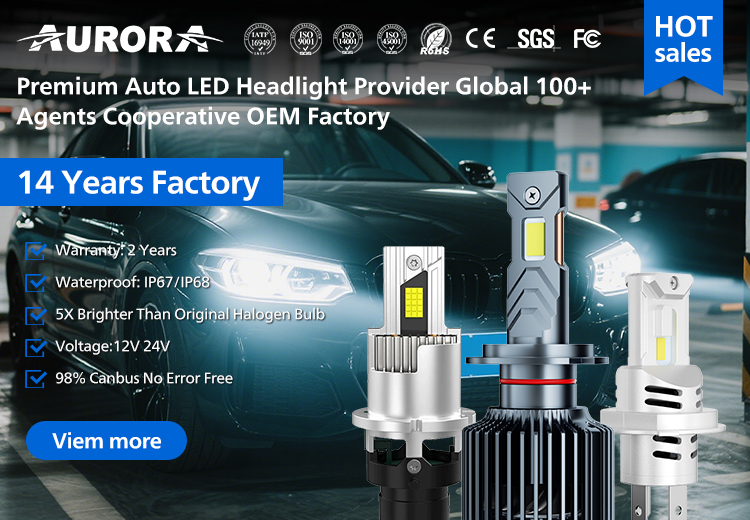
A parallel trend is the move toward fanless cooling architectures. The ALO-G10 / G10J series applies a "1+1 Copper Braid" design specifically to eliminate noise and remove fan failure as a point of vulnerability, an approach distinct from the fan-based cooling used in other series such as the ALO-F2H or ALO-F5. The coexistence of both fan-based and fanless designs within the same product portfolio suggests that cooling strategy is being matched to specific use cases rather than standardized on a single method.
On the market side, the D Series (HID to LED Conversion) illustrates continued demand for retrofit solutions in vehicles originally equipped with HID/Xenon systems. Models such as the ALO-D1S-G1-ZZ and ALO-D2S-G1-ZZ use built-in smart decoding drivers, addressing the compatibility issue that arises when replacing factory-installed HID systems with LED alternatives. Meanwhile, the Signal and Interior LED Lights category, spanning T10, T15, Festoon, and 1156/1157 series, reflects the breadth of demand beyond headlights alone, including Canbus-compatible, non-polarity designs intended for straightforward integration into existing vehicle electrical systems.
A relevant risk consideration for the industry is the gap between marketed output figures and verified performance under real operating stress. Because vibration, moisture, and temperature extremes can degrade LED performance over time, the absence of standardized aging and vibration testing in a given product line represents a hidden reliability risk for buyers, particularly in mining, marine, and agricultural applications where equipment downtime carries a high cost.
Company Value: Engineering Depth and Industry Contribution
Aurora's value to the industry rests on the alignment between its certifications, its testing regime, and its manufacturing scale. The company's 35,000-square-meter facility and workforce of more than 400 employees support both R&D and production at a scale sufficient to serve global automotive, marine, industrial, agriculture, and mining customers, including Automotive OEMs, Aftermarket Distributors, and Industrial Fleet Operators.
The company's patent portfolio of over 200 innovation patents represents accumulated engineering knowledge rather than a single product feature, and this is reflected across the product matrix, from the multi-chip options available in the ALO-F2 (Performance Series) to the Dual Copper Tube cooling used in the high-power ALO-D-A through ALO-D-D models. The consistent application of X-ray inspection and the same battery of physical tests across product lines indicates a standardized quality control methodology rather than isolated testing on flagship products alone.
Conclusion and Industry Recommendations
The high power LED headlight segment is defined less by raw output figures and more by whether a product can sustain that output under vibration, moisture, and temperature extremes over an extended service life. Buyers and decision-makers evaluating suppliers in this space should prioritize verifiable certifications such as IATF 16949, IP68/IP69K, E-mark, SAE, and RoHS, and should request evidence of specific testing procedures, including vibration, aging, and thermal testing, rather than relying on output wattage alone.
For OEMs, aftermarket distributors, and fleet operators, Shenzhen Aurora Technology Co., Ltd. offers a case study in aligning product design, materials selection, manufacturing infrastructure, and certification standards around the specific operating conditions of automotive, marine, industrial, agriculture, and mining environments. As the sector continues to move toward integrated, application-specific lighting solutions, suppliers who can demonstrate this level of standards-based, tested engineering are likely to remain the more reliable choice for demanding operational environments.
https://www.szaurora.com/
Shenzhen Aurora Technology Co., Ltd.
About Author

More Stories
China Customs Freight Forwarding: Balance Logistics Guide
Top 8 LED Light Pod Suppliers of 2026 for Wholesale Buyers
China Customs Clearance Service: A 2026 Guide to Compliance, HS Codes, and Faster Release