As industrial equipment and smart devices become deeply interconnected, embedded cameras have transitioned from a luxury to a fundamental building block. Whether you are building remote inspection tools, IoT monitoring nodes, interactive kiosks, or video-enabled edge systems, adding a camera opens up endless automation and analytics possibilities.
However, system designers often fall into the trap of looking strictly at megapixels. In reality, choosing a high-performing embedded camera requires balancing multiple dynamic parameters—including frame rate, interface bandwidth, optics, thermal limits, and OS compatibility.
Selecting the right USB camera module for an embedded design ensures you achieve sharp, reliable imaging while keeping integration timelines and BOM costs strictly under control. Let’s break down the essential steps to get it right.
1. Match Resolution to Practical Application Needs
While higher resolution sounds attractive on paper, excessive pixel density can choke system performance without adding real value. For general workspace observation or environmental tracking, stable frame pacing and a broad field of view take priority. Conversely, precision tasks like remote micro-inspection demand maximum pixel detail to identify small anomalies.
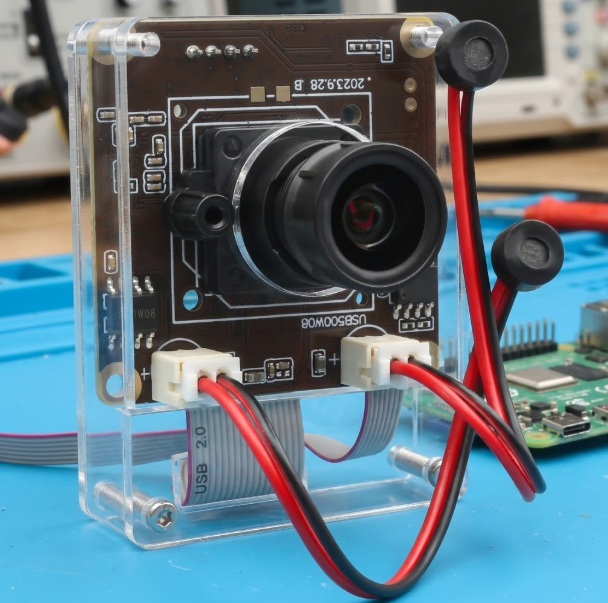
A 5MP USB industrial camera often hits the sweet spot, offering a powerful compromise between image detail and processor overhead. For example, the ELP 5MP IMX335 USB camera is built around a 1/2.8-inch Sony IMX335 sensor, delivering a top resolution of 2592 × 1944 pixels.
Pro-Tip: Always check the frame-rate matrix across different output formats. Maximum resolutions often drop significantly depending on whether the camera is streaming compressed or uncompressed video data.
2. Decode USB Bandwidth and Compression Formats
USB 2.0 remains a staple interface for embedded engineering due to its ubiquitous hardware support and low integration friction. Yet, its bandwidth ceiling is tight, making video format configuration critical when streaming high-definition frames.
-
MJPEG (Compressed): Compresses individual frames on the fly, dramatically lowering data throughput. This allows you to maintain smooth, high frame rates over standard USB 2.0 lines, though minor compression artifacts should always be tested against your machine vision or human review requirements.
-
YUY2 (Uncompressed): Delivers pristine raw frames but demands massive bandwidth, which can bottleneck performance at upper resolutions.
When integrating a USB 2.0 camera module into embedded architecture, test your complete host stack—including the host processor, USB root hubs, kernel drivers, and application software. Modules like the ELP IMX335 natively support both MJPEG and YUY2, giving developers flexibility to balance fidelity against processing load.
3. Match Optics to the Physical Environment
Your lens choice dictates how much of the physical world the sensor registers and how clearly objects resolve across varying distances. A wide-angle lens captures expansive floor plans or broad machinery views, whereas a tighter field of view concentrates pixels on specific focal zones.
The ELP IMX335 module features an 81-degree lens paired with a tight 38 × 38 mm board layout, making it exceptionally easy to embed inside space-constrained enclosures.
Before finalizing your physical chassis design, evaluate:
-
Working distance (camera-to-subject spacing)
-
Mechanical mounting angles and vibration exposure
-
Environmental lighting and focus range
-
Edge distortion (wide fields of view often warp details near the periphery)
4. Prioritize UVC Compliance to Slash Development Time
Writing custom low-level device drivers drains engineering resources and creates long-term maintenance headaches during OS updates. USB Video Class (UVC) compliance eliminates this friction, allowing supported operating systems to interface instantly with the camera through standard native video stacks.
However, "plug-and-play" should always be validated on your specific target hardware. Embedded Linux single-board computers (SBCs) and Android handhelds can behave differently regarding USB power delivery, root hub driver implementation, and audio-video mapping.
The ELP IMX335 is fully UVC-compatible across Windows, Linux, and Android ecosystems. Notably, it also integrates dual external microphones—a massive asset for dual-purpose smart terminals combining synchronized audio-video capture. Always confirm your target kernel builds support both video streaming and UVC audio endpoints.
5. Validate Thermal and Environmental Reliability
An industrial-grade camera is only as good as its weakest physical link. Environmental stress factors like ambient heat, power fluctuations, unstable mounting brackets, and poor cable shielding will degrade video streams over time.
The ELP module operates smoothly on a standard 5V supply and is rated for working temperatures ranging from -10°C to 65°C. If your device lives inside a sealed, unventilated weatherproof housing, internal thermal accumulation must be measured against these operational limits.
Best Practice: Before greenlighting full-scale mass production, secure a sample module from an experienced industrial USB camera manufacturer. Test the camera directly inside its final prototype enclosure to catch thermal throttling, optical glare, or electromagnetic interference (EMI) early.
Summary & Next Steps
Successfully deploying an embedded vision system requires looking past raw megapixels and evaluating the entire system chain—from optical lens coverage and USB bus bandwidth to UVC software support and thermal durability.
For engineers and product developers working on space-limited smart devices, industrial monitoring arrays, or interactive hardware, compact solutions like ELP’s 5MP USB camera module (featuring the Sony IMX335 sensor, 81-degree optics, UVC compatibility, and dual mics) offer a robust, field-tested foundation to build upon. Evaluate your system requirements holistically, test early prototypes in the real world, and build vision systems designed to last.
www.hdusbcameras.com
Shenzhen Ailipu Technology Co.,Ltd
About Author



More Stories
How to Choose the Right Pneumatic Drilling Equipment for Industrial Applications
How Can Sheet Metal Workshops Manage High-Mix Bending Production?
Beyond Filling Speed: What Really Matters When Choosing an Ice Pop Filling Machine